SLAAEH8 October 2024 AFE781H1 , AFE782H1 , AFE881H1 , AFE882H1 , DAC8740H , DAC8741H , DAC8742H
- 1
- Abstract
- Trademarks
- 1Introduction
- 2AFE881H1 HART Modem
-
3HART Testing and Registration
- 3.1 HART History and the FieldComm Group
- 3.2 HART Testing Overview
- 3.3 HART Test Equipment
- 3.4 HART Physical Layer Testing
- 3.5 Data Link Layer Tests
- 3.6 Universal Command Tests
- 3.7 Common-Practice Command Tests
- 3.8 Device Specific Command Tests
- 3.9 HART Protocol Test Submission
- 3.10 HART Registration
- 4Other TI HART Modem Designs
- 5Summary
- 6Acknowledgments
- 7References
3.4.2 Carrier Start and Stop Time Tests
In addition to the FSK characteristics, the physical layer tests also measure the start and start times of the carrier from the transmitter. Figure 3-7 shows a figure of the carrier start and stop time test setup. When the microprocessor in the HART transmitter sends a transmission, the request-to-send (RTS) pin on the AFE881H1 is set low as a trigger to enable the modulator for the FSK. The modulator generates the sine-wave signals for the HART communication.
 Figure 3-7 HART Carrier Start and Stop Time
Tests Setup
Figure 3-7 HART Carrier Start and Stop Time
Tests SetupWhen the active-low RTS pin on the AFE881H1 is set low, the modulator is enabled and the HART sinusoid appears on the MOD_OUT pin of the device. Part of the physical layer tests measure the time to enable the modulator when the RTS signal is set low, and the time to disable the modulator when the RTS signal is returned high.
In this setup, the RTS signal from the microprocessor triggers an oscilloscope to plot the enable and disable time for the HART signal. Figure 3-8 and Figure 3-9 show the required timing for the HART carrier start and stop tests.
 Figure 3-8 Carrier Start Timing
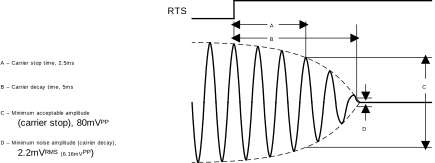 Figure 3-9 Carrier Stop Timing
For RTS enable, the maximum amount of time allowed to start the modulator is 5 HART bit times or 4.2ms. This is the time for the sinusoid to reach the minimum amplitude of 120mVPP. For RTS disable, the maximum carrier stop time is 2.5ms to verify that the carrier amplitude is below 80mVPP. There is a total of 5ms of allowable decay time. After this time period, the maximum noise amplitude from the HART signal is 2.2mVRMS (or about 6.16mVPP). Figure 3-10 shows the oscilloscope plot for the HART carrier start and stop timing and Table 3-2 reports the measured data.
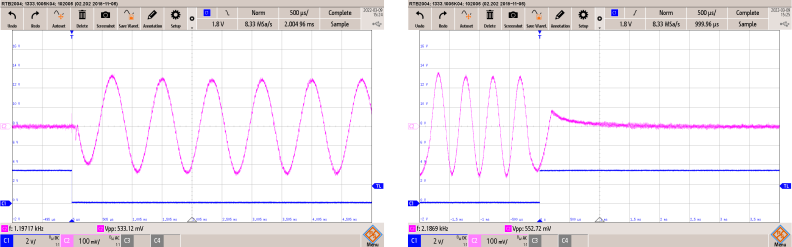 Figure 3-10 HART Carrier Start and Stop Time
Test Oscilloscope Results
Figure 3-10 HART Carrier Start and Stop Time
Test Oscilloscope Results| TEST | MEASURED | MAXIMUM | RESULT |
|---|---|---|---|
| Carrier start time | 120µs | 4.2ms | Pass |
| Carrier stop time | 0.4ms | 2.5ms | Pass |
| Carrier decay time | 1.8ms | 5.0ms | Pass |