SLAAEG4B October 2023 – July 2025 MSPM0C1104 , MSPM0C1105 , MSPM0C1106 , MSPM0H3216 , MSPM0L1306
- 1
- Abstract
- Trademarks
- 1 MSPM0C Hardware Design Check List
- 2 Power Supplies in MSPM0C Devices
- 3 Reset and Power Supply Supervisor
- 4 Clock System
- 5 Debugger
- 6 Key Analog Peripherals
- 7 Key Digital Peripherals
- 8 GPIOs
- 9 Layout Guides
- 10Bootloader
- 11Summary
- 12References
- 13Revision History
7.3 I2C and SPI Design Considerations
SPI and I2C protocols are widely used in communication between devices or boards, such as data exchange between an MCU and a sensor. MSPM0C1103 and MSPM0C1104 include up to 12MHz high-speed SPI, and MSPM0C1105 and MSPM0C1106 include up to 16MHz high-speed SPI. The SPI supports 3wire, 4wire, chip select, and command mode. To design a system based on the requirements, see Figure 7-4.
Some SPI peripheral devices need PICO (Peripherals Input Controller Output) keep high logic. In this case, add a pullup resistor to PICO pin.
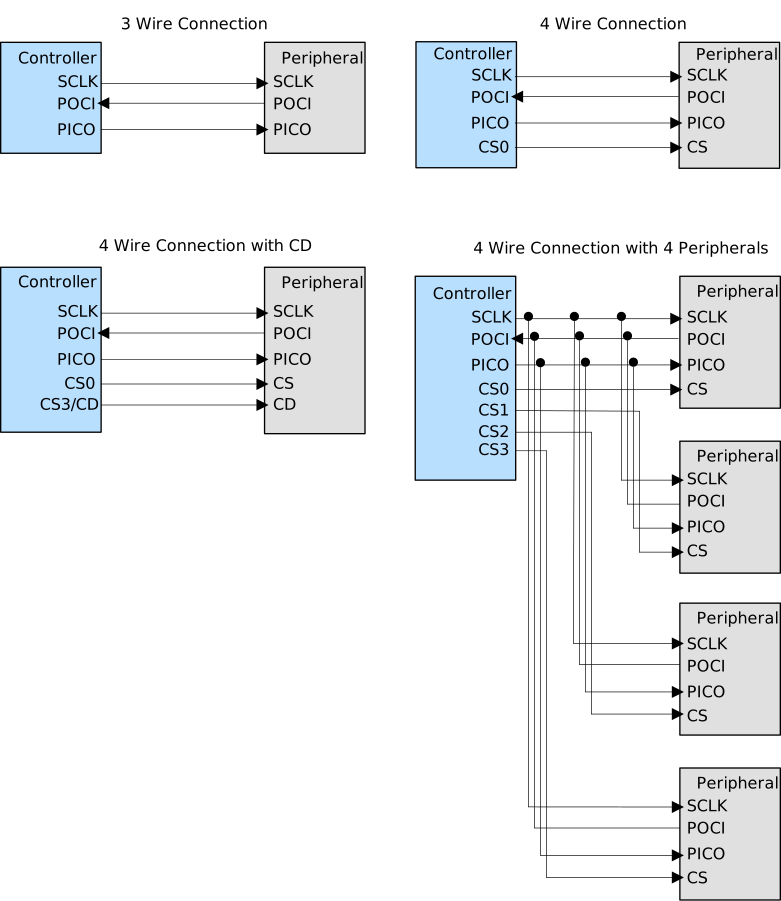 Figure 7-4 External Connections for
Different SPI Configurations
Figure 7-4 External Connections for
Different SPI ConfigurationsFor I2C bus, the MSPM0C device supports standard, fast and fast plus mode, as shown in Table 7-4.
External pullup resistors are required when using I2C bus. The value of these resistors depends on the I2C speed; TI recommends 2.2k to support Fast mode+. For systems concerned with power consumption, large resistor values can be used. ODIO (see Section 8) can be used to implement communication with a 5V device.
| PARAMETERS | TEST CONDITIONS | Standard Mode | Fast Mode | Fast Mode Plus | UNIT | |||||
|---|---|---|---|---|---|---|---|---|---|---|
| MIN | MAX | MIN | MAX | MIN | MAX | |||||
| fI2C | I2C input clock frequency | I2C in Power Domain0 | MSPM0C1103 and MSPM0C1104 | 24 | 24 | 24 | MHz | |||
| MSPM0C1105 and MSPM0C1106 | 2 | 32 | 8 | 32 | 20 | 32 | ||||
| fSCL | SCL clock frequency | 100K | 400K | 1M | Hz | |||||
| tHD,STA | Hold time (repeated) START | 4 | 0.6 | 0.26 | us | |||||
| tLOW | Low period of the SCL clock | 4.7 | 1.3 | 0.5 | us | |||||
| tHIGH | High period of the SCL clock | 4 | 0.6 | 0.26 | us | |||||
| tSU,STA | Setup time for a repeated START | 4.7 | 0.6 | 0.26 | us | |||||
| tHD,DAT | Data hold time | 0 | 0 | 0 | us | |||||
| tSU,DAT | Data setup time | 250 | 100 | 50 | us | |||||
| tSU,STO | Setup time for STOP | 4 | 0.6 | 0.26 | us | |||||
| tBUF | Bus free time between a STOP and START condition | 4.7 | 1.3 | 0.5 | us | |||||
| tVD;DAT | Data valid time | 3.45 | 0.9 | 0.45 | us | |||||
| tVD;ACK | Data valid acknowledge time | 3.45 | 0.9 | 0.45 | us | |||||
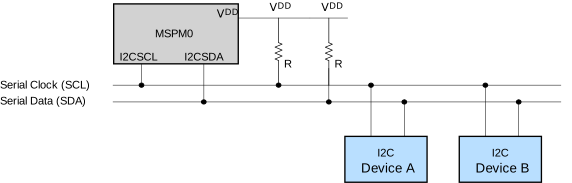 Figure 7-5 Typical I2C Bus
Connection
Figure 7-5 Typical I2C Bus
Connection