SPRABJ8D September 2022 – May 2025 AM2612 , AM2612-Q1 , AM2631 , AM2631-Q1 , AM2632 , AM2632-Q1 , AM2634 , AM2634-Q1 , AM263P2 , AM263P2-Q1 , AM263P4 , AM263P4-Q1
- 1
- Abstract
- Trademarks
- 1 Introduction
- 2 Power
- 3 Clocking
- 4 Resets
- 5 Bootstrapping
- 6 OSPI and QSPI Memory Implementation
- 7 Debug Interfaces
- 8 USB
- 9 Multiplexed Peripherals
- 10Digital Peripherals
- 11Analog Peripherals
- 12Layer Stackup
- 13Vias
- 14BGA Power Fan-Out and Decoupling Placement
- 15Summary
- 16References
- 17Revision History
2.5 Power Distribution Network
This section outlines the latest estimates of the AM26x transient current requirements on a per net basis. These values can change as more power modeling and characterization is performed.
These transient use-case values were used to constrain the PDN design of the AM26x EVMs (controlCards, LaunchPads, and controlSOM) by creating a set of minimum/maximum operating frequency and PDN impedance (Zmax) target limits. These limits were based on the magnitude and slew-rate of simulated transient current use-cases. The use-cases were used to estimate the PDN bandwidth needed to adequately decouple the resulting transient event. Additional z-parameter simulation of the EVM PDN was used to verify that the power plane design and decoupling placement and component values meet the defined limits. This is summarized in Figure 2-12.
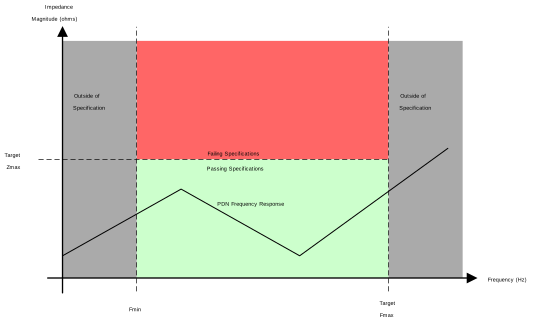 Figure 2-12 AM26x PDN Requirements – Example Diagram
| Transient Case | Net Name | Nominal Voltage (V) | DC IR Budget (%) | AC Ripple Budget (%) | Idle Current (mA) | Peak Current (mA) | Idle to Peak Slew Rate (ns) | Comment |
|---|---|---|---|---|---|---|---|---|
| VDDBASELINE1 | VDD | 1.2 | 2.5 | 2.5 | 0 | 2402 | 2.5 | Baseline, simple transient model assuming 0 to peak transition in minimal 1 R5F clock cycle. |
| VDDXTAL_PLL1 | VDD | 1.2 | 2.5 | 2.5 | 42 | 875 | 10 | XTAL to PLL turn-on transient |
| VDD WFI1 | VDD | 1.2 | 2.5 | 2.5 | 750 | 1117 | 12.5 | 4x RF5 WFI event transient |
| VDDS33BASELINE1 | VDDS33 | 3.3 | 2.5 | 2.5 | 0 | 84 | 2.5 | Baseline, simple transient model assuming 0 to peak transition in a single R5F clock cycle |
| VDDA33BASELINE1 | VDDA33 | 3.3 | 2.5 | 2.5 | 0 | 34 | 2.5 | Baseline, simple transient model assuming 0 to peak transition in a single R5F clock cycle |
| VDDS18LDOBASELINE1 | VDDS18LDO | 1.8 | 2.5 | 2.5 | 0 | 01 | 2.5 | Baseline, simple transient model assuming 0 to peak transition in minimal 1 R5F clock cycle |
| VDDA18LDOBASELINE1 | VDDA18LDO | 1.8 | 2.5 | 2.5 | 0 | 66 | 2.5 | Baseline, simple transient model assuming 0 to peak transition in minimal 1 R5F clock cycle |
| Transient Case | Net Name | Fmax (MHz) | Current Step(mA) | PCB DC Tolerance(mV) | PCB AC Tolerance(mV) | PCB Target DC IR(mΩ) | PCB Target AC Zmax(mΩ) | Comment |
|---|---|---|---|---|---|---|---|---|
| VDD BASELINE1 |
VDD | 200 | 2402 | 30 | 30 | 12 | 12 | Baseline, simple transient model assuming 0 to peak transition in minimal 1 R5F clock cycle. |
| VDD XTAL_PLL1 |
VDD | 50 | 833 | 30 | 30 | 36 | 36 | XTAL to PLL turn-on transient. |
| VDD WFI1 |
VDD | 40 | 367 | 30 | 30 | 82 | 82 | 4x RF5 WFI event transient. |
| VDDS33 BASELINE1 |
VDDS33 | 200 | 84 | 83 | 83 | 982 | 982 | Baseline, simple transient model assuming 0 to peak transition in minimal 1 R5F clock cycle. |
| VDDA33 BASELINE1 |
VDDA33 | 200 | 34 | 83 | 83 | 2419 | 2419 | Baseline, simple transient model assuming 0 to peak transition in minimal 1 R5F clock cycle. |
| VDDS18LDO BASELINE1 |
VDDS18LDO | 200 | 1 | 45 | 45 | 45 | 45 | Baseline, simple transient model assuming 0 to peak transition in minimal 1 R5F clock cycle. |
| VDDA18LDO BASELINE1 |
VDDA18LDO | 200 | 66 | 45 | 45 | 682 | 682 | Baseline, simple transient model assuming 0 to peak transition in minimal 1 R5F clock cycle. |