SPRUJE8C December 2024 – June 2025 AM2752-Q1 , AM2754-Q1
- 1
- Description
- Features
- 4
- 1Evaluation Module Overview
-
2Hardware
- 2.1 Component Identification
- 2.2 Power Requirements
- 2.3 Reset
- 2.4 Clock
- 2.5 Boot Mode Selection
- 2.6 Header Information
- 2.7 Push Buttons
- 2.8 Switches
- 2.9 GPIO Mapping
- 2.10 Interfaces
- 2.11 AEC Mapping
- 2.12 Test Points
- 3Hardware Design Files
- 4Additional Information
- 5References
- 6Revision History
2.10.7 MCAN
The AM275x EVM features a single MCAN Transceiver (TCAN1043ADYYRQ1) that is mapped to the MCAN0 Interface of the AM275x SoC. The MCAN Transceiver has three independent power inputs: VIO, VCC and VSUP. VIO is the transceiver 1.8V system level supply voltage, VCC is the CAN transceiver 5V supply voltage, and VSUP provides the supply to the internal regulators that support the digital core and the low power CAN receiver.
A 120Ω split termination on the MCAN0_CAN_H and MCAN0_CAN_L signals is provided to improve Electromagnetic Interference (EMI) performance. Split termination improves the electromagnetic emission's behavior of the network by eliminating fluctuations in the bus common-mode voltages at the start and end of message transmissions.
The WAKE pin of the Transceiver provides local wake-up (LWU) function. A local Wake-up event occurs when the state of the WAKE pin transitions from high-to-low or low-to-high. When a LWU event occurs, the device comes out of sleep-mode.
The INH Pin enables the transceiver to Enable/Disable the EVM's peripheral power supply buck regulator (LM61460AASQRJRRQ1).
The EN pin of the transceiver provides an input for transceiver mode control in conjunction with the nSTB pin.
The nSTB pin of the transceiver provides an input for transceiver stand-by mode control.
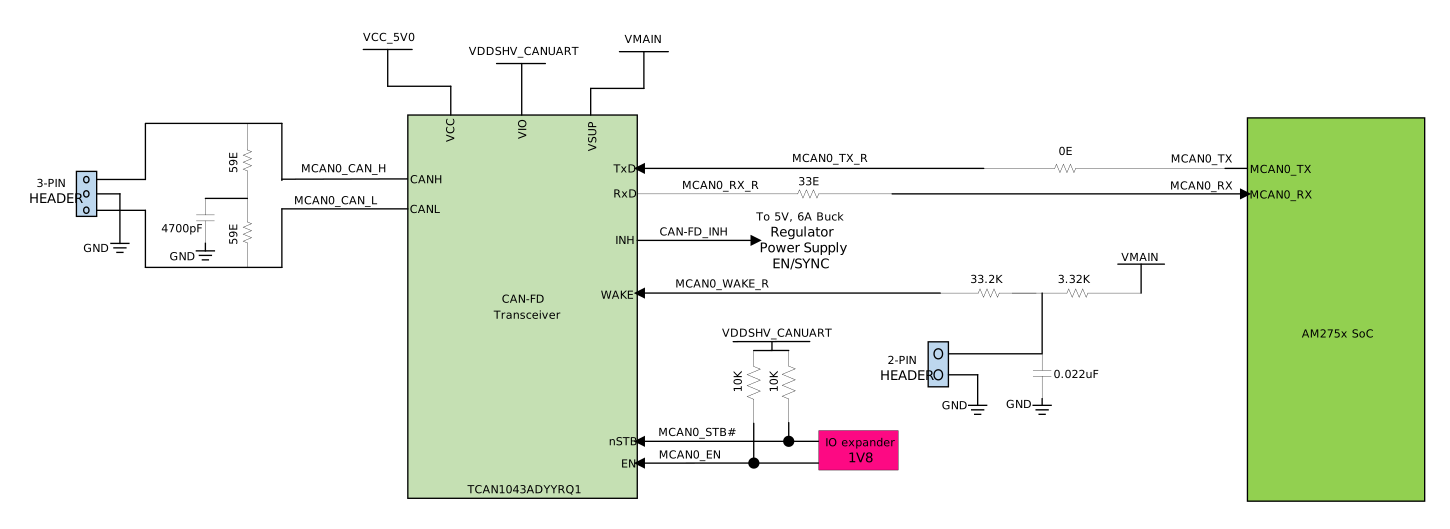 Figure 2-35 MCAN Interface Block
Diagram
Figure 2-35 MCAN Interface Block
Diagram