SWRU543B January 2019 – June 2025 CC3230S , CC3230SF , CC3235MODS , CC3235MODSF , CC3235S , CC3235SF
- 1
- Read This First
-
1 Architecture Overview
- 1.1 Introduction
- 1.2 Architecture Overview
- 1.3
Functional Overview
- 1.3.1 Processor Core
- 1.3.2 Memory
- 1.3.3 Micro-Direct Memory Access Controller (µDMA)
- 1.3.4 General-Purpose Timer (GPT)
- 1.3.5 Watchdog Timer (WDT)
- 1.3.6 Multichannel Audio Serial Port (McASP)
- 1.3.7 Serial Peripheral Interface (SPI)
- 1.3.8 Inter-Integrated Circuit (I2C) Interface
- 1.3.9 Universal Asynchronous Receiver/Transmitter (UART)
- 1.3.10 General-Purpose Input/Output (GPIO)
- 1.3.11 Analog-to-Digital Converter (ADC)
- 1.3.12 SD Card Host
- 1.3.13 Parallel Camera Interface
- 1.3.14 Debug Interface
- 1.3.15 Hardware Cryptography Accelerator
- 1.3.16 Clock, Reset, and Power Management
- 1.3.17 SimpleLink™ Subsystem
- 1.3.18 I/O Pads and Pin Multiplexing
-
2 Cortex®-M4 Processor
- 2.1 Overview
- 2.2 Functional Description
- 3 Cortex®-M4 Peripherals
- 4 Direct Memory Access (DMA)
- 5 General-Purpose Input/Outputs (GPIOs)
- 6 Universal Asynchronous Receivers/Transmitters (UARTs)
- 7 Inter-Integrated Circuit (I2C) Interface
-
8 SPI (Serial Peripheral Interface)
- 8.1 Overview
- 8.2
Functional Description
- 8.2.1 SPI
- 8.2.2 SPI Transmission
- 8.2.3 Master Mode
- 8.2.4 Slave Mode
- 8.2.5 Interrupts
- 8.2.6 DMA Requests
- 8.2.7 Reset
- 8.3 Initialization and Configuration
- 8.4 Access to Data Registers
- 8.5 Module Initialization
- 8.6 SPI Registers
- 9 General-Purpose Timers
- 10Watchdog Timer
- 11SD Host Controller Interface
-
12Inter-Integrated Sound (I2S) Multichannel Audio Serial Port
- 12.1 Overview
- 12.2 Functional Description
- 12.3 Programming Model
- 12.4
Peripheral Library APIs for I2S Configuration
- 12.4.1
Basic APIs for Enabling and Configuring the Interface
- 12.4.1.1 void I2SDisable (unsigned long ulBase)
- 12.4.1.2 void I2SEnable (unsigned long ulBase, unsigned long ulMode)
- 12.4.1.3 void I2SSerializerConfig (unsigned long ulBase, unsigned long ulDataLine, unsigned long ulSerMode, unsigned long ulInActState)
- 12.4.1.4 void I2SConfigSetExpClk (unsigned long ulBase, unsigned long ulI2SClk, unsigned long ulBitClk, unsigned long ulConfig)
- 12.4.2
APIs for Data Access if DMA is Not Used
- 12.4.2.1 void I2SDataGet (unsigned long ulBase, unsigned long ulDataLine, unsigned long * pulData)
- 12.4.2.2 long I2SDataGetNonBlocking (unsigned long ulBase, unsigned long ulDataLine, unsigned long * pulData)
- 12.4.2.3 void I2SDataPut (unsigned long ulBase, unsigned long ulDataLine, unsigned long ulData)
- 12.4.2.4 void I2SDataPut (unsigned long ulBase, unsigned long ulDataLine, unsigned long ulData)
- 12.4.3
APIs for Setting Up, Handling Interrupts, or Getting Status from I2S Peripheral
- 12.4.3.1 void I2SIntRegister (unsigned long ulBase, void(*)(void) pfnHandler)
- 12.4.3.2 void I2SIntEnable (unsigned long ulBase, unsigned long ulIntFlags)
- 12.4.3.3 void I2SIntDisable (unsigned long ulBase, unsigned long ulIntFlags)
- 12.4.3.4 unsigned long I2SIntStatus (unsigned long ulBase)
- 12.4.3.5 void I2SIntUnregister (unsigned long ulBase)
- 12.4.3.6 void I2SIntClear (unsigned long ulBase, unsigned long ulStatFlags)
- 12.4.3.7 Values that can be Passed to I2SIntEnable() and I2SIntDisable() as the ulIntFlags Parameter
- 12.4.3.8 Values that can be Passed to I2SIntClear() as the ulStatFlags Parameter and Returned from I2SIntStatus()
- 12.4.4
APIs to Control FIFO Structures Associated With I2S Peripheral
- 12.4.4.1 void I2SRxFIFODisable (unsigned long ulBase)
- 12.4.4.2 void I2SRxFIFOEnable (unsigned long ulBase, unsigned long ulRxLevel, unsigned long ulWordsPerTransfer)
- 12.4.4.3 unsigned long I2SRxFIFOStatusGet (unsigned long ulBase)
- 12.4.4.4 void I2STxFIFODisable (unsigned long ulBase)
- 12.4.4.5 void I2STxFIFOEnable (unsigned long ulBase, unsigned long ulTxLevel, unsigned long ulWordsPerTransfer)
- 12.4.4.6 unsigned long I2STxFIFOStatusGet (unsigned long ulBase)
- 12.4.1
Basic APIs for Enabling and Configuring the Interface
- 12.5 I2S Registers
-
13Analog-to-Digital Converter (ADC)
- 13.1 Overview
- 13.2 Key Features
- 13.3 ADC Register Mapping
- 13.4 ADC_MODULE Registers
- 13.5 Initialization and Configuration
- 13.6
Peripheral Library APIs for ADC Operation
- 13.6.1 Overview
- 13.6.2 Configuring the ADC Channels
- 13.6.3 Basic APIs for Enabling and Configuring the Interface
- 13.6.4
APIs for Data Transfer [Direct Access to FIFO and DMA Setup]
- 13.6.4.1 unsigned char ADCFIFOLvlGet (unsigned long ulBase, unsigned long ulChannel)
- 13.6.4.2 unsigned long ADCFIFORead (unsigned long ulBase, unsigned long ulChannel)
- 13.6.4.3 void ADCDMAEnable (unsigned long ulBase, unsigned long ulChannel)
- 13.6.4.4 void ADCDMADisable (unsigned long ulBase, unsigned long ulChannel)
- 13.6.5
APIs for Interrupt Usage
- 13.6.5.1 void ADCIntEnable (unsigned long ulBase, unsigned long ulChannel, unsigned long ulIntFlags)
- 13.6.5.2 void ADCIntDisable (unsigned long ulBase, unsigned long ulChannel, unsigned long ulIntFlags)
- 13.6.5.3 void ADCIntRegister (unsigned long ulBase, unsigned long ulChannel, void(*)(void) pfnHandler)
- 13.6.5.4 void ADCIntUnregister (unsigned long ulBase, unsigned long ulChannel)
- 13.6.5.5 unsigned long ADCIntStatus (unsigned long ulBase, unsigned long ulChannel)
- 13.6.5.6 void ADCIntClear (unsigned long ulBase, unsigned long ulChannel, unsigned long ulIntFlags)
- 13.6.6 APIs for Setting Up ADC Timer for Time-Stamping the Samples
- 14Parallel Camera Interface Module
- 15Power, Reset, and Clock Management
- 16I/O Pads and Pin Multiplexing
- 17Advance Encryption Standard Accelerator (AES)
- 18Data Encryption Standard Accelerator (DES)
-
19SHA/MD5 Accelerator
- 19.1
SHA/MD5 Functional Description
- 19.1.1 SHA/MD5 Block Diagram
- 19.1.2 µDMA and Interrupt Requests
- 19.1.3 Operation Description
- 19.1.4
SHA/MD5 Programming Guide
- 19.1.4.1
Global Initialization
- 19.1.4.1.1 Surrounding Modules Global Initialization
- 19.1.4.1.2 Starting a New HMAC using the SHA-1 Hash Function and HMAC Key Processing
- 19.1.4.1.3 Subsequence - Continuing a Prior HMAC Using the SHA-1 Hash Function
- 19.1.4.1.4 Subsequence - Hashing a Key Bigger than 512 Bits with the SHA-1 Hash Function
- 19.1.4.1.5 Operational Modes Configuration
- 19.1.4.1.6 SHA/MD5 Event Servicing
- 19.1.4.1
Global Initialization
- 19.2 SHA-MD5 Registers
- 19.1
SHA/MD5 Functional Description
- 20Cyclical Redundancy Check (CRC)
-
21On-Chip Parallel Flash
- 21.1 Flash Memory Configuration
- 21.2 Interrupts
- 21.3 Flash Memory Programming
- 21.4 32-Word Flash Memory Write Buffer
- 21.5 Flash Registers
- 21.6 CC323xSF Boot Flow
- 21.7 Flash User Application and Memory Partition
- 21.8 Programming, Bootstrapping, and Updating the Flash User Application
- 21.9 Image Authentication and Integrity Check
- 21.10 Debugging Flash User Application Using JTAG
- 22Revision History
- A Software Development Kit Examples
-
B CC323x Device Miscellaneous Registers
- 24.1 DMA_IMR Register (offset = 8Ch) [reset = FF0Fh]
- 24.2 DMA_IMS Register (offset = 90h) [reset = 0h]
- 24.3 DMA_IMC Register (offset = 94h) [reset = 0h]
- 24.4 DMA_ICR Register (offset = 9Ch) [reset = 0h]
- 24.5 DMA_MIS Register (offset = A0h) [reset = 0h]
- 24.6 DMA_RIS Register (offset = A4h) [reset = 0h]
- 24.7 GPTTRIGSEL Register (offset = B0h) [reset = 0h]
2.2.6 Power Management
The CC32xx Wi-Fi microcontroller is a multiprocessor system-on-chip. An advanced power-management scheme has been implemented at chip level that delivers the best-in-class energy efficiency across a wide class of application profiles, while handling the asynchronous sleep-wake requirements of multiple high-performance processors and Wi-Fi radio subsystems. The Cortex®-M4 application processor subsystem (consisting of the CM4 core and application peripherals) is a subset of this.
In the chip-level power-management scheme, the application program is unaware of the power state transitions of the other subsystems. This approach insulates the user from the complexities of a multiprocessor system and simplifies the application development process.
From the standpoint of the Cortex®-M4 application processor, CC32xx supports the SLEEP mode similar to those in discrete microcontrollers. In addition to SLEEP mode, additional modes are offered that consume much less power:
- Low-Power Deep-Sleep (LPDS) mode:
- Recommended for ultra-low power always-connected cloud and Wi-Fi applications
- Up to 256KB of SRAM retention and fast wakeup (<5 mS)
- When networking and Wi-Fi subsystems are disabled, the MCU draws less than 100 µA with 256KB of SRAM retained (code and data). Total system current (including Wi-Fi and network periodic wakeup) as low as 700 µA
- Processor and peripheral registers are not retained. Global always ON configurations at SoC level are retained
- Hibernate (HIB) Mode:
- Recommended for ultra-low power infrequently connected cloud and Wi-Fi applications
- Ultra low current of 4 µA, including RTC
- Wake on RTC or selected GPIO
- No SRAM or logic retention. 2 × 32-bit register retention
- Shutdown Mode (choose this mode when periodic activity is required and the period between cycles is long):
- Lowest power mode of about 1 µA
- System including RTC and memories are off
- Cold boot initialization is required
LPDS and HIB modes are discussed in more detail in the Power Clock and Reset Management chapter.
Figure 2-7 shows the architecture of the CC32xx SoC level power management, especially from the application point of view.
The Cortex®-M4 processor implementation inside the CC32xx multiprocessor SoC has a few differences when compared to a discrete MCU. While SLEEP mode is supported, in the CC32xx this mode is limited in energy consumption savings.
Ultra-low power applications should be architected such that time spent in LPDS or hibernate mode is maximized. The Cortex®-M4 application processor can be configured wake up on selected events, for example network events such as an incoming data packet, timer, or I/O pad toggle. The time spent in RUN (or ACTIVE) state should then be minimized. The dedicated Cortex®-M4 application processor in CC32xx is particularly suited for this mode of operation due to its advanced power management, DMA, zero wait-state multi-layer AHB interconnect, fast execution and retention over the entire range of zero wait-state SRAM.
- SLEEP: Sleep mode stops the processor clock (clock gating).
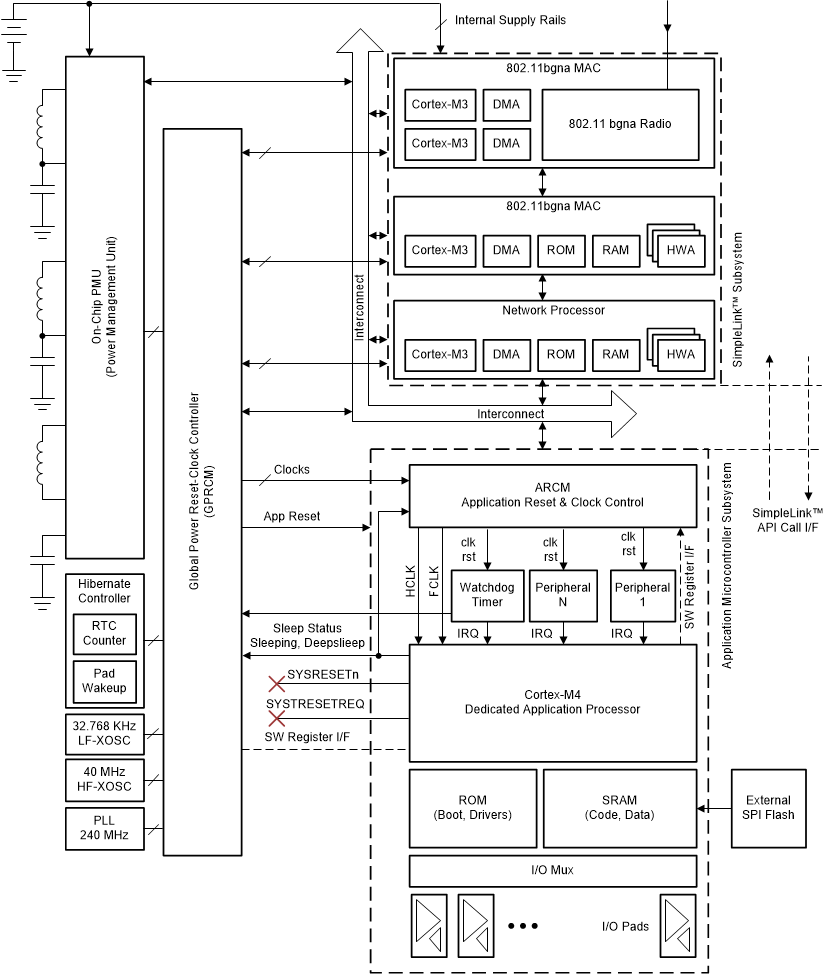 Figure 2-7 Power-Management Architecture in CC32xx SoC