SLVUCI2A March 2023 – May 2025 AM68 , AM68A , AM69 , AM69A , TDA4AH-Q1 , TDA4AL-Q1 , TDA4AP-Q1 , TDA4APE-Q1 , TDA4VE-Q1 , TDA4VH-Q1 , TDA4VL-Q1 , TDA4VP-Q1 , TDA4VPE-Q1 , TPS6594-Q1
- 1
- TPS6594133A-Q1 PMIC User Guide for Jacinto J784S4 or J721S2, PDN-3A, PDN-3B, PDN-3F
- Trademarks
- 1Introduction
- 2Processor Connections
- 3Supporting Functional Safety Systems
-
4Static NVM Settings
- 4.1 Application-Based Configuration Settings
- 4.2 Device Identification Settings
- 4.3 BUCK Settings
- 4.4 LDO Settings
- 4.5 VCCA Settings
- 4.6 GPIO Settings
- 4.7 Finite State Machine (FSM) Settings
- 4.8 Interrupt Settings
- 4.9 POWERGOOD Settings
- 4.10 Miscellaneous Settings
- 4.11 Interface Settings
- 4.12 Multi-Device Settings
- 4.13 Watchdog Settings
- 5Pre-Configurable Finite State Machine (PFSM) Settings
- 6Application Examples
- 7Impact of NVM Changes
- 8References
- 9Revision History
2.1 Power Mapping
The PDN-3x base power resources are the TPS6594133A-Q1 PMIC, two High-Current Power Stages (HCPS-A & HCPS-B), two TPS389006004-Q1 Safety Voltage Supervisors, two TPS74501P-Q1 LDOs and one TPS622965-Q1 load switch. The processor CPU and CORE power rails are powered by HCPS-A and HCPS-B respectively. Each HCPS consists of one or multiple, stackable TPS6287xY1-Q1 buck converters. For recommended HCPS configurations based upon JS84S4 or J721S2 processor type, see Table 2-1. The PMIC has built-in input supply voltage level detection, which enables it to use either a 3.3V or 5V system input voltage. If a system does use a 5V input, then the load switches used to supply the processor with 3.3V for IO signaling need to be replaced with either a buck converter or LDO depending upon overall system needs.
| Processor | HCPS - A (CPU Power) | HCPS - B (CORE Power) |
|---|---|---|
| J784S4 | 3 x TPS62873Y1 - Q1 | 2 x TPS62873Y1 - Q1 |
| J721S2 | 1 x TPS62873Y1 - Q1 | 2 x TPS62871Y1 - Q1 |
For Functional Safety applications, the PMIC provides majority of all key requirements, see TPS6594 Data Sheet. In addition, there is a protection FET before VCCA that connects to the OVPGDRV pin of the PMIC, allowing voltage monitoring of the input supply. Two TPS389006004-Q1 Safety Voltage Supervisors (SVS) are used for OV/UV monitoring on all discrete power resource voltages as required for functional safety systems that are ASIL-B/D capable.
Figure 2-1 shows PDN-3A power map for supplying a J784S4 or J721S2 processor platform (SoC, Flaxh & LPDDR4 memories, power resources) with base features plus all optional features that includes three processor low power modes (MCU Only, GPIO Retention and DDR Retention) and three optional functions (UHS-I SD card, USB2.0 interface and HS eFuse programming). PDN - 3A.I Power Connections - Full Features, Industrial Application is the same as the PDN-3A but intended for industrial applications and uses a slightly different voltage monitoring strategy. Figure 2-3 depicts the PDN-3F power map using only the PDN-3x base power resources to support the base feature set (ASIL-D safety capable system, MCU and Main supply isolation, MCU Safety Island, MCU Only low power mode, dual voltage 1.8/3.3V IO signaling, four LPDDR4 memories, OSPI boot Flash & eMMC storage Flash).
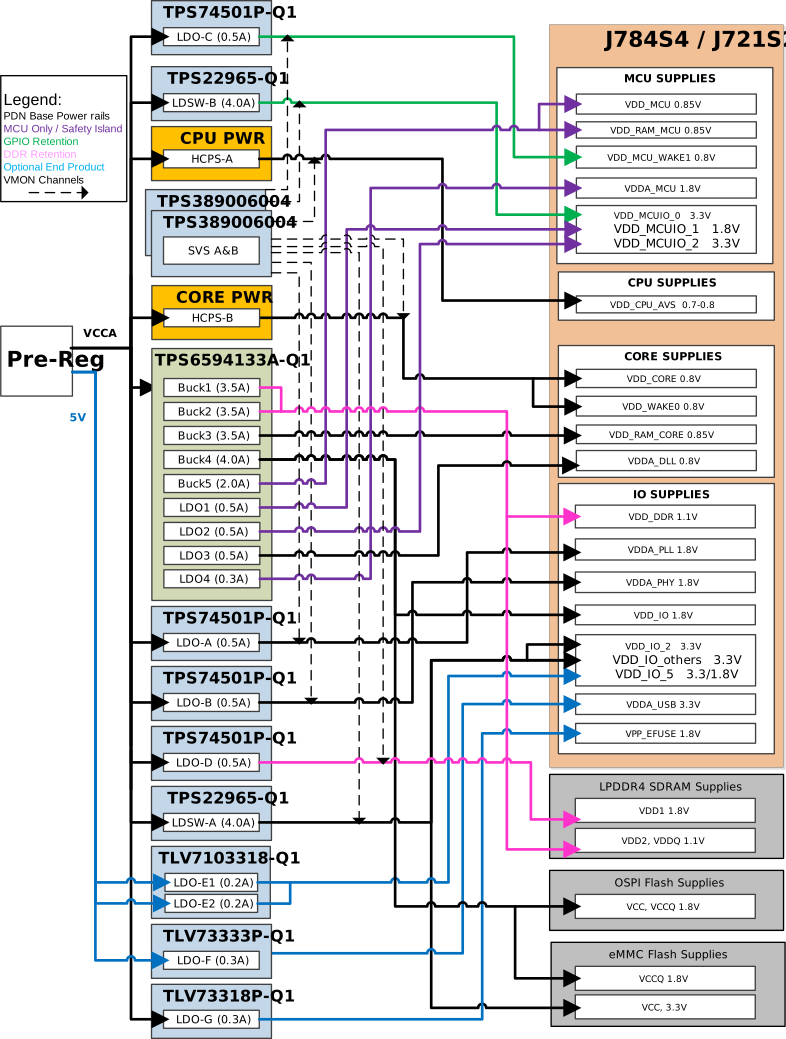 Figure 2-1 PDN-3A Power Connections - Full
Features
Figure 2-1 PDN-3A Power Connections - Full
Features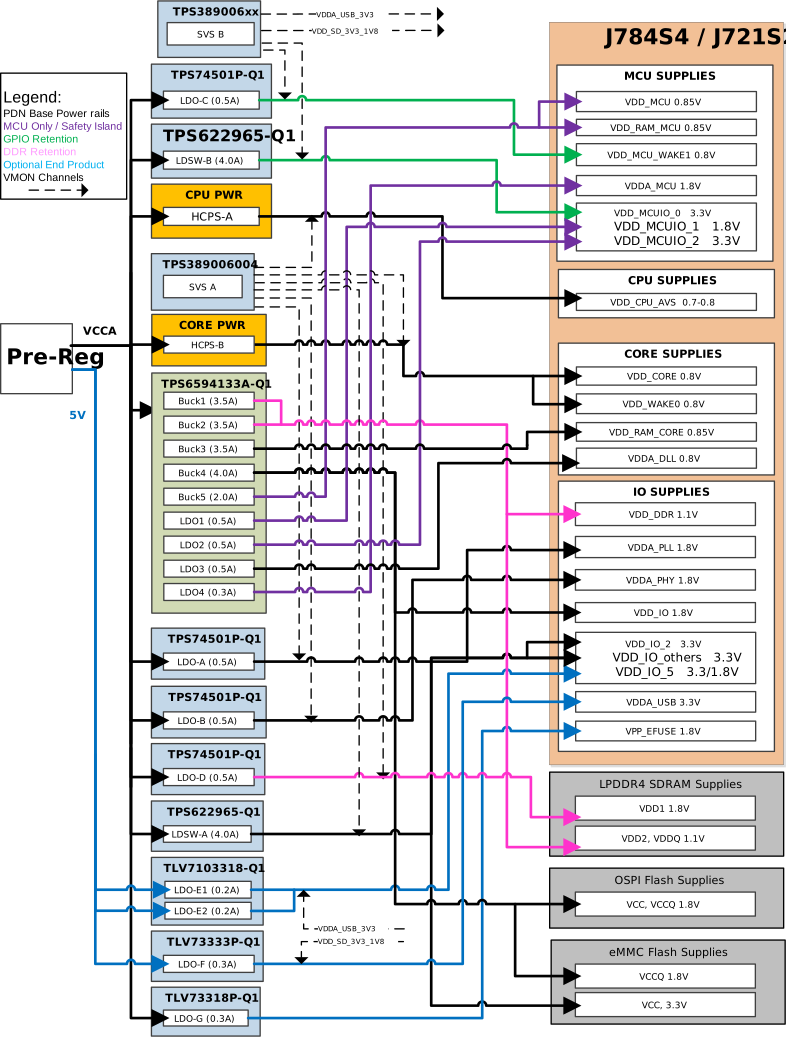 Figure 2-2 PDN - 3A.I Power Connections - Full
Features, Industrial Application
Figure 2-2 PDN - 3A.I Power Connections - Full
Features, Industrial Application Figure 2-3 PDN-3F Power Connections - Reduced
Features
Figure 2-3 PDN-3F Power Connections - Reduced
FeaturesTable 2-2 identifies the required power resources and rails needed to support PDN-3A full featured system. If a feature is not desired, the power resource and rail can be removed but the processor input supply must be connected to another power rail of like voltage and type since all supplies need to be energized for full active operations. Table 2-3 gives guidance on grouping of processor input supplies into base power rails if any of the three low power modes or optional functions are not desired. Applying this guidance to the full featured PDN-3A scheme enables other PDN-3x variants (x = B/C/D/E/ F) that support end products with different feature sets in between PDN-3A and PDN-3F.
| Power Mapping | System Features(1) | |||||||||
|---|---|---|---|---|---|---|---|---|---|---|
| Device | Power Resource | Power Rails | Processor and Memory Domains | Active SoC | MCU Only | DDR Ret | GPIO Ret | SD Card | EFUSE | USB |
| TPS6594133A-Q1 | BUCK12 | VDD_DDR_1V1 | VDDS_DDR, VDDS_DDR_C3:0 | R | R | |||||
| Mem: VDD2, VDDQ | ||||||||||
| BUCK3 | VDD_RAM_0V85 | VDDAR_CORE, VDDAR_CPU | R | |||||||
| BUCK4 | VDD_IO_1V8 |
VDDS_MMC0 |
R | |||||||
| BUCK5 | VDD_MCU_0V85 | VDD_MCU, VDDAR_MCU | R | R | ||||||
| LDO1 | VDD_MCUIO_1V8 | VDDSHV1_MCU | R | R | ||||||
| LDO2 | VDD_MCUIO_3V3 | VDDSHV2_MCU | R | R | ||||||
| LDO3 | VDA_DLL_0V8 | VDDA_0P8_PLL_DDR3:0, VDDA_0P8_DLL_MMC0 | R | |||||||
| LDO4 | VDA_MCU_1V8 | VDDA_MCU_PLLGRP0, VDDAMCU_TEMP, VDDA_POR_WKUP, VDDA_WKUP, VDDA_ADC1:0 | R | R | ||||||
| TPS22965-Q1 | Load Switch-A | VDD_IO_3V3 | VDDSHV0, VDDSHV2 | R | ||||||
| TPS22965-Q1 | Load Switch-B | VDD_MCU_GPIORET_3V3 | VDDSHV0_MCU | R | R | R | ||||
| CPU PWR HCPS-A | HCPS-A | VDD_CPU_AVS | VDD_CPU | R | ||||||
| CORE PWR HCPS-B | HCPS-B | VDD_CORE_0V8 | VDD_CORE, VDD_WAKE0, VDDA_0p8_CSIRX, VDDA_0P8_DSITX, VDDA_0P8_DSITX_C, VDDA_0P8_SERDES, VDDA_0P8_SERDES_C, VDDA_0P8_USB, VDDA_0P8_UFS | R | ||||||
| TLV73318P-Q1 | LDO-G | VPP_EFUSE_1V8 | VPP_x(EFUSE) | R | ||||||
| TLV3333-Q1 | LDO-F | VDD_USB_3V3 | VDDA_3P3_USB | R | R | |||||
| TLV7103318-Q1 | LDO-E | VDD_SD_DV | VDDSHV5 (3.3V or 1.8V) | R | R | |||||
| TPS74501P-Q1 | LDO-D | VDD1_DDR_1V8 | Mem: VDD1 | R | R | |||||
| TPS74501P-Q1 | LDO-C | VDD_MCU_GPIORET_0V8 | VDD_MCU_WAKE1 | R | R | R | ||||
| TPS74501P-Q1 | LDO-B | VDA_PHY_1V8 | VDDA_1P8_CSI_RX, VDDA_1P8_DSITX, VDDA_1P8_SERDES, VDDA_1P8_USB, VDDA_1P8_UFS | R | ||||||
| TPS74501P-Q1 | LDO-A | VDA_PLL_1V8 | VDDA_OSC1, VDDA_PLLGRP13:0, VDDA_TEMP4:0 | R | ||||||
| Feature Removal | Power Resource and Power Rail Removal | New Supply Mappings |
|---|---|---|
| HS SoC EFUSE Programming | Discrete LDO-G: VPP_EFUSE_1V8 | SoC: VPPs → No Connect |
| Compliant, USB 2.0 Data Eye | Discrete LDO-F: VDA_USB_3V3 | SoC: VDDA_3P3_USB → Filtered VDD_IO_3V3 |
| Compliant, High-Speed SD Card | Discrete LDO-E: VDD_SD_DV | SoC: VDDSHV5 → VDD_IO_3V3 or VDD_IO_1V8 |
| DDR Retention Low Power Mode | Discrete LDO-D: VDD1_DDR_1V8 | LPDDR4: VDD1 → VDD_IO_1V8 |
| MCU GPIO Retention Low Power Mode | Discrete LDO-C: VDD_MCU_GPIORET_0V8 | SoC: VDD_MCU_WAKE1 → VDD_MCU_0V85 |
| Discrete LDSW-B: VDD_MCU_GPIORET_3V3 | SoC: VDDSHV0_MCU → VDD_MCUIO_3V3 or VDD_MCUIO_1V8 | |
| Discrete SVS | PMIC: GPIO10 pulled up to VCCA_3V3 |