TIDUF82B August   2024  – May 2025 DRV8162 , INA241A , ISOM8710


  1.   1
  2.   Description
  3.   Resources
  4.   Features
  5.   Applications
  6.   6
  7. 1System Description
    1. 1.1 Reference Design Overview
    2. 1.2 Key System Specifications
  8. 2System Overview
    1. 2.1 Block Diagram
    2. 2.2 Design Considerations
      1. 2.2.1 Hardware Design
        1. 2.2.1.1 Power Stage Gate Driver
          1. 2.2.1.1.1 Gate Driver
          2. 2.2.1.1.2 Protection Features
          3. 2.2.1.1.3 VGVDD Definition
          4. 2.2.1.1.4 Strap Functions
        2. 2.2.1.2 Power Stage FETs
          1. 2.2.1.2.1 VGS versus RDS(ON)
        3. 2.2.1.3 Phase Current and Voltage Sensing
          1. 2.2.1.3.1 Phase A and Phase B Current Sensing
          2. 2.2.1.3.2 Phase C Current Sensing
          3. 2.2.1.3.3 Voltage Sensing
        4. 2.2.1.4 Host Processor Interface
        5. 2.2.1.5 Gate Drive Shutdown Path
        6. 2.2.1.6 System Diagnostic Measurements
          1. 2.2.1.6.1 Temperature Measurement
        7. 2.2.1.7 System Power Supply
          1. 2.2.1.7.1 12V Rail
          2. 2.2.1.7.2 3.3V Rail
      2. 2.2.2 Software Design
    3. 2.3 Highlighted Products
      1. 2.3.1 DRV8162L
      2. 2.3.2 INA241A
      3. 2.3.3 AMC0106M05
      4. 2.3.4 TPSM861253
      5. 2.3.5 LMR38010
      6. 2.3.6 TMP6131
      7. 2.3.7 ISOM8710
  9. 3Hardware, Software Test Requirements and Test Results
    1. 3.1 Hardware Requirements
      1. 3.1.1 PCB Overview
      2. 3.1.2 Hardware Configuration
        1. 3.1.2.1 Prerequisites
        2. 3.1.2.2 Default Resistor and Jumper Configuration
        3. 3.1.2.3 Connector
          1. 3.1.2.3.1 Host Processor Interface
    2. 3.2 Test Setup
    3. 3.3 Test Results
      1. 3.3.1 Power Management
        1. 3.3.1.1 Power Up
        2. 3.3.1.2 Power Down
      2. 3.3.2 Gate Voltage and Phase Voltage
        1. 3.3.2.1 20 VDC
        2. 3.3.2.2 48 VDC
        3. 3.3.2.3 60 VDC
      3. 3.3.3 Digital PWM and Gate Voltage
      4. 3.3.4 Phase-Current Measurements
      5. 3.3.5 System Test Results
        1. 3.3.5.1 Thermal Analysis
  10. 4Design and Documentation Support
    1. 4.1 Design Files
      1. 4.1.1 Schematics
      2. 4.1.2 BOM
    2. 4.2 Tools and Software
    3. 4.3 Documentation Support
    4. 4.4 Support Resources
    5. 4.5 Trademarks
  11. 5About the Authors
  12. 6Revision History
Phase C Current Sensing

Phase C current sensing is using the functionally isolated modulator AMC0106M05 (U4) with a ±50mV linear input voltage range, and a 300μΩ, 8W shunt resistor. The 300μΩ shunt value determines that the linear input range is ±167A. The AMC0106M05 has a ±64mV input clipping range; therefore, the maximum current range can be ±213A. The power dissipation in the shunt at 160A is 7.68W.
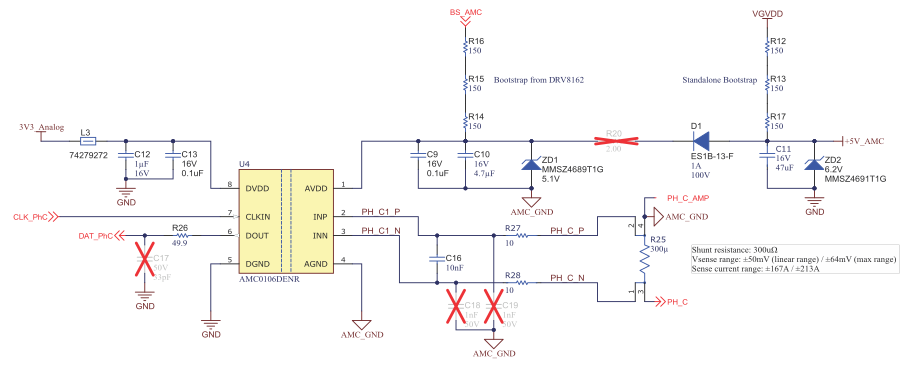
TIDA-010956 Inline Phase Current Sense With ACM0306M05 for Phase CFigure 2-5 Inline Phase Current Sense With ACM0306M05 for Phase C

The application circuit here follows the recommended pattern in the data sheet. For the high-side power supply, two channels of boot-strap circuits are available to choose. One channel comes from the bootstrap voltage BS_AMC of the phase C gate driver, through R14, R15, R16, and then clamps at 5.1V by ZD1; another channel comes from a standalone bootstrap circuit by R20, D1, C11, ZD2 and R12, R13, R17. By default, the R20 is not populated and the standalone bootstrap circuit is not active.

For more details about the AMC0106M05 application and performance, see the High Resolution, Small Form Factor Phase Current Sense for 48V Robotics and Servo Drives application note.

See also the Achieving Better Signal Integrity With Isolated Delta-Sigma Modulators in Motor Drives and Clock Edge Delay Compensation With Isolated Modulators Digital Interface to MCUs application notes for more design tips.