SBOSA39A April   2025  – October 2025 THS3470

PRODUCTION DATA  

  1.   1
  2. Features
  3. Applications
  4. Description
  5. Pin Configuration and Functions
  6. Specifications
    1. 5.1 Absolute Maximum Ratings
    2. 5.2 ESD Ratings
    3. 5.3 Recommended Operating Conditions
    4. 5.4 Thermal Information
    5. 5.5 Electrical Characteristics ±VS = ±30V
    6. 5.6 Electrical Characteristics ±VS = ±20V
    7. 5.7 Typical Characteristics
  7. Detailed Description
    1. 6.1 Overview
    2. 6.2 Functional Block Diagram
    3. 6.3 Feature Description
      1. 6.3.1 Output Current Limit
      2. 6.3.2 Output Current Enable
      3. 6.3.3 Over Temperature Flag
      4. 6.3.4 Output Current Flags
      5. 6.3.5 Output Current Monitoring
      6. 6.3.6 Die Temperature Monitoring
      7. 6.3.7 External Compensation
    4. 6.4 Device Functional Modes
      1. 6.4.1 Power Modes
      2. 6.4.2 Choosing a Feedback Resistor
  8. Application and Implementation
    1. 7.1 Application Information
    2. 7.2 Typical Application
      1. 7.2.1 High-Voltage, High-Precision, Composite Amplifier
        1. 7.2.1.1 Design Requirements
        2. 7.2.1.2 Detailed Design Procedure
        3. 7.2.1.3 Application Curves
      2. 7.2.2 120V Bootstrap Amplifier
        1. 7.2.2.1 Design Requirements
        2. 7.2.2.2 Detailed Design Procedure
        3. 7.2.2.3 Application Performance Plots
    3. 7.3 Short Circuit Protection
    4. 7.4 Power Supply Recommendations
    5. 7.5 Layout
      1. 7.5.1 Thermal Considerations
        1. 7.5.1.1 Top-Side Cooling Benefits
        2. 7.5.1.2 THS3470 Safe Operating Area
      2. 7.5.2 Layout Guidelines
      3. 7.5.3 Layout Example
  9. Device and Documentation Support
    1. 8.1 Documentation Support
    2. 8.2 Receiving Notification of Documentation Updates
    3. 8.3 Support Resources
    4. 8.4 Trademarks
    5. 8.5 Electrostatic Discharge Caution
    6. 8.6 Glossary
  10. Revision History
  11. 10Mechanical, Packaging, and Orderable Information
    1. 10.1 TAPE AND REEL INFORMATION

Package Options

Refer to the PDF data sheet for device specific package drawings

Mechanical Data (Package|Pins)
  • REB|42
Thermal pad, mechanical data (Package|Pins)
Orderable Information

Over Temperature Flag

The THS3470 over temperature flag, OVTEMP_FLAG, is used to monitor when the internal thermal shutdown of the device is active. The OVTEMP_FLAG typically asserts low when the die temperature exceeds 160 degrees, depending on process variation of the device. After asserting the flag low, the flag typically asserts high when the device temperature cools to 140 degrees, also dependent on process variation, to create a hysteresis window to prevent the device from continuously asserting an de-asserting.

There are two primary use cases for the over temperature flag. The typical use case is to connect the OVTEMP_FLAG directly to the P0 and P1 pins to allow the device to thermally shutdown when the die temperature is too hot. Additionally, if one of the other power modes is desired on the P0 and P1 pins, a logical AND gate can be used with the preferred P0 and P1 bias states. The second use case is to connect OVTEMP_FLAG to a digital input/output pin of a micro controller and monitor the pin as a temperature warning flag. In this case, the micro controller can make decisions, along with the DIE_TEMP pin, to toggle the P0 and P1 pins earlier or later than when the P0 or P1 pins are tied to the OVTEMP_FLAG to more tightly control the thermal regulation of the THS3470.
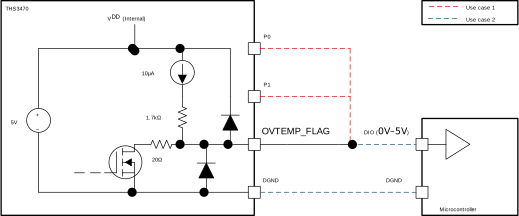
THS3470 OVTEMP_FLAG Schematic Figure 6-4 OVTEMP_FLAG Schematic
Note: The device temperature is not always symmetric across the die and "hot spots" can develop depending on the application. Pay special attention to rapid heating scenarios, such as driving large capacitive loads, that cannot trigger the OVTEMP_FLAG in time to save the device from a destructive failure. Refer to the Safe Operating Area of the data sheet for more information on preventing device overheating in these applications.