SBOSA39A April 2025 – October 2025 THS3470
PRODUCTION DATA
- 1
- 1 Features
- 2 Applications
- 3 Description
- 4 Pin Configuration and Functions
- 5 Specifications
- 6 Detailed Description
- 7 Application and Implementation
- 8 Device and Documentation Support
- 9 Revision History
- 10Mechanical, Packaging, and Orderable Information
Package Options
Refer to the PDF data sheet for device specific package drawings
Mechanical Data (Package|Pins)
- REB|42
Thermal pad, mechanical data (Package|Pins)
Orderable Information
7.2.2 120V Bootstrap Amplifier
The THS3470's unique combination of high supply voltage (60V), high output current (1.35A DC, 2A Peak), and fast slew rate (3kV/us) make the device an attractive option for many applications. Despite the already high voltage of the THS3470 amplifier, many applications demand higher voltage requirements with the unique feature set that the THS3470 already provides. Creating a 3-Amplifier "Bootstrap" design allows designers to increase the voltage headroom while mostly preserving the electrical performance and diagnostic features of the THS3470.
Amplifier bootstrapping uses a resistor divider, a doubled supply range, and two additional amplifiers to move the "signal amplifier" supplies dynamically as the output voltage is moving. The amplifier that is connected to the input signal, as shown in Figure 7-6, is known as the "signal amplifier" and provides the output voltage and current to the application. The "supply amplifiers" are connected such that VCC/VEE = 60V/0V for the top supply amplifier which provides the signal amplifiers VCC connection. Conversely, the bottom supply amplifier has a supply voltage of VCC/VEE = 0V/-60V and provides the signals amplifiers VEE connection. By providing multiple supplies in this way, and using the resistor divider, every amplifier can operate within the operating maximum of the THS3470 (60V) and enable a 100VPP output signal.
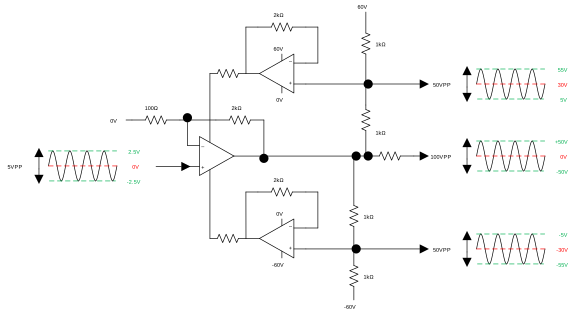 Figure 7-6 120V Bootstrap Amplifier
Example
Figure 7-6 120V Bootstrap Amplifier
Example