SBOSA39A April 2025 – October 2025 THS3470
PRODUCTION DATA
- 1
- 1 Features
- 2 Applications
- 3 Description
- 4 Pin Configuration and Functions
- 5 Specifications
- 6 Detailed Description
- 7 Application and Implementation
- 8 Device and Documentation Support
- 9 Revision History
- 10Mechanical, Packaging, and Orderable Information
Package Options
Refer to the PDF data sheet for device specific package drawings
Mechanical Data (Package|Pins)
- REB|42
Thermal pad, mechanical data (Package|Pins)
Orderable Information
6.3.2 Output Current Enable
The THS3470 features two pins, ISNK_LIMIT_EN and ISRC_LIMIT_EN that allow toggling of the internal current limiting features set by the ISNK_LIMIT and ISRC_LIMIT pins.
If the ISNK_LIMIT_EN pin is connected low, the internal current limit for sinking current is activated, and the current at the VOUT pin is regulated according to the ISNK_LIMIT configuration. If the ISNK_LIMIT_EN is connected high, the internal current limit for sinking current is deactivated and limited by the inherent maximum allowable current (2.1A). Regardless of the ISNK_LIMIT_EN pin configuration, the ISNK_FLAG pin triggers when the VOUT sinking current exceeds the threshold dictated by the ISNK_LIMIT configuration.
For the ISNK_LIMIT_EN disabled case, use this functionality as a warning flag when the device is approaching a limit that must be monitored closely for system health using the IOUT pin or the OVTEMP_FLAG pin. This approach gives designers an option to better control when to disable or shutdown the device on a microcontroller; Figure 6-3 shows this option. If the application does not require fine control of the current limit, designers can hard connect the ISNK_FLAG pin to the ISNK_LIMIT_EN pin; Figure 6-3 also shows this option.
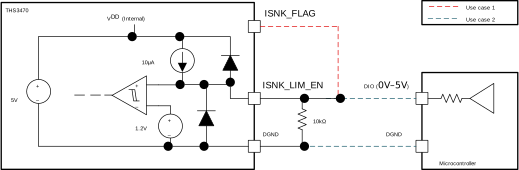 Figure 6-3 Output Current Enable
Schematic
Figure 6-3 Output Current Enable
SchematicThe ISRC_LIMIT_EN, ISRC_LIMIT, and ISRC_FLAG pins all function identically to the sinking current equivalents, but instead govern the sourcing limits of the VOUT pin.