The THS3470 comes in a top-side cooled REB package which
gives thermal performance benefits over traditional bottom-side cooled QFN devices.
Traditional packages, as shown in
Figure 7-14, must interface with the PCB material before entering the heat sink. Without a heat
sink, bottom-side cooled devices rely on convection across a smaller surface area of the
PCB to remove heat. A helpful conceptualization in these circumstances is to think about
the different interfaces as “thermal resistances” that prevent the heat generated by the
silicon die from moving to the ambient air. The result of these bottom-side cooled
packages often results in a best-case θ
JA of above 10°C/W for the total
system level performance, even with a forced air system.
The THS3470 top-side cooled
package, however, does not rely on heat to travel through the PCB before interfacing
with the air or heat sink. This more direct contact method essentially removes the
PCB “thermal resistance”, as shown in Figure 7-15, and can enable a full system level θJA performance of approximately
4°C/W. This configuration also enables the potential use of a cold plate or other
direct contact methods of cooling that have better mechanisms for removing heat from
the system.
Note: For
air cooled systems, achieving 4°C/W is typically dependent on the "Linear
Airflow Velocity" along the fins of the heat sink, typically measured in meters
per second (m/s) or linear feet per minute (LFM). Air flow velocities of 1m/s or
greater is typically required to achieve 4°C/W θJA
performance.
Due to the high voltage nature of the THS3470, mechanically
mounting the heat-sink can require special considerations depending on the
application. To provide the best thermal performance possible, the THS3470 uses a
conductive die attach that internally connects the thermal pad to VEE. In single
ended applications where VEE is connected to −60V and VCC is connected to 0V, the
high voltage potential on the thermal pad creates the possibility of a high voltage
hazard for the system. To circumvent potential high voltage hazards, a
non-conductive thermal interface material can be placed in between a copper or
graphite heat spreader and the heat sink as shown in
Figure 7-16. The copper heat spreader helps to distribute the heat to a wider surface area
before the thermal interface, resulting in a lower overall thermal resistance.
Additionally, using an anodized heat sink can help to provide electrical isolation
while not degrading the thermal performance significantly. Designers need to keep in
mind that anodization on heat sinks can become scratched or damaged, so using a
thermal interface material is preferable for situations where the heat-sink has to
be regularly removed from the device. Lastly, use alumina or ceramic screws to
mechanically secure the fixture while maintaining electrical isolation between the
heat spreader and heat sink.
 Figure 7-14 Typical Bottom-Side Cooling
Example
Figure 7-14 Typical Bottom-Side Cooling
Example Figure 7-15 THS3470 Top-Side Cooling
Example
Figure 7-15 THS3470 Top-Side Cooling
Example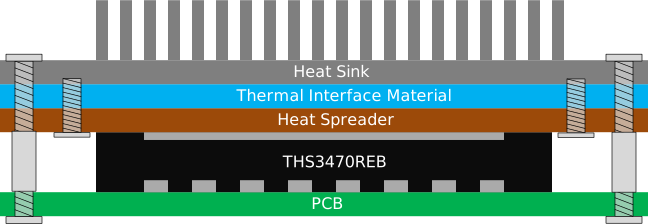 Figure 7-16 Electrical Isolation in
Top-Side Cooling Example
Figure 7-16 Electrical Isolation in
Top-Side Cooling Example