SBOSA39A April 2025 – October 2025 THS3470
PRODUCTION DATA
- 1
- 1 Features
- 2 Applications
- 3 Description
- 4 Pin Configuration and Functions
- 5 Specifications
- 6 Detailed Description
- 7 Application and Implementation
- 8 Device and Documentation Support
- 9 Revision History
- 10Mechanical, Packaging, and Orderable Information
Package Options
Refer to the PDF data sheet for device specific package drawings
Mechanical Data (Package|Pins)
- REB|42
Thermal pad, mechanical data (Package|Pins)
Orderable Information
7.5.1.2 THS3470 Safe Operating Area
The Safe Operating Area of a device helps designers to identify best practices for managing inherent power limitations of semiconductor devices. For operational amplifiers, these limitations typically manifest through large output currents paired with large voltage drop across the output transistors. The high voltage and high current nature of the THS3470 inherently dissipates more power inside the package, thus special design considerations must be taken to optimize device health over lifetime. For more information regarding sources of stress for power amplifiers with regards to the Safe Operating Area, see SBOA022.
The THS3470 is equipped with a top-side cooled REB package, which helps to optimize thermal performance when burning large amounts of power inside the package. For DC, or near DC performance (i.e. high duty cycle and/or >100ms pulses), power burned in the output stage causes the device to heat up at a near worst-case scenario. While the THS3470 does include diagnostic and protection features such as the DIE_TEMP and OVERTEMP_FLAG to help with thermal management, best practice for enabling device integrity includes planning for the safe operating area of the device.
Figure 7-17 shows how the THS3470 functions at different output voltages and output currents under different cooling conditions. These results showcase the necessity of a heat sink in most applications, with a nearly 2x improvement in power delivered by adding the heat sink. Additionally, the convection across the heat sink fins is the primary mechanism for removing the heat from the die. Figure 7-17 shows 3 scenarios that highlight air flow and heat sink impact: no heat sink, heat sink without air flow (THS3470EVM without fan), and heat sink with air flow (THS3470EVM with fan).
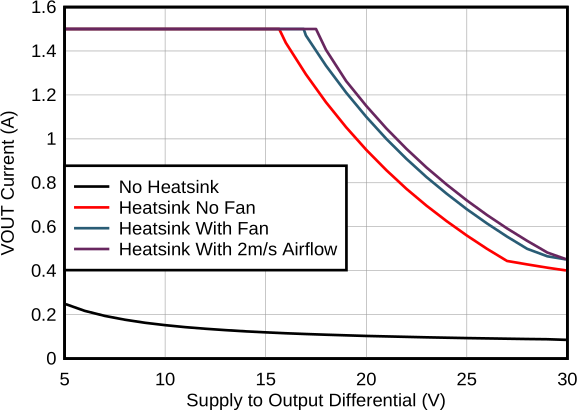 Figure 7-17 THS3470 DC Safe Operating Area
(THS3470EVM, VS = 60V)
Figure 7-17 THS3470 DC Safe Operating Area
(THS3470EVM, VS = 60V)In addition to dc operation, the THS3470's high slew rate and bandwidth make the device well suited for large voltage pulses. Many applications for the THS3470 use low duty cycle pulses to minimize power dissipated in the system, instead of using a continuous dc voltage, which is often characterized by an "IV Chart". Figure 7-18 shows how the thermal performance of the THS3470 changes under various pulse durations and duty cycles with a purely resistive load while using the THS3470EVM, heat sink, and fan.
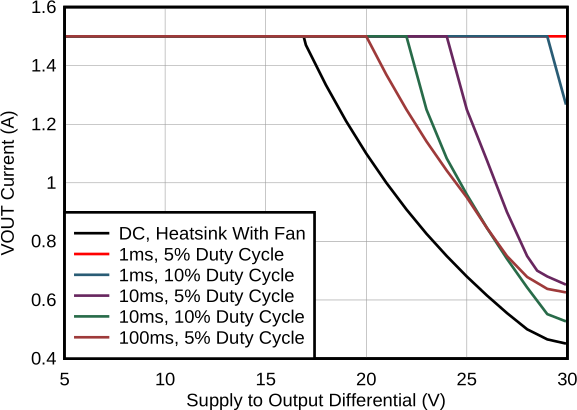 Figure 7-18 THS3470 Safe Operating Area
(Square Wave, VS = 60V)
Figure 7-18 THS3470 Safe Operating Area
(Square Wave, VS = 60V)When driving capacitive loads, Figure 7-19 shows how the THS3470 power consumption changes versus frequency for a square wave with a fixed capacitive load. Since the current into a capacitor is directly correlated to the dv/dt of the output step multiplied by the capacitance, all of the power consumption occurs during the slew event of the square wave. Higher frequencies contain more edges within the same time span, so the THS3470 consumes more power and generates more heat as the frequency increases while driving capacitive loads. The effect of different capacitive loads for a fixed voltage can also be seen in Figure 7-20.
 Figure 7-19 THS3470 Safe Operating Area
(Square Wave, CL = 1nF, VS = 60V)
Figure 7-19 THS3470 Safe Operating Area
(Square Wave, CL = 1nF, VS = 60V)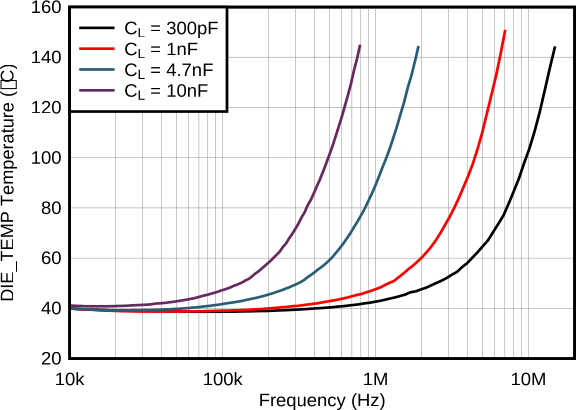 Figure 7-20 THS3470 Safe Operating Area
(Square Wave, VOUT = 50VPP, VS = 60V)
Figure 7-20 THS3470 Safe Operating Area
(Square Wave, VOUT = 50VPP, VS = 60V)