SPRSPB9B July 2025 – October 2025 F28E120SB , F28E120SC
PRODUCTION DATA
- 1
- 1 Features
- 2 Applications
- 3 Description
- 4 Device Comparison
- 5 Pin Configuration and Functions
-
6 Specifications
- 6.1 Absolute Maximum Ratings
- 6.2 ESD Ratings
- 6.3 Recommended Operating Conditions
- 6.4 Power Consumption Summary
- 6.5 Electrical Characteristics
- 6.6 Thermal Resistance Characteristics for PT Package
- 6.7 Thermal Resistance Characteristics for VFC Package
- 6.8 Thermal Resistance Characteristics for RHB Package
- 6.9 Thermal Design Considerations
- 6.10
System
- 6.10.1 Power Management Module (PMM)
- 6.10.2 Reset Timing
- 6.10.3
Clock Specifications
- 6.10.3.1 Clock Sources
- 6.10.3.2 Clock Frequencies, Requirements, and Characteristics
- 6.10.3.3 Input Clocks and PLLs
- 6.10.3.4 XTAL Oscillator
- 6.10.3.5 Internal Oscillators
- 6.10.4 Flash Parameters
- 6.10.5 RAM Specifications
- 6.10.6 ROM Specifications
- 6.10.7 Emulation/JTAG
- 6.10.8 GPIO Electrical Data and Timing
- 6.10.9 Interrupts
- 6.10.10
Low-Power Modes
- 6.10.10.1 Clock-Gating Low-Power Modes
- 6.10.10.2
Low-Power Mode Wake-up Timing
- 6.10.10.2.1 IDLE Mode Timing Requirements
- 6.10.10.2.2 IDLE Mode Switching Characteristics
- 6.10.10.2.3 IDLE Entry and Exit Timing Diagram
- 6.10.10.2.4 STANDBY Mode Timing Requirements
- 6.10.10.2.5 STANDBY Mode Switching Characteristics
- 6.10.10.2.6 STANDBY Entry and Exit Timing Diagram
- 6.10.10.2.7 HALT Mode Timing Requirements
- 6.10.10.2.8 HALT Mode Switching Characteristics
- 6.10.10.2.9 HALT Entry and Exit Timing Diagram
- 6.11
Analog Peripherals
- 6.11.1 Analog Pins and Internal Connections
- 6.11.2 Analog-to-Digital Converter (ADC)
- 6.11.3
Comparator Subsystem (CMPSS_LITE)
- 6.11.3.1 COMPDACOUT
- 6.11.3.2 CMPSS Connectivity Diagram
- 6.11.3.3 Block Diagram
- 6.11.3.4
CMPSS Electrical Data and Timing
- 6.11.3.4.1 CMPSS_LITE Comparator Electrical Characteristics
- CMPSS Comparator Input Referred Offset and Hysteresis
- 6.11.3.4.2 CMPSS_LITE DAC Static Electrical Characteristics
- 6.11.3.4.3 CMPSS Illustrative Graphs
- 6.11.3.4.4 Buffered Output from CMPx_LITE_DACL Operating Conditions
- 6.11.3.4.5 Buffered Output from CMPx_LITE_DACL Electrical Characteristics
- 6.11.4 Programmable Gain Amplifier (PGA)
- 6.11.5 Temperature Sensor
- 6.12 Control Peripherals
- 6.13 Communications Peripherals
- 7 Detailed Description
- 8 Applications, Implementation, and Layout
- 9 Device and Documentation Support
- 10Revision History
- 11Mechanical, Packaging, and Orderable Information
Package Options
Refer to the PDF data sheet for device specific package drawings
Mechanical Data (Package|Pins)
- RHB|32
- PT|48
- VFC|32
Thermal pad, mechanical data (Package|Pins)
Orderable Information
7.5 Direct Memory Access (DMA)
The DMA module provides a hardware method of transferring data between peripherals and/or memory without intervention from the CPU, thereby freeing up bandwidth for other system functions. Additionally, the DMA has the capability to orthogonally rearrange the data as it is transferred as well as “ping-pong” data between buffers. These features are useful for structuring data into blocks for optimal CPU processing. Figure 7-1 shows a device-level block diagram of the DMA.
DMA features include:
- Two channels with independent ePIE interrupts
- Peripheral interrupt trigger sources
- ADC interrupts and EVT signals
- External Interrupts
- MCPWM SOC signals
- CPU timers
- SPI transmit and receive
- UART transmit and receive
- Regular FIFO level triggers (UARTx_TX and UARTx_RX) and single request triggers (UARTx_TX_SREQ and UARTx_RX_SREQ)
- Data sources and destinations:
- GSx RAM
- ADC result registers
- Control peripheral registers (MCPWM, eQEP)
- Communication peripheral registers (SPI, UART)
- PGA control registers
- CMPSS control registers
- Word Size: 16-bit or 32-bit (SPI limited to 16-bit)
- Throughput: Three cycles per word without arbitration
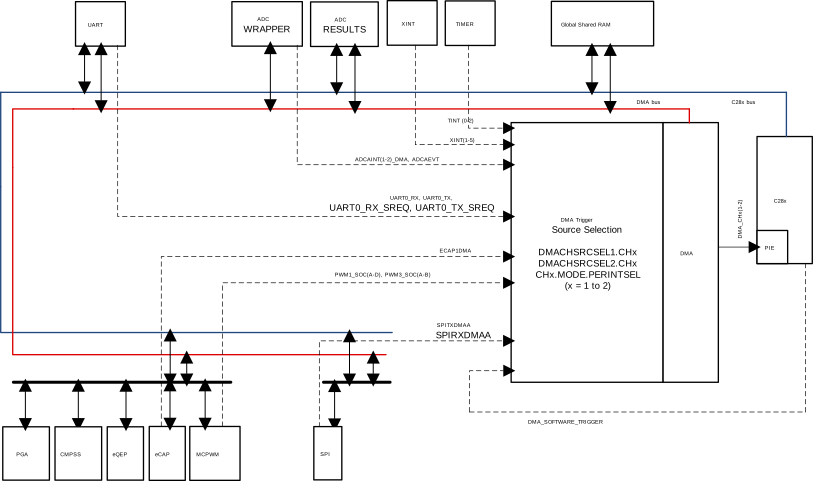 Figure 7-1 DMA Block Diagram