SNVSCF0 October 2024 LM65680-Q1
ADVANCE INFORMATION
- 1
- 1 Features
- 2 Applications
- 3 Description
- 4 Device Comparison Table
- 5 Pin Configuration and Functions
- 6 Specifications
-
7 Detailed Description
- 7.1 Overview
- 7.2 Functional Block Diagram
- 7.3
Feature Descriptions
- 7.3.1 Output Voltage Selection
- 7.3.2 EN Pin and Use as VIN UVLO
- 7.3.3 Device Configuration
- 7.3.4 Single-Output Dual-Phase Operation
- 7.3.5 Mode Selection
- 7.3.6 Adjustable Switching Frequency
- 7.3.7 Dual Random Spread Spectrum (DRSS)
- 7.3.8 Internal LDO, VCC UVLO, and BIAS Input
- 7.3.9 Bootstrap Voltage (BST Pin)
- 7.3.10 Soft Start and Recovery From Dropout
- 7.3.11 Safety Features
- 7.4 Device Functional Modes
- 8 Application and Implementation
- 9 Device and Documentation Support
- 10Revision History
- 11Mechanical, Packaging, and Orderable Information
Package Options
Mechanical Data (Package|Pins)
- RZY|26
Thermal pad, mechanical data (Package|Pins)
Orderable Information
7.3.4 Single-Output Dual-Phase Operation
For single-output, dual-phase operation, two LM656x0-Q1 devices are required. Additional phases cannot be added. Configure the first device as a primary device and the second device as a secondary device per Device Configuration. This action disables the feedback error amplifier of the secondary device and places feedback error amplifier into a high-impedance state. As shown in Figure 7-3, connect the FB pin of the secondary device to VCC. Furthermore, connect the COMP pins of the primary and secondary devices together with minimal trace length. Add an external compensation network near the primary device. Internal compensation feature is not supported when operating in dual-phase configuration.
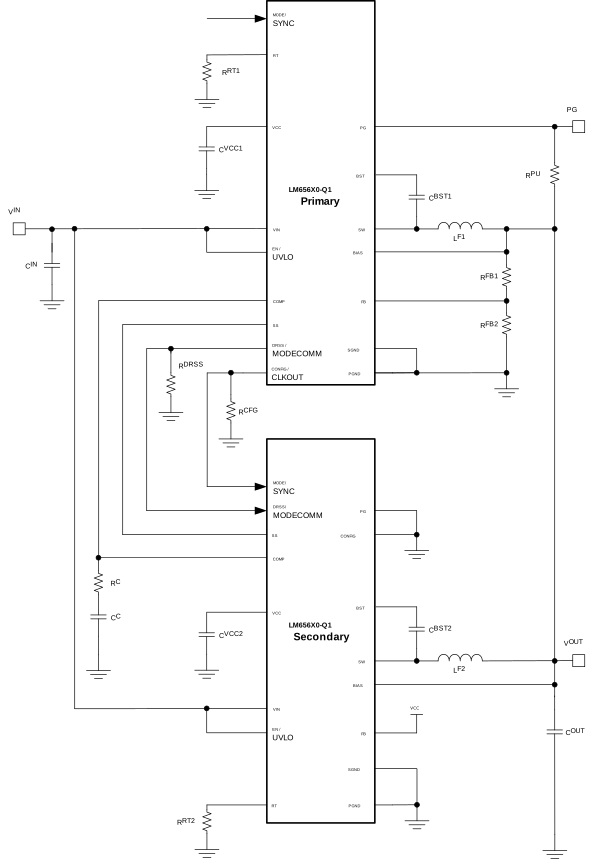 Figure 7-3 Simplified Schematic for
Single-Output Dual-Phase Operation
Figure 7-3 Simplified Schematic for
Single-Output Dual-Phase OperationThe CONFIG / CLKOUT pin of the primary device must be connected to the MODE / SYNC pin of the secondary device. The CLKOUT signal from the primary device is 180° out-of-phase and facilitates the interleaved operation. When operating in dual-phase configuration, both devices need to be enabled at the exact same time for start-up.
When configured for dual-phase operation, the DRSS / MODECOMM pin conveys the mode information from the primary device to the secondary device. A MODECOMM high signal from the primary device forces the secondary device to operate in FPWM mode. A MODECOMM low signal from the primary device forces the secondary device to operate in PFM mode. MODECOMM pins of the primary and secondary devices must be tied together. The SS pins of both primary and secondary devices must also be tied together for fault communication.
For more information, see Benefits of a Multiphase Buck Converter analog design journal and Multiphase Buck Design From Start to Finish. application note.