SLVAE87B December 2020 – June 2025 BQ79600-Q1 , BQ79612-Q1 , BQ79614-Q1 , BQ79616-Q1 , BQ79652-Q1 , BQ79654-Q1 , BQ79656-Q1
- 1
- Abstract
- Trademarks
- 1 NPN LDO Supply
- 2 AVDD, CVDD Outputs and DVDD, NEG5, REFHP and REFHM
- 3 OTP Programming
- 4 Cell Voltage Sense (VCn) and Cell Balancing (CBn)
- 5 Bus Bar Support
- 6 TSREF
- 7 General Purpose Input-Output (GPIO) Configurations
- 8 Base and Bridge Device Configuration
- 9 Daisy-Chain Stack Configuration
- 10Multidrop Configuration
- 11Main ADC Digital LPF
- 12AUX Anti Aliasing Filter (AAF)
- 13Layout Guidelines
- 14BCI Performance
- 15Common and Differential Mode Noise
- 16Summary
- 17References
- 18Revision History
9.1.3 Transformer Isolation
Transformer isolation is the most effective method for removing common mode noise from the system. The two options for this implementation can be seen in Figure 9-6. The following parameters are recommended for the transformer selection:
- Inductance = 150-600µH
- Isolation Voltage = 2500V, AC
The HMU1228 transformer is recommended and is recommended to be center tapped with a 100pF capacitor. ESD562-Q1 TVS diode can be added optionally for ESD protection.
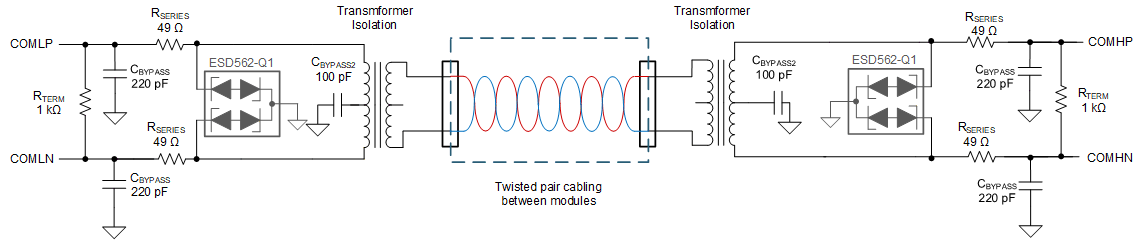 Figure 9-6 Components Required for Transformer Coupled Daisy Chain
Regardless of which isolation method is chosen, there are a few things that are common among all of them. First, is the 220pF capacitor and 49Ω resistor before the ESD isolation on both the high and low side on both the positive and negative lines.
Lastly, each design has a termination resistor. The purpose of this resistor is to prevent reflected signals from interfering in the communication. The recommendation is that a 1kΩ be used.
In all of these situations, the recommendation is based off how long the cable between boards is, and in all cases, twisted pair cabling is used between modules. The main purpose of these noise isolation methods is to remove common mode noise from the signal. More details can be found in Section 15.
The recommendation is that with any design that is chosen, that additional ESD protection is added. The ESD562-Q1 is shown in the following sections to provide ESD isolation on the communication lines.