SLOS893D September 2014 – August 2025 DRV2624
PRODUCTION DATA
- 1
- 1 Features
- 2 Applications
- 3 Description
- 4 Pin Configuration and Functions
- 5 Specifications
- 6 Parameter Measurement Information
-
7 Detailed Description
- 7.1 Overview
- 7.2 Functional Block Diagram
- 7.3
Feature Description
- 7.3.1 Support for ERM and LRA Actuators
- 7.3.2 Smart-Loop Architecture
- 7.3.3 Open-Loop Operation
- 7.3.4 Flexible Front-End Interface
- 7.3.5 Noise Gate Control
- 7.3.6 Edge Rate Control
- 7.3.7 Constant Vibration Strength
- 7.3.8 Battery Voltage Reporting
- 7.3.9 Ultra Low-Power Shutdown
- 7.3.10 Automatic Go-To-Stand-by (Low Power)
- 7.3.11 I2C Watchdog Timer
- 7.3.12 Device Protection
- 7.3.13 POR
- 7.3.14 Silicon Revision Control
- 7.3.15 Support for LRA and ERM Actuators
- 7.3.16 Multi-Purpose Pin Functionality
- 7.3.17 Automatic Transition to Standby State
- 7.3.18 Automatic Brake into Standby
- 7.3.19 Battery Monitoring and Power Preservation
- 7.4 Device Functional Modes
- 7.5 Operation During Exceptional Conditions
- 7.6
Programming
- 7.6.1 Auto-Resonance Engine Programming for the LRA
- 7.6.2 Automatic-Level Calibration Programming
- 7.6.3 I2C Interface
- 7.6.4 Programming for Open-Loop Operation
- 7.6.5 Programming for Closed-Loop Operation
- 7.6.6 Diagnostics Routine
- 7.6.7 Calibration Routine
- 7.6.8 Waveform Playback Programming
- 7.6.9 Waveform Setup and Playback
- 7.6.10 120
-
8 Register Map
- 8.1 Address: 0x00
- 8.2 Address: 0x01
- 8.3 Address: 0x02
- 8.4 Address: 0x03
- 8.5 Address: 0x04
- 8.6 Address: 0x05
- 8.7 Address: 0x06
- 8.8 Address: 0x07
- 8.9 Address: 0x08
- 8.10 Address: 0x09
- 8.11 Address: 0x0A
- 8.12 Address: 0x0B
- 8.13 Address: 0x0C
- 8.14 Address: 0x0D
- 8.15 Address: 0x0E
- 8.16 Address: 0x0F
- 8.17 Address: 0x10
- 8.18 Address: 0x11
- 8.19 Address: 0x12
- 8.20 Address: 0x13
- 8.21 Address: 0x14
- 8.22 Address: 0x15
- 8.23 Address: 0x16
- 8.24 Address: 0x17
- 8.25 Address: 0x18
- 8.26 Address: 0x19
- 8.27 Address: 0x1A
- 8.28 Address: 0x1B
- 8.29 Address: 0x1C
- 8.30 Address: 0x1D
- 8.31 Address: 0x1F
- 8.32 Address: 0x20
- 8.33 Address: 0x21
- 8.34 Address: 0x22
- 8.35 Address: 0x23
- 8.36 Address: 0x24
- 8.37 Address: 0x25
- 8.38 Address: 0x26
- 8.39 Address: 0x27
- 8.40 Address: 0x28
- 8.41 Address: 0x29
- 8.42 Address: 0x2A
- 8.43 Address: 0x2C
- 8.44 Address: 0x2E
- 8.45 Address: 0x2F
- 8.46 Address: 0x30
- 8.47 Address: 0xFD
- 8.48 Address: 0xFE
- 8.49 Address: 0xFF
- Application and Implementation
- 9 Device and Documentation Support
- 10Revision History
- 11Mechanical, Packaging, and Orderable Information
Package Options
Refer to the PDF data sheet for device specific package drawings
Mechanical Data (Package|Pins)
- YFF|9
Thermal pad, mechanical data (Package|Pins)
Orderable Information
7.6.9.3 Waveform Sequencer
To play haptic effects from the internal memory, the effects must first be loaded into the waveform sequencer, and then the effects can be launched by using any of the trigger options.
The waveform sequencer queues waveform-library identifiers for playback. Eight sequence registers queue up to eight library waveforms for sequential playback. A waveform identifier is an integer value referring to the index position of a waveform in the internal memory. Playback begins at WAV_FRM_SEQ1 when the user triggers the waveform sequencer. When playback of that waveform ends, the waveform sequencer plays the next waveform identifier held in WAV_FRM_SEQ2 (if non-zero). The waveform sequencer continues in this way until the sequencer reaches an identifier value of zero or until all eight identifiers are played whichever comes first.
The waveform identifier is a 7-bit number. The MSB of each sequence register can be used to implement a delay between sequence waveforms. When the MSB is high, bits 6-0 indicate the length of the wait time. The wait time for that step then becomes WAV_FRM_SEQ[6:0] × 10ms.
The DRV2624 device allows for looping of individual waveforms by using the WAVn_SEQ_LOOP parameters. When used, the state machine loops the particular waveform the number of times specified in the associated WAVn_SEQ_LOOP parameter before moving to the next waveform. Additionally, the entire sequencer of waveforms can be looped a number of times specified by the WAV_SEQ_MAIN_LOOP parameter. The waveform-looping feature is useful for long, custom haptic playbacks, such as a haptic ringtone.
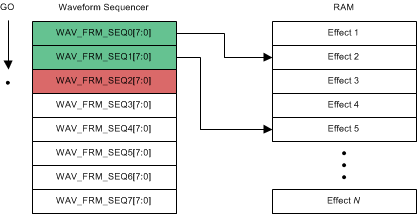 Figure 7-18 Waveform Sequencer Programming