SLOS893D September 2014 – August 2025 DRV2624
PRODUCTION DATA
- 1
- 1 Features
- 2 Applications
- 3 Description
- 4 Pin Configuration and Functions
- 5 Specifications
- 6 Parameter Measurement Information
-
7 Detailed Description
- 7.1 Overview
- 7.2 Functional Block Diagram
- 7.3
Feature Description
- 7.3.1 Support for ERM and LRA Actuators
- 7.3.2 Smart-Loop Architecture
- 7.3.3 Open-Loop Operation
- 7.3.4 Flexible Front-End Interface
- 7.3.5 Noise Gate Control
- 7.3.6 Edge Rate Control
- 7.3.7 Constant Vibration Strength
- 7.3.8 Battery Voltage Reporting
- 7.3.9 Ultra Low-Power Shutdown
- 7.3.10 Automatic Go-To-Stand-by (Low Power)
- 7.3.11 I2C Watchdog Timer
- 7.3.12 Device Protection
- 7.3.13 POR
- 7.3.14 Silicon Revision Control
- 7.3.15 Support for LRA and ERM Actuators
- 7.3.16 Multi-Purpose Pin Functionality
- 7.3.17 Automatic Transition to Standby State
- 7.3.18 Automatic Brake into Standby
- 7.3.19 Battery Monitoring and Power Preservation
- 7.4 Device Functional Modes
- 7.5 Operation During Exceptional Conditions
- 7.6
Programming
- 7.6.1 Auto-Resonance Engine Programming for the LRA
- 7.6.2 Automatic-Level Calibration Programming
- 7.6.3 I2C Interface
- 7.6.4 Programming for Open-Loop Operation
- 7.6.5 Programming for Closed-Loop Operation
- 7.6.6 Diagnostics Routine
- 7.6.7 Calibration Routine
- 7.6.8 Waveform Playback Programming
- 7.6.9 Waveform Setup and Playback
- 7.6.10 120
-
8 Register Map
- 8.1 Address: 0x00
- 8.2 Address: 0x01
- 8.3 Address: 0x02
- 8.4 Address: 0x03
- 8.5 Address: 0x04
- 8.6 Address: 0x05
- 8.7 Address: 0x06
- 8.8 Address: 0x07
- 8.9 Address: 0x08
- 8.10 Address: 0x09
- 8.11 Address: 0x0A
- 8.12 Address: 0x0B
- 8.13 Address: 0x0C
- 8.14 Address: 0x0D
- 8.15 Address: 0x0E
- 8.16 Address: 0x0F
- 8.17 Address: 0x10
- 8.18 Address: 0x11
- 8.19 Address: 0x12
- 8.20 Address: 0x13
- 8.21 Address: 0x14
- 8.22 Address: 0x15
- 8.23 Address: 0x16
- 8.24 Address: 0x17
- 8.25 Address: 0x18
- 8.26 Address: 0x19
- 8.27 Address: 0x1A
- 8.28 Address: 0x1B
- 8.29 Address: 0x1C
- 8.30 Address: 0x1D
- 8.31 Address: 0x1F
- 8.32 Address: 0x20
- 8.33 Address: 0x21
- 8.34 Address: 0x22
- 8.35 Address: 0x23
- 8.36 Address: 0x24
- 8.37 Address: 0x25
- 8.38 Address: 0x26
- 8.39 Address: 0x27
- 8.40 Address: 0x28
- 8.41 Address: 0x29
- 8.42 Address: 0x2A
- 8.43 Address: 0x2C
- 8.44 Address: 0x2E
- 8.45 Address: 0x2F
- 8.46 Address: 0x30
- 8.47 Address: 0xFD
- 8.48 Address: 0xFE
- 8.49 Address: 0xFF
- Application and Implementation
- 9 Device and Documentation Support
- 10Revision History
- 11Mechanical, Packaging, and Orderable Information
Package Options
Refer to the PDF data sheet for device specific package drawings
Mechanical Data (Package|Pins)
- YFF|9
Thermal pad, mechanical data (Package|Pins)
Orderable Information
7.6.3.3 General I2C Operation
The I2C bus employs two signals, SDA (data) and SCL (clock), to communicate between integrated circuits in a system. The bus transfers data serially, one bit at a time. The 8-bit address and data bytes are transferred with the most-significant bit (MSB) first. In addition, each byte transferred on the bus is acknowledged by the receiving device with an acknowledge bit. Each transfer operation begins with the controller device driving a start condition on the bus and ends with the controller device driving a stop condition on the bus. The bus uses transitions on the data pin (SDA) while the clock is at logic high to indicate start and stop conditions. A high-to-low transition on the SDA signal indicates a start, and a low-to-high transition indicates a stop. Normal data-bit transitions must occur within the low time of the clock period. Figure 7-8 shows a typical sequence. The controller device generates the 7-bit peripheral address and the read-write (R/W) bit to start communication with a peripheral device. The controller device then waits for an acknowledge condition. The peripheral device holds the SDA signal low during the acknowledge clock period to indicate acknowledgment. When the acknowledgment occurs, the controller transmits the next byte of the sequence. Each device is addressed by a unique 7-bit peripheral address plus a R/W bit (1 byte). All compatible devices share the same signals through a bidirectional bus using a wired-AND connection.
The number of bytes that can be transmitted between start and stop conditions is not limited. When the last word transfers, the controller generates a stop condition to release the bus. Figure 7-8 shows a generic data-transfer sequence.
Use external pull-up resistors for the SDA and SCL signals to set the logic-high level for the bus. Pull-up resistors between 660 O and 4.7kO are recommended. Do not allow the SDA and SCL voltages to exceed the DRV2624 supply voltage, VDD.
The DRV2624 peripheral address is 0x5A (7-bit), or 1011010 in binary.
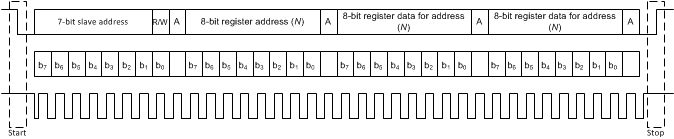 Figure 7-8 Typical I2C Sequence
The DRV2624 device operates as an I2C-peripheral 1.8V logic thresholds, but can operate up to the VDD voltage. The device address is 0x5A (7-bit), or 1011010 in binary which is equivalent to 0xB4 (8-bit) for writing and 0xB5 (8-bit) for reading.