SBASAO8 June 2025 DAC39RF20
ADVANCE INFORMATION
- 1
- 1 Features
- 2 Applications
- 3 Description
- 4 Device Comparison
- 5 Pin Configuration and Functions
-
6 Specifications
- 6.1 Absolute Maximum Ratings
- 6.2 ESD Ratings
- 6.3 Recommended Operating Conditions
- 6.4 Thermal Information
- 6.5 Electrical Characteristics - DC Specifications
- 6.6 Electrical Characteristics - AC Specifications
- 6.7 Electrical Characteristics - Power Consumption
- 6.8 Timing Requirements
- 6.9 Switching Characteristics
- 6.10 SPI Interface Timing Diagrams
-
7 Detailed Description
- 7.1 Overview
- 7.2 Functional Block Diagram
- 7.3
Feature Description
- 7.3.1 DAC Output Modes
- 7.3.2 DAC Core
- 7.3.3 DEM and Dither
- 7.3.4 Offset Adjustment
- 7.3.5 Clocking Subsystem
- 7.3.6
Digital Signal Processing Blocks
- 7.3.6.1 Bypass Mode
- 7.3.6.2 DUC Mode
- 7.3.6.3 DDS SPI Mode
- 7.3.6.4
DDS Vector Mode
- 7.3.6.4.1 Second Order Amplitude Support
- 7.3.6.4.2 Vector Order and Symmetric Vector Mode
- 7.3.6.4.3 Initial Startup
- 7.3.6.4.4 Trigger Queuing
- 7.3.6.4.5 Trigger Burst
- 7.3.6.4.6 Hold Mode
- 7.3.6.4.7 Indexing Mode
- 7.3.6.4.8 Queued or Burst Triggers in Indexing-Mode
- 7.3.6.4.9 Writing Vectors While DDS is Enabled
- 7.3.6.5 DDS Streaming Mode
- 7.3.6.6 DSP Triggering
- 7.3.6.7 NCO Square Wave Mode
- 7.3.6.8 DSP Mute Function
- 7.3.6.9 DSP Output Gain
- 7.3.6.10 Complex Output Support
- 7.3.6.11 Channel Bonder
- 7.3.6.12 Programmable FIR Filter
- 7.3.6.13 DES Interpolator
- 7.3.7 Serdes Physical Layer
- 7.3.8
JESD204C Interface
- 7.3.8.1 Deviation from JESD204C Standard
- 7.3.8.2 Link Layer
- 7.3.8.3 SYSREF Alignment Required in Subclass 1 Mode
- 7.3.8.4 Transport Layer
- 7.3.8.5 JESD204C Debug Capture (JCAP)
- 7.3.8.6 JESD204C Interface Modes
- 7.3.9 Data Path Latency
- 7.3.10 Multi-Device Synchronization and Deterministic Latency
- 7.3.11 Link Reset
- 7.3.12 Alarm Generation
- 7.3.13 Mute Function
- 7.4 Device Functional Modes
-
8 Programming
- 8.1 Using the Standard SPI Interface
- 8.2 Using the Fast Reconfiguration Interface
- 8.3
Register Maps
- 8.3.1 Standard_SPI-3.1 Registers
- 8.3.2 System Registers
- 8.3.3 Trigger Registers
- 8.3.4 CPLL_AND_CLOCK Registers
- 8.3.5 SYSREF Registers
- 8.3.6 JESD204C Registers
- 8.3.7 JESD204C_Advanced Registers
- 8.3.8 SerDes_Equalizer Registers
- 8.3.9 SerDes_Eye-Scan Registers
- 8.3.10 SerDes_Lane_Status Registers
- 8.3.11 SerDes_PLL Registers
- 8.3.12 DAC_and_Analog_Configuration Registers
- 8.3.13 Datapath Registers
- 8.3.14 NCO_and_Mixer Registers
- 8.3.15 Alarm Registers
- 8.3.16 Fuse_Control Registers
- 8.3.17 Fuse_Backed Registers
- 8.3.18 DDS_Vector_Mode Registers
- 8.3.19 Programmable_FIR Registers
- 9 Application and Implementation
- 10Device and Documentation Support
- 11Revision History
- 12Mechanical, Packaging, and Orderable Information
7.3.8 JESD204C Interface
The devices uses a JESD204C high-speed serial interface to transfer data from the logic device to the receiving DAC. The device serialized lanes are capable of operating with both 8b/10b encoding and 64b/66b encoding. The JESD204C formats using 8B/10B encoding are backwards compatible with existing JESD204B receivers. A maximum of 16 lanes can be used to lower lane rates for interfacing with speed limited logic devices. There are a few differences between 8b/10b and 64B/66B encoded JESD204C, which is highlighted throughout this section. Figure 7-50 shows a simplified block diagram of the 8b/10b encoded JESD204C interface and Figure 7-51 shows a simplified block diagram of the 64b/66b encoded JESD204C interface.
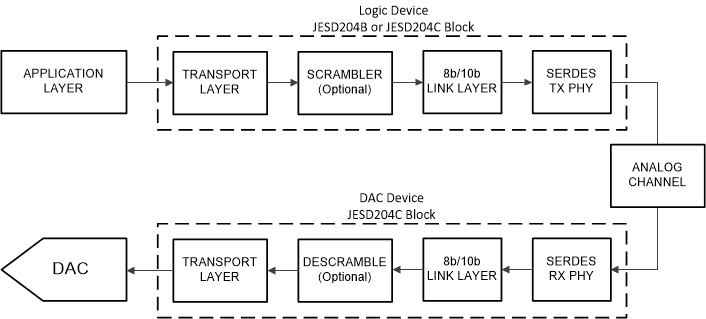 Figure 7-50 Simplified JESD204C
Interface Diagram with 8b/10b Encoding
Figure 7-50 Simplified JESD204C
Interface Diagram with 8b/10b Encoding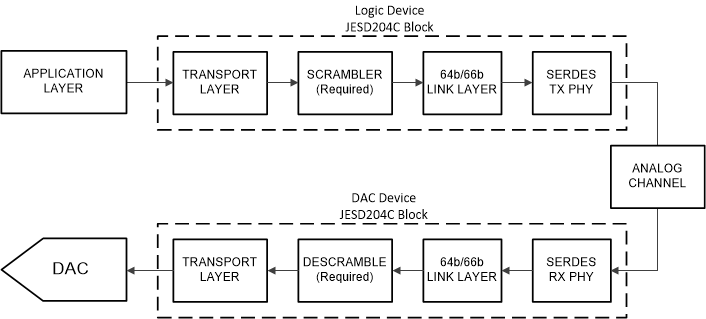 Figure 7-51 Simplified JESD204C Interface Diagram with
64b/66b Encoding
Figure 7-51 Simplified JESD204C Interface Diagram with
64b/66b EncodingNot all optional features of JESD204C are supported by the device. The list of features that are supported and the features that are not supported is provided in Table 7-38
| LETTER IDENTIFIER | FEATURE | SUPPORTED BY DEVICE? |
|---|---|---|
| a | 8b/10b link layer | Yes |
| b | 64b/66b link layer | Yes |
| c | 64b/80b link layer | No |
| d | The command channel when using 64b/66b or 64b/80b link layer | No |
| e | Forward error correction (FEC) when using the 64b/66b or 64b/80b link layer | Yes |
| f | CRC3 when using the 64b/66b or 64b/80b link layer | No |
| g | A physical SYNC pin when using the 8b/10b link layer | Yes |
| h | Subclass 0 | Yes |
| i | Subclass 1 | Yes |
| j | Subclass 2 | No |
| k | Lane alignment within a single link | Yes |
| l | Subclass 1 with support for lane alignment on a multipoint link by means of the MULTIREF signal | No |
| m | SYNC interface timing compatible with JESD204A | Yes |
| n | SYNC interface timing compatible with JESD204B | Yes |
The various signals used in the JESD204C interface and the associated device pin names are summarized briefly in Table 7-39 for reference.
| SIGNAL NAME | DEVICE PIN NAMES | DESCRIPTION |
|---|---|---|
| Data | [15:0]SRX± | High-speed serialized data after 8b/10b or 64b/66b encoding that is received by the SerDes receivers. |
| SYNC | SYNC | Link initialization signal (handshake), toggles low to start code group synchronization (CGS) process. Not used for 64B/66B encoding modes. |
| Device clock | DACCLK+, DACCLK– | DAC sampling clock, also used for clocking digital logic and SerDes receivers. |
| SYSREF | SYSREF+, SYSREF– | System timing reference used to deterministically reset the internal local multiframe clock (LMFC) or local extended multiblock clock (LEMC) counters in each JESD204C device |