SPRSPA1B March 2025 – November 2025 AM62L
PRODUCTION DATA
- 1
- 1 Features
- 2 Applications
- 3 Description
- 4 Device Comparison
-
5 Terminal Configuration and Functions
- 5.1 Pin Diagrams
- 5.2 Pin Attributes
- 5.3
Signal Descriptions
- 14
- 5.3.1 ADC
- 5.3.2 CPSW3G
- 5.3.3 CPTS
- 5.3.4 DDRSS
- 5.3.5 DSI
- 5.3.6 DSS
- 5.3.7 ECAP
- 5.3.8 Emulation and Debug
- 5.3.9 EPWM
- 5.3.10 EQEP
- 5.3.11 GPIO
- 5.3.12 GPMC
- 5.3.13 I2C
- 5.3.14 MCAN
- 5.3.15 MCASP
- 5.3.16 MCSPI
- 5.3.17 MDIO
- 5.3.18 MMC
- 5.3.19 OSPI
- 5.3.20 Power Supply
- 5.3.21 Reserved
- 5.3.22 System and Miscellaneous
- 5.3.23 TIMER
- 5.3.24 UART
- 5.3.25 USB
- 5.4 Pin Connectivity Requirements
-
6 Specifications
- 6.1 Absolute Maximum Ratings
- 6.2 ESD Ratings
- 6.3 Power-On Hours (POH)
- 6.4 Recommended Operating Conditions
- 6.5 Operating Performance Points
- 6.6 Power Consumption Summary
- 6.7
Electrical
Characteristics
- 6.7.1 I2C Open-Drain, and Fail-Safe (I2C OD FS) Electrical Characteristics
- 6.7.2 Fail-Safe Reset (FS RESET) Electrical Characteristics
- 6.7.3 High-Frequency Oscillator (HFOSC) Electrical Characteristics
- 6.7.4 Low-Frequency Oscillator (LFXOSC) Electrical Characteristics
- 6.7.5 SDIO Electrical Characteristics
- 6.7.6 LVCMOS Electrical Characteristics
- 6.7.7 1P8-LVCMOS Electrical Characteristics
- 6.7.8 RTC-LVCMOS Electrical Characteristics
- 6.7.9 ADC Electrical Characteristics
- 6.7.10 DSI (D-PHY) Electrical Characteristics
- 6.7.11 USB2PHY Electrical Characteristics
- 6.7.12 DDR Electrical Characteristics
- 6.8 VPP Specifications for One-Time Programmable (OTP) eFuses
- 6.9 Thermal Resistance Characteristics
- 6.10 Temperature Sensor Characteristics
- 6.11
Timing and Switching Characteristics
- 6.11.1 Timing Parameters and Information
- 6.11.2 Power Supply Requirements
- 6.11.3 System Timing
- 6.11.4 Clock Specifications
- 6.11.5
Peripherals
- 6.11.5.1 CPSW3G
- 6.11.5.2 CPTS
- 6.11.5.3 DDRSS
- 6.11.5.4 DSI
- 6.11.5.5 DSS
- 6.11.5.6 ECAP
- 6.11.5.7 Emulation and Debug
- 6.11.5.8 EPWM
- 6.11.5.9 EQEP
- 6.11.5.10 GPIO
- 6.11.5.11 GPMC
- 6.11.5.12 I2C
- 6.11.5.13 MCAN
- 6.11.5.14 MCASP
- 6.11.5.15 MCSPI
- 6.11.5.16
MMCSD
- 6.11.5.16.1
MMC0 - eMMC/SD/SDIO Interface
- 6.11.5.16.1.1 Legacy SDR Mode
- 6.11.5.16.1.2 High Speed SDR Mode
- 6.11.5.16.1.3 High Speed DDR Mode
- 6.11.5.16.1.4 HS200 Mode
- 6.11.5.16.1.5 Default Speed Mode
- 6.11.5.16.1.6 High Speed Mode
- 6.11.5.16.1.7 UHS–I SDR12 Mode
- 6.11.5.16.1.8 UHS–I SDR25 Mode
- 6.11.5.16.1.9 UHS–I SDR50 Mode
- 6.11.5.16.1.10 UHS–I DDR50 Mode
- 6.11.5.16.1.11 UHS–I SDR104 Mode
- 6.11.5.16.2 MMC1/MMC2 - SD/SDIO Interface
- 6.11.5.16.1
MMC0 - eMMC/SD/SDIO Interface
- 6.11.5.17 OSPI
- 6.11.5.18 Timers
- 6.11.5.19 UART
- 6.11.5.20 USB
-
7 Detailed Description
- 7.1 Overview
- 7.2 Processor Subsystem
- 7.3 Other Subsystem
- 7.4
Peripherals
- 7.4.1 ADC
- 7.4.2 Gigabit Ethernet Switch (CPSW3G)
- 7.4.3 DDR Subsystem (DDRSS)
- 7.4.4 Display Subsystem (DSS)
- 7.4.5 Enhanced Capture (ECAP)
- 7.4.6 Error Location Module (ELM)
- 7.4.7 Enhanced Pulse Width Modulation (EPWM)
- 7.4.8 Enhanced Quadrature Encoder Pulse (EQEP)
- 7.4.9 General-Purpose Interface (GPIO)
- 7.4.10 General-Purpose Memory Controller (GPMC)
- 7.4.11 Global Timebase Counter (GTC)
- 7.4.12 Inter-Integrated Circuit (I2C)
- 7.4.13 Modular Controller Area Network (MCAN)
- 7.4.14 Multichannel Audio Serial Port (MCASP)
- 7.4.15 Multichannel Serial Peripheral Interface (MCSPI)
- 7.4.16 Multi-Media Card Secure Digital (MMCSD)
- 7.4.17 Octal Serial Peripheral Interface (OSPI)
- 7.4.18 Timers
- 7.4.19 Real-Time Clock (RTC)
- 7.4.20 Universal Asynchronous Receiver/Transmitter (UART)
- 7.4.21 Universal Serial Bus Subsystem (USBSS)
-
8 Applications, Implementation, and Layout
- 8.1 Device Connection and Layout Fundamentals
- 8.2 Peripheral- and Interface-Specific Design Information
- 8.3 Clock Routing Guidelines
- 9 Device and Documentation Support
- Revision History
- 10Mechanical, Packaging, and Orderable Information
Package Options
Refer to the PDF data sheet for device specific package drawings
Mechanical Data (Package|Pins)
- ANB|373
Thermal pad, mechanical data (Package|Pins)
Orderable Information
6.11.4.1.2 WKUP_OSC0 LVCMOS Digital Clock Source
Figure 6-24 shows the recommended oscillator connections when WKUP_OSC0_XI is connected to a 1.8V LVCMOS square-wave digital clock source.
Note:
- A DC steady-state condition is not
allowed on WKUP_OSC0_XI when the oscillator is powered up. This is not allowed because
WKUP_OSC0_XI is internally AC coupled to a comparator that can enter an unknown state
when DC is applied to the input. Therefore, application software must power down
WKUP_OSC0 any time WKUP_OSC0_XI is not toggling between logic states.
- The LVCMOS clock signal sourcing the
WKUP_OSC0_XI input must have monotonic transitions. The clock source should be connected
to WKUP_OSC0_XI with a point-to-point connection, via a series termination resistor
placed near the clock source. The series termination resistor value should match the
clock source output impedance to the transmission line impedance. For example, the
series termination resistor value needs to be 20 ohms if the clock source has an output
impedance of 30 ohms and the PCB signal trace has a characteristic impedance of 50 ohms.
This allows the reflection that returns from the far end of the un-terminated
transmission line to be completely absorbed such that is does not introduce any
non-monotonic events on the signal.
- The PCB trace length connecting the LVCMOS clock source to WKUP_OSC0_XI should be minimized. This reduces capacitive loading and decreases probability of external noise sources coupling into the clock signal. Reduced capacitive loading improves rise/fall times of the clock signal which reduces the probability of jitter being introduced in the system.
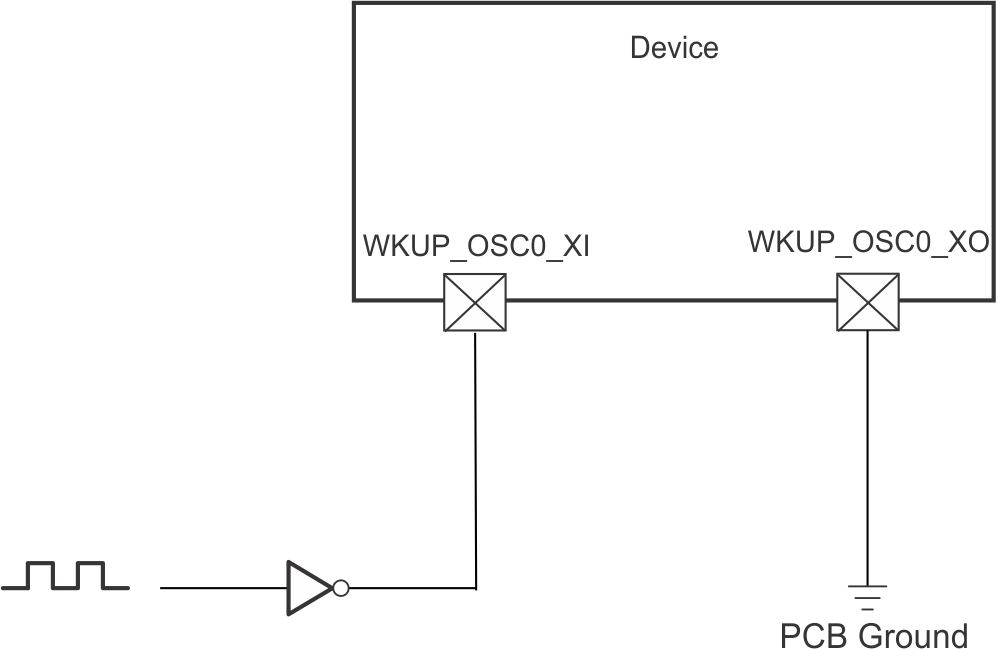 Figure 6-24 1.8V
LVCMOS-Compatible Clock Input
Figure 6-24 1.8V
LVCMOS-Compatible Clock InputTable 6-20 WKUP_OSC0 LVCMOS Digital Clock Source
Requirements
| PARAMETER | MIN | TYP | MAX | UNIT | |||
|---|---|---|---|---|---|---|---|
| Fxtal | Frequency | 25 | MHz | ||||
| Frequency Stability and Tolerance | Ethernet RGMII and RMII not used | ±100 | ppm | ||||
| Ethernet RGMII and RMII using derived clock | ±50 | ||||||
| DC | Duty Cycle | 45 | 55 | % | |||
| tR/F | Rise/Fall Time (10%-90% rise, 90%-10% fall) | 4(1) | ns | ||||
| JPeriod(RMS) | Period Jitter, RMS (100k samples) | 20 | ps | ||||
| JPeriod(PK-PK) | Period Jitter, Peak to Peak (100k samples) | 300 | ps | ||||
| JPhase(RMS) | Phase Jitter, RMS (BW 100Hz to 1MHz) | 10(2) | ps | ||||
(1) Most LVCMOS oscillator datasheets define
their maximum Output Rise/Fall times with a capacitive load much larger than the actual
load that will be applied by the combined PCB trace capacitance and WKUP_OSC0_XI input
capacitance. It should not be difficult to find a LVCMOS oscillator that meets this
requirement. However, the system designer must confirm the LVCMOS oscillator selected will
provide the appropriate rise/fall time to WKUP_OSC0_XI input.
(2) Most LVCMOS oscillator datasheets define
their max RMS Phase Jitter using a larger bandwidth integration range than required by
this device. To get a more appropriate value, it may be necessary to contact the LVCMOS
oscillator manufacture and ask them to provide a maximum RMS Phase Jitter using the same
bandwidth integration range that has been defined for this parameter.