SPRSPA1B March 2025 – November 2025 AM62L
PRODUCTION DATA
- 1
- 1 Features
- 2 Applications
- 3 Description
- 4 Device Comparison
-
5 Terminal Configuration and Functions
- 5.1 Pin Diagrams
- 5.2 Pin Attributes
- 5.3
Signal Descriptions
- 14
- 5.3.1 ADC
- 5.3.2 CPSW3G
- 5.3.3 CPTS
- 5.3.4 DDRSS
- 5.3.5 DSI
- 5.3.6 DSS
- 5.3.7 ECAP
- 5.3.8 Emulation and Debug
- 5.3.9 EPWM
- 5.3.10 EQEP
- 5.3.11 GPIO
- 5.3.12 GPMC
- 5.3.13 I2C
- 5.3.14 MCAN
- 5.3.15 MCASP
- 5.3.16 MCSPI
- 5.3.17 MDIO
- 5.3.18 MMC
- 5.3.19 OSPI
- 5.3.20 Power Supply
- 5.3.21 Reserved
- 5.3.22 System and Miscellaneous
- 5.3.23 TIMER
- 5.3.24 UART
- 5.3.25 USB
- 5.4 Pin Connectivity Requirements
-
6 Specifications
- 6.1 Absolute Maximum Ratings
- 6.2 ESD Ratings
- 6.3 Power-On Hours (POH)
- 6.4 Recommended Operating Conditions
- 6.5 Operating Performance Points
- 6.6 Power Consumption Summary
- 6.7
Electrical
Characteristics
- 6.7.1 I2C Open-Drain, and Fail-Safe (I2C OD FS) Electrical Characteristics
- 6.7.2 Fail-Safe Reset (FS RESET) Electrical Characteristics
- 6.7.3 High-Frequency Oscillator (HFOSC) Electrical Characteristics
- 6.7.4 Low-Frequency Oscillator (LFXOSC) Electrical Characteristics
- 6.7.5 SDIO Electrical Characteristics
- 6.7.6 LVCMOS Electrical Characteristics
- 6.7.7 1P8-LVCMOS Electrical Characteristics
- 6.7.8 RTC-LVCMOS Electrical Characteristics
- 6.7.9 ADC Electrical Characteristics
- 6.7.10 DSI (D-PHY) Electrical Characteristics
- 6.7.11 USB2PHY Electrical Characteristics
- 6.7.12 DDR Electrical Characteristics
- 6.8 VPP Specifications for One-Time Programmable (OTP) eFuses
- 6.9 Thermal Resistance Characteristics
- 6.10 Temperature Sensor Characteristics
- 6.11
Timing and Switching Characteristics
- 6.11.1 Timing Parameters and Information
- 6.11.2 Power Supply Requirements
- 6.11.3 System Timing
- 6.11.4 Clock Specifications
- 6.11.5
Peripherals
- 6.11.5.1 CPSW3G
- 6.11.5.2 CPTS
- 6.11.5.3 DDRSS
- 6.11.5.4 DSI
- 6.11.5.5 DSS
- 6.11.5.6 ECAP
- 6.11.5.7 Emulation and Debug
- 6.11.5.8 EPWM
- 6.11.5.9 EQEP
- 6.11.5.10 GPIO
- 6.11.5.11 GPMC
- 6.11.5.12 I2C
- 6.11.5.13 MCAN
- 6.11.5.14 MCASP
- 6.11.5.15 MCSPI
- 6.11.5.16
MMCSD
- 6.11.5.16.1
MMC0 - eMMC/SD/SDIO Interface
- 6.11.5.16.1.1 Legacy SDR Mode
- 6.11.5.16.1.2 High Speed SDR Mode
- 6.11.5.16.1.3 High Speed DDR Mode
- 6.11.5.16.1.4 HS200 Mode
- 6.11.5.16.1.5 Default Speed Mode
- 6.11.5.16.1.6 High Speed Mode
- 6.11.5.16.1.7 UHS–I SDR12 Mode
- 6.11.5.16.1.8 UHS–I SDR25 Mode
- 6.11.5.16.1.9 UHS–I SDR50 Mode
- 6.11.5.16.1.10 UHS–I DDR50 Mode
- 6.11.5.16.1.11 UHS–I SDR104 Mode
- 6.11.5.16.2 MMC1/MMC2 - SD/SDIO Interface
- 6.11.5.16.1
MMC0 - eMMC/SD/SDIO Interface
- 6.11.5.17 OSPI
- 6.11.5.18 Timers
- 6.11.5.19 UART
- 6.11.5.20 USB
-
7 Detailed Description
- 7.1 Overview
- 7.2 Processor Subsystem
- 7.3 Other Subsystem
- 7.4
Peripherals
- 7.4.1 ADC
- 7.4.2 Gigabit Ethernet Switch (CPSW3G)
- 7.4.3 DDR Subsystem (DDRSS)
- 7.4.4 Display Subsystem (DSS)
- 7.4.5 Enhanced Capture (ECAP)
- 7.4.6 Error Location Module (ELM)
- 7.4.7 Enhanced Pulse Width Modulation (EPWM)
- 7.4.8 Enhanced Quadrature Encoder Pulse (EQEP)
- 7.4.9 General-Purpose Interface (GPIO)
- 7.4.10 General-Purpose Memory Controller (GPMC)
- 7.4.11 Global Timebase Counter (GTC)
- 7.4.12 Inter-Integrated Circuit (I2C)
- 7.4.13 Modular Controller Area Network (MCAN)
- 7.4.14 Multichannel Audio Serial Port (MCASP)
- 7.4.15 Multichannel Serial Peripheral Interface (MCSPI)
- 7.4.16 Multi-Media Card Secure Digital (MMCSD)
- 7.4.17 Octal Serial Peripheral Interface (OSPI)
- 7.4.18 Timers
- 7.4.19 Real-Time Clock (RTC)
- 7.4.20 Universal Asynchronous Receiver/Transmitter (UART)
- 7.4.21 Universal Serial Bus Subsystem (USBSS)
-
8 Applications, Implementation, and Layout
- 8.1 Device Connection and Layout Fundamentals
- 8.2 Peripheral- and Interface-Specific Design Information
- 8.3 Clock Routing Guidelines
- 9 Device and Documentation Support
- Revision History
- 10Mechanical, Packaging, and Orderable Information
Package Options
Refer to the PDF data sheet for device specific package drawings
Mechanical Data (Package|Pins)
- ANB|373
Thermal pad, mechanical data (Package|Pins)
Orderable Information
6.11.2.2.2 RTC Only Low-Power Mode Sequencing
Table 6-7, Figure 6-7, Figure 6-8, and Figure 6-9 define device power requirements when using RTC Only low-power mode.
Table 6-6 RTC
Only Low-Power Mode Sequencing – Supply / Signal
Assignments See: Figure 6-7, Figure 6-8, and Figure 6-9
| WAVEFORM | SUPPLY / SIGNAL NAME |
|---|---|
| A | System power |
| B | VDDS_RTC(1) |
| C | VDD_RTC(2) |
| D | PMIC_LPM_EN0(3) |
| E | RTC_PORz(4) |
| F | VDDSHV0(5), VDDSHV1(5), VDDA_3P3_USB |
| G | VDDSHV0(6), VDDSHV1(6), VDDS_OSC0, VDDA_PLL0, VDDA_PLL1, VDDS_WKUP, VDDS0, VDDS1, VDDA_ADC, VDDA_1P8_DSI, VDDA_1P8_USB |
| H | VDDA_3P3_SDIO(7)(8), VDDSHV2(7), VDDSHV3(7), VDDSHV4(7) |
| I | VDDS_DDR(9) |
| J | VDD_CORE(10), VDDA_CORE_DSI(11), VDDA_CORE_DSI_CLK(11), VDDA_CORE_USB(11), VDDA_DDR_PLL0(11) |
| K | WKUP_OSC0_XI, WKUP_OSC0_XO |
| L | PORz |
(1) VDDS_RTC must be sourced from an always on
power source when using RTC Only low-power
mode.
(2) VDD_RTC must be sourced from an always on
power source when using RTC Only low-power
mode.
(3) PMIC_LPM_EN0 is pulled high with a weak
internal pull-up while RTC_PORz is asserted. The
weak internal pull-up is turned off and
PMIC_LPM_EN0 is driven high on the rising edge of
RTC_PORz. The RTC module can be configured to
drive PMIC_LPM_EN0 low to enter RTC Only low-power
mode and drive PMIC_LPM_EN0 high to exit RTC Only
low-power mode, such that PMIC_LPM_EN0 can be used
to cycle power on/off to all non-RTC power
rails.
(4) RTC_PORz can be released once the VDDS_RTC and
VDD_RTC power rails are valid.
(5) VDDSHV0 and VDDSHV1 are dual voltage IO supplies which can be operated at 1.8V or 3.3V
depending on the application requirements. When any of the VDDSHVx [x=0-1] IO supplies are
operating at 3.3V, they shall be ramped down with other 3.3V supplies during the 3.3V ramp
period defined by this waveform.
(6) VDDSHV0 and VDDSHV1 are dual voltage IO supplies which can be operated at 1.8V or 3.3V
depending on the application requirements. When any of the VDDSHVx [x=0-1] IO supplies are
operating at 1.8V, they shall be ramped down with other 1.8V supplies during the 1.8V ramp
period defined by this waveform.
(7) VDDA_3P3_SDIO was designed to support power-up or power-down without any dependency on
other power rails. VDDSHV2, VDDSHV3, and VDDSHV4 were designed to support power-up,
power-down, or dynamic voltage change without any dependency on other power rails. This
capability is required to support UHS-I SD Cards.
(8) VDDA_3P3_SDIO is the 3.3V power rail for
the internal SDIO_LDO. This power rail must be sourced from the same 3.3V power supply
that provides power to a UHS-I SD Card connected to MMC1, which allows the MMC1 IOs and
the SD Card IOs to power-up and power-down at the same time when the SD Card power supply
is powered off to reset the SD Card. For this use case the SDIO_LDO output
(CAP_VDDSHV_MMC) is used to power the VDDSHV3 IO power rail, which will ramp-up and
ramp-down along with the VDDA_3P3_SDIO power rail.
(9) VDDS_DDR does not have any specific power
sequence requirement, but the JEDEC standard for DDR devices requires the potential
applied to its VDD1 power rail to always be greater than the potential applied
to its VDD2 power rail during the power-up and power-down sequences.
(10) The potential applied to VDD_CORE must
never be greater than the potential applied to VDD_RTC + 0.18V during power-up or
power-down. This requires VDD_RTC to ramp up before and ramp down after VDD_CORE.
(11) VDDA_CORE_DSI, VDDA_CORE_DSI_CLK, VDDA_CORE_USB, and VDDA_DDR_PLL0 shall be sourced from
the same power source as VDD_CORE. Care should be taken to ensure that voltage
differential between VDD_CORE and VDDA_CORE_USB is within +/- 1%.
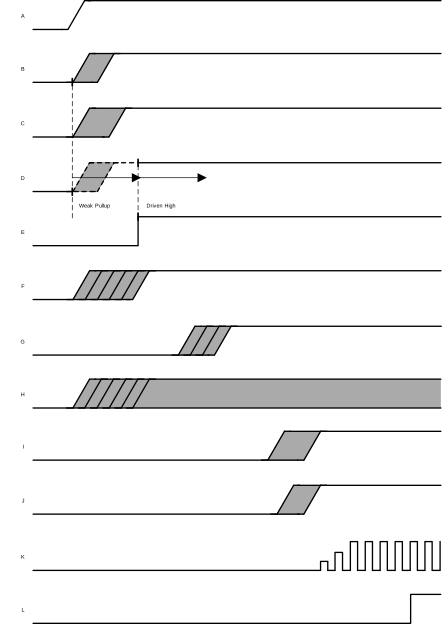 Figure 6-7 RTC Only
Low-Power Mode Power-Up Sequencing
Figure 6-7 RTC Only
Low-Power Mode Power-Up Sequencing Figure 6-8 RTC Only
Low-Power Mode Enter/Exit Sequencing
Figure 6-8 RTC Only
Low-Power Mode Enter/Exit Sequencing Figure 6-9 RTC Only
Low-Power Mode Power-Down Sequencing
Figure 6-9 RTC Only
Low-Power Mode Power-Down Sequencing