TIDUA05B June   2015  – March 2025


  1.   1
  2.   Description
  3.   Resources
  4.   Features
  5.   Applications
  6.   6
  7. System Description
    1. 1.1 Design Overview
    2. 1.2 Analog Sin/Cos Incremental Encoder
      1. 1.2.1 Sin/Cos Encoder Output Signals
      2. 1.2.2 Sin/Cos Encoder Electrical Parameter Examples
    3. 1.3 Method to Calculate High-Resolution Position With Sin/Cos Encoders
      1. 1.3.1 Theoretical Approach
        1. 1.3.1.1 Overview
        2. 1.3.1.2 Coarse Resolution Angle Calculation
        3. 1.3.1.3 Fine Resolution Angle Calculation
        4. 1.3.1.4 Interpolated High-Resolution Angle Calculation
        5. 1.3.1.5 Practical Implementaion for Non-Ideal Synchronization
        6. 1.3.1.6 Resolution, Accuracy, and Speed Considerations
    4. 1.4 Sin/Cos Encoder Parameters Impact on Analog Circuit Specification
      1. 1.4.1 Analog Signal Chain Design Consideration for Phase Interpolation
      2. 1.4.2 Comparator Function System Design for Incremental Count
  8. Design Features
    1. 2.1 Sin/Cos Encoder Interface
    2. 2.2 Host Processor Interface
    3. 2.3 Evaluation Firmware
    4. 2.4 Power Management
    5. 2.5 EMC Immunity
  9. Block Diagram
  10. Circuit Design and Component Selection
    1. 4.1 Analog Signal Chain
      1. 4.1.1 High-Resolution Signal Path With 16-Bit Dual Sampling ADC
        1. 4.1.1.1 Component Selection
        2. 4.1.1.2 Input Signal Termination and Protection
        3. 4.1.1.3 Differential Amplifier THS4531A and 16-Bit ADC ADS8354
      2. 4.1.2 Analog Signal Path With Single-Ended Output for MCU With Embedded ADC
      3. 4.1.3 Comparator Subsystem for Digital Signals A, B, and R
        1. 4.1.3.1 Non-Inverting Comparator With Hysteresis
    2. 4.2 Power Management
      1. 4.2.1 24-V Input to 6-V Intermediate Rail
      2. 4.2.2 Encoder Supply
      3. 4.2.3 Signal Chain Power Supply 5 V and 3.3 V
    3. 4.3 Host Processor Interface
      1. 4.3.1 Signal Description
      2. 4.3.2 High-Resolution Path Using 16-Bit Dual ADC ADS8354 With Serial Output
        1. 4.3.2.1 ADS8354 Input Full Scale Range Output Data Format
        2. 4.3.2.2 ADS8354 Serial Interface
        3. 4.3.2.3 ADS8354 Conversion Data Read
        4. 4.3.2.4 ADS8354 Register Configuration
    4. 4.4 Encoder Connector
    5. 4.5 Design Upgrades
  11. Software Design
    1. 5.1 Overview
    2. 5.2 C2000 Piccolo Firmware
    3. 5.3 User Interface
  12. Getting Started
    1. 6.1 TIDA-00176 PCB Overview
    2. 6.2 Connectors and Jumper Settings
      1. 6.2.1 Connector and Jumpers Overview
      2. 6.2.2 Default Jumper Configuration
    3. 6.3 Design Evaluation
      1. 6.3.1 Prerequisites
      2. 6.3.2 Hardware Setup
      3. 6.3.3 Software Setup
      4. 6.3.4 User Interface
  13. Test Results
    1. 7.1 Analog Performance Tests
      1. 7.1.1 High-Resolution Signal Path
        1. 7.1.1.1 Bode Plot of Analog Path from Encoder Connector to ADS8354 Input
        2. 7.1.1.2 Performance Plots (DFT) for Entire High-Resulation Signal Path
        3. 7.1.1.3 Background on AC Performance Definitions With ADCs
      2. 7.1.2 Differential to Single-Ended Analog Signal Path
      3. 7.1.3 Comparator Subsystem With Digital Output Signals ATTL, BTTL, and RTTL
    2. 7.2 Power Supply Tests
      1. 7.2.1 24-V DC/DC Input Supply
        1. 7.2.1.1 Load-Line Regulation
        2. 7.2.1.2 Output Voltage Ripple
        3. 7.2.1.3 Switching Node and Switching Frequency
        4. 7.2.1.4 Efficiency
        5. 7.2.1.5 Bode Plot
        6. 7.2.1.6 Thermal Plot
      2. 7.2.2 Encoder Power Supply Output Voltage
      3. 7.2.3 5-V and 3.3-V Point-of-Load
    3. 7.3 System Performance
      1. 7.3.1 Sin/Cos Encoder Output Signal Emulation
        1. 7.3.1.1 One Period (Incremental Phase) Test
        2. 7.3.1.2 One Mechanical Revolution Test at Maximum Speed
    4. 7.4 Sin/Cos Encoder System Tests
      1. 7.4.1 Zero Index Marker R
      2. 7.4.2 Functional System Tests
    5. 7.5 EMC Test Result
      1. 7.5.1 Test Setup
      2. 7.5.2 IEC-61000-4-2 ESD Test Results
      3. 7.5.3 IEC-61000-4-4 EFT Test Results
      4. 7.5.4 IEC-61000-4-5 Surge Test Results
  14. Design Files
    1. 8.1 Schematics
    2. 8.2 Bill of Materials
    3. 8.3 PCB Layout Guidelines
      1. 8.3.1 PCB Layer Plots
    4. 8.4 Altium Project
    5. 8.5 Gerber Files
    6. 8.6 Software Files
  15. References
  16. 10About the Author
    1.     Recognition
  17. 11Revision History

Functional System Tests

The following static angle tests have been done with a ROD480-1024 Sin/Cos Encoder at 1-m and 71-m cable length. Total accuracy measurements with a precision better than 0.003 degrees (10 arc seconds) were not possible due to a lack of a mechanical precise enough encoder test bench. A picture of the test setup is shown in Figure 7-33.

TIDA-00176 TIDA-00176 Test Setup with 70-m Cable (20 m + 50 m) and ROD4800-1024 Sin/Cos
                    Encoder Figure 7-33 TIDA-00176 Test Setup with 70-m Cable (20 m + 50 m) and ROD4800-1024 Sin/Cos Encoder

Figure 7-34 and Figure 7-35 show the measured angle with the ROD480-1024 (1024 line count) over time for a static angle at the 1-m and 70-m cable lengths accordingly. The shaft was not fixed.

Note that the absolute angle for the 1-m and 71-m measurement slightly changed due mechanical vibrations when unscrewing the 1-m cable from the encoder and mounting the 70-m cable instead.

TIDA-00176 System Test, Measured Angle Distribution With ROD480-1024 at 1-m Cable
                        LengthFigure 7-34 System Test, Measured Angle Distribution With ROD480-1024 at 1-m Cable Length
TIDA-00176 System Test, Measured Angle Distribution With ROD480-1024 at 71-m Cable
                        LengthFigure 7-35 System Test, Measured Angle Distribution With ROD480-1024 at 71-m Cable Length

The measured angle with the ROD480-1024 has a noise distribution of ±0.0001 degree (0.36 arc seconds). There is no significant difference between the 1-m and 70-m measurements because the attenuation of the cable was around –1.5 dB at 0 Hz.

To verify the basic accuracy and repeatability of the TIDA-00176 design with a Sin/Cos encoder, the ROD480-1024 Sin/Cos encoder is mechanically coupled with an EnDat 2.2 encoder ROQ437. The ROD480-1024 is connected through a 70-m cable. A picture of the test setup is shown in Figure 7-37.

Figure 7-36 shows the angle difference between the TIDA-00176 connected to a ROD480-1024 Sin/Cos encoder and a ROQ437 EnDat 2.2 absolute encoder, where the absolute angle is read through a Sitara AM437x EnDat 2.2 Master. The absolute angle exhibits a cosine-shape error, which is due to a non-ideal, non-centric coupling of the two shafts with a small run-out.

The encoder was turned multiple times and the angle was captured accordingly to check repeatability too.

As expected, however, the mechanical setup was not accurate and precise enough to draw conclusions on the overall absolute system accuracy. Therefore, the tests conducted in Section 7.3 based on Encoder emulation are more representative to the performance to be expected from the TIDA-00176 reference design.
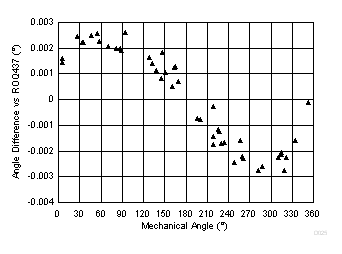
TIDA-00176 Basic System Accuracy Test With Sin/Cos Encoder at 70-m Cable LengthFigure 7-36 Basic System Accuracy Test With Sin/Cos Encoder at 70-m Cable Length