TIDUA05B June 2015 – March 2025
- 1
- Description
- Resources
- Features
- Applications
- 6
- 1 System Description
- 2 Design Features
- 3 Block Diagram
-
4 Circuit Design and Component Selection
- 4.1 Analog Signal Chain
- 4.2 Power Management
- 4.3 Host Processor Interface
- 4.4 Encoder Connector
- 4.5 Design Upgrades
- 5 Software Design
- 6 Getting Started
- 7 Test Results
- 8 Design Files
- 9 References
- 10About the Author
- 11Revision History
7.1.3 Comparator Subsystem With Digital Output Signals ATTL, BTTL, and RTTL
In this section, the performance of the comparator with hysteresis that converts the single-ended analog signals A, B, and R into digital signals was tested.
The focus was on the propagation delay of the comparator output signals ATTL, BTTL, and RTTL at the host connector J6 versus the analog input at the ADS8354 for the high-resolution path as well as the single-ended analog signals for the analog path.
The aim of the test was to measure the overall signal delay of the comparator path versus the analog path, considering the delays introduced by hysteresis, phase shift due to low-pass filtering and the propagation delay of the comparator itself.
Since all three channels A, B, and R were done absolutely symmetrical with regards to the comparator output, measurements have only been conducted with channel A.
The analog signals were both measured with a single-ended probe, hence on the differential input of the ADS8354 only the positive differential signal was measured versus GND.
For the test sinusoidal input signals were injected at the encoder connector J9, A_P, A_M (sine) and B_P, B_M (cosine) as well as P_M and R_P.
For the high-resolution path, the amplitude was set to 1.0 VPP (typical) and 0.3 VPP (minimum) with 100 Hz and 500 kHz (maximum) to test the worst case scenario for the propagation delay. For analog path, the measurement was conducted at 0.3 VPP with 100 Hz and 500 kHz, as corner cases.
Test results are shown in the following figures. Note that both, the high-resolution path (at the differential input of the ADS8354) and the single-ended analog path (at connector J6.Pin 12) are compared versus the comparator output (at connector J6.Pin 18).
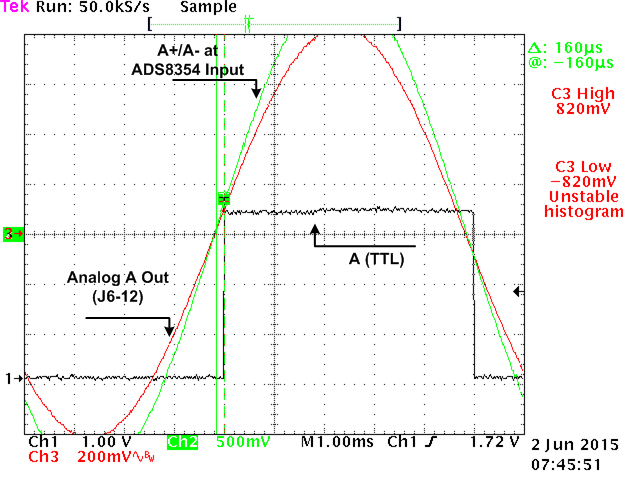 Figure 7-13 Comparator Output ATTL versus Differential Input to ADS8354 and Analog Output A (J6-12) With Input 1.0 VPP, 100 Hz at Encoder Connector J9-1, J9-2
 Figure 7-15 Comparator Output ATTL versus Differential Input to ADS8354 and Analog Output A (J6-12) With Input 1.0 VPP, 500-kHz Encoder Connector J9-1, J9-2
 Figure 7-14 Comparator Output ATTL versus Differential Input to ADS8354 and Analog Output A (J6-12) With Input 0.3 VPP, 100 Hz at Encoder Connector J9-1, J9-2
 Figure 7-16 Comparator Output ATTL versus Differential Input to ADS8354 and Analog Output A (J6-12) With Input 0.3 VPP, 500 kHz at Encoder Connector J9-1, J9-2
As expected, the maximum overall phase shift including RC filter decoupling networks occurs at 500 kHz with the lowest input amplitude and is total around 320 ns, equal to 57 degrees, which is well below 90 degree and within the 60 degree the specification per Section 2. The very low propagation delay of the TLV3201 with typically 40 ns has a major impact on this low number. This also gives a major margin to compensate all the possible spreads in the parameters influencing the amount of phase delay like due to low-pass filters, and so on.
The propagation delay at 100 Hz is almost the same than for the high-resolution channel because the delay at lower frequencies is dominated by the amplitude-dependent hysteresis.
On the single-ended analog path, there’s almost no delay at 500 kHz despite a 250-ns propagation delay of the comparator with hysteresis itself. This is due to the strong low-pass filter at the single-ended analog output (R = 100 Ω, C = 4.7 nF) to drive an embedded switched capacitor ADC like in the Piccolo MCU. This frequency depended phase delay slightly compensates the delay from the comparator at higher frequencies.
In a second step, only the delay related to the comparator with hysteresis was measured. The delay was specified as the input to the comparator (analog signal at R50) and the output of the comparator. Note that 0.3 VPP at the encoder input equals around 0.5 VPP at the comparator input due to the previous amplifier stage with gain of 1.66.
The delay introduced by the comparator block only (hysteresis and comparator propagation delay) has been measured and is listed in Table 7-3.
| INPUT AT ENCODER CONNECTOR | VOLTAGE AT COMPARATOR INPUT (FOR EXAMPLE, R50) | PROPAGATION DELAY | PHASE DELAY |
|---|---|---|---|
| 1.0 VPP, 100 Hz | 1.66 V | 170 µs | 6.1 degrees |
| 0.3 VPP, 100 Hz | 0.5 V | 560 µs | 20.1 degrees |
| 1.0 VPP, 500 kHz | 1.52 V | 120 ns | 21 degrees |
| 0.3 VPP, 500 kHz | 0.46 V | 200 ns | 36 degrees |
The difference to the overall delay in Figure 7-13 to Figure 7-16 is to the low-pass noise filter in the analog path, which contributes to around further 22 degrees at 500 kHz for the high-resolution signal path. However, the delay is still well below 90 degrees.
If an ideal phase matching is desired, a corresponding low-pass filter can be implemented with the THS4531A as outlined in Section 4.5.