SLAU847E October 2022 – May 2025 MSPM0L1105 , MSPM0L1106 , MSPM0L1116 , MSPM0L1117 , MSPM0L1227 , MSPM0L1227-Q1 , MSPM0L1228 , MSPM0L1228-Q1 , MSPM0L1303 , MSPM0L1304 , MSPM0L1304-Q1 , MSPM0L1305 , MSPM0L1305-Q1 , MSPM0L1306 , MSPM0L1306-Q1 , MSPM0L1343 , MSPM0L1344 , MSPM0L1345 , MSPM0L1346 , MSPM0L2116 , MSPM0L2117 , MSPM0L2227 , MSPM0L2227-Q1 , MSPM0L2228 , MSPM0L2228-Q1
- 1
- Read This First
-
1 Architecture
- 1.1 Architecture Overview
- 1.2 Bus Organization
- 1.3 Platform Memory Map
- 1.4
Boot Configuration
- 1.4.1 Configuration Memory (NONMAIN)
- 1.4.2 Boot Configuration Routine (BCR)
- 1.4.3 Bootstrap Loader (BSL)
- 1.4.4 NONMAIN Layout Types
- 1.4.5 NONMAIN_TYPEA Registers
- 1.4.6 NONMAIN_TYPEC Registers
- 1.4.7 NONMAIN_TYPEE Registers
- 1.5 Factory Constants
-
2 PMCU
- 2.1 PMCU Overview
- 2.2 Power Management (PMU)
- 2.3
Clock Module (CKM)
- 2.3.1 Oscillators
- 2.3.2
Clocks
- 2.3.2.1 MCLK (Main Clock) Tree
- 2.3.2.2 CPUCLK (Processor Clock)
- 2.3.2.3 ULPCLK (Low-Power Clock)
- 2.3.2.4 MFCLK (Middle Frequency Clock)
- 2.3.2.5 MFPCLK (Middle Frequency Precision Clock)
- 2.3.2.6 LFCLK (Low-Frequency Clock)
- 2.3.2.7 HFCLK (High-Frequency External Clock)
- 2.3.2.8 HSCLK (High Speed Clock)
- 2.3.2.9 ADCCLK (ADC Sample Period Clock)
- 2.3.2.10 RTCCLK (RTC Clock)
- 2.3.2.11 External Clock Output (CLK_OUT)
- 2.3.2.12 Direct Clock Connections for Infrastructure
- 2.3.3 Clock Tree
- 2.3.4 Clock Monitors
- 2.3.5 Frequency Clock Counter (FCC)
- 2.4
System Controller (SYSCTL)
- 2.4.1 Resets and Device Initialization
- 2.4.2 Operating Mode Selection
- 2.4.3 Asynchronous Fast Clock Requests
- 2.4.4 SRAM Write Protection
- 2.4.5 Flash Wait States
- 2.4.6 Flash Bank Address Swap
- 2.4.7 Shutdown Mode Handling (if present)
- 2.4.8 Configuration Lockout
- 2.4.9 System Status
- 2.4.10 Error Handling
- 2.4.11 SYSCTL Events
- 2.5
Quick Start Reference
- 2.5.1 Default Device Configuration
- 2.5.2 Leveraging MFCLK
- 2.5.3 Optimizing Power Consumption in STOP Mode
- 2.5.4 Optimizing Power Consumption in STANDBY Mode
- 2.5.5 Increasing MCLK and ULPCLK Precision
- 2.5.6 High Speed Clock (SYSPLL, HFCLK) Handling in Low-Power Modes
- 2.5.7 Optimizing for Lowest Wakeup Latency
- 2.5.8 Optimizing for Lowest Peak Current in RUN/SLEEP Mode
- 2.6 SYSCTL Layout Types
- 2.7 SYSCTL_TYPEA Registers
- 2.8 SYSCTL_TYPEB Registers
- 2.9 SYSCTL_TYPEC Registers
- 3 CPU
- 4 SECURITY
-
5 DMA
- 5.1 DMA Overview
- 5.2
DMA Operation
- 5.2.1 Addressing Modes
- 5.2.2 Channel Types
- 5.2.3 Transfer Modes
- 5.2.4 Extended Modes
- 5.2.5 Initiating DMA Transfers
- 5.2.6 Stopping DMA Transfers
- 5.2.7 Channel Priorities
- 5.2.8 Burst Block Mode
- 5.2.9 Using DMA with System Interrupts
- 5.2.10 DMA Controller Interrupts
- 5.2.11 DMA Trigger Event Status
- 5.2.12 DMA Operating Mode Support
- 5.2.13 DMA Address and Data Errors
- 5.2.14 Interrupt and Event Support
- 5.3 DMA Registers
-
6 NVM (Flash)
- 6.1 NVM Overview
- 6.2 Flash Memory Bank Organization
- 6.3 Flash Controller
- 6.4 Write Protection
- 6.5 Read Interface
- 6.6 FLASHCTL Registers
- 7 Events
- 8 IOMUX
- 9 GPIO
-
10AESADV
- 10.1 AESADV Overview
- 10.2
AESADV Operation
- 10.2.1 Loading the Key
- 10.2.2 Writing Input Data
- 10.2.3 Reading Output Data
- 10.2.4
Operation Descriptions
- 10.2.4.1 Single Block Operation
- 10.2.4.2 Electronic Codebook (ECB) Mode
- 10.2.4.3 Cipher Block Chaining (CBC) Mode
- 10.2.4.4 Output Feedback (OFB) Mode
- 10.2.4.5 Cipher Feedback (CFB) Mode
- 10.2.4.6 Counter (CTR) Mode
- 10.2.4.7 Galois Counter (GCM) Mode
- 10.2.4.8 Counter With Cipher Block Chaining Message Authentication Code (CCM)
- 10.2.5 AES Events
- 10.3 AESADV Registers
- 11CRC
- 12Keystore
- 13TRNG
- 14Temperature Sensor
-
15ADC
- 15.1 ADC Overview
- 15.2
ADC Operation
- 15.2.1 ADC Core
- 15.2.2 Voltage Reference Options
- 15.2.3 Generic Resolution Modes
- 15.2.4 Hardware Averaging
- 15.2.5 ADC Clocking
- 15.2.6 Common ADC Use Cases
- 15.2.7 Power Down Behavior
- 15.2.8 Sampling Trigger Sources and Sampling Modes
- 15.2.9 Sampling Period
- 15.2.10 Conversion Modes
- 15.2.11 Data Format
- 15.2.12 Advanced Features
- 15.2.13 Status Register
- 15.2.14 ADC Events
- 15.3 ADC12 Registers
-
16COMP
- 16.1 Comparator Overview
- 16.2 Comparator Operation
- 16.3 COMP Registers
- 17OPA
- 18GPAMP
- 19VREF
-
20LCD
- 20.1 LCD Introduction
- 20.2 LCD Clocking
- 20.3
Voltage Generation
- 20.3.1 Mode 0 - Voltage Generation from external reference and external resistor divider
- 20.3.2 Mode 1 - Voltage Generation from AVDD and external resistor divider
- 20.3.3 Mode 2 - Voltage Generation from external reference and internal resistor divider
- 20.3.4 Mode 3 - Voltage Generation From AVDD and Internal Resistor Ladder
- 20.3.5 Mode 4 - Voltage Generation from charge pump with external supply
- 20.3.6 Mode 5 - Voltage Generation From Charge Pump With AVDD
- 20.3.7 Mode 6 - Voltage Generation From Charge Pump With External Reference on R13
- 20.3.8 Mode 7 - Voltage Generation From Charge Pump With Internal Reference on R13
- 20.3.9 Charge pump
- 20.3.10 Internal Reference Generation
- 20.4 Analog Mux
- 20.5 LCD Memory and output drive
- 20.6 IO Muxing
- 20.7 Interrupt Generation
- 20.8 Power Domains and Power Modes
- 20.9 LCD Registers
-
21UART
- 21.1 UART Overview
- 21.2
UART Operation
- 21.2.1 Clock Control
- 21.2.2 Signal Descriptions
- 21.2.3
General Architecture and Protocol
- 21.2.3.1 Transmit Receive Logic
- 21.2.3.2 Bit Sampling
- 21.2.3.3 Majority Voting Feature
- 21.2.3.4 Baud Rate Generation
- 21.2.3.5 Data Transmission
- 21.2.3.6 Error and Status
- 21.2.3.7 Local Interconnect Network (LIN) Support
- 21.2.3.8 Flow Control
- 21.2.3.9 Idle-Line Multiprocessor
- 21.2.3.10 9-Bit UART Mode
- 21.2.3.11 RS485 Support
- 21.2.3.12 DALI Protocol
- 21.2.3.13 Manchester Encoding and Decoding
- 21.2.3.14 IrDA Encoding and Decoding
- 21.2.3.15 ISO7816 Smart Card Support
- 21.2.3.16 Address Detection
- 21.2.3.17 FIFO Operation
- 21.2.3.18 Loopback Operation
- 21.2.3.19 Glitch Suppression
- 21.2.4 Low Power Operation
- 21.2.5 Reset Considerations
- 21.2.6 Initialization
- 21.2.7 Interrupt and Events Support
- 21.2.8 Emulation Modes
- 21.3 UART Registers
-
22I2C
- 22.1 I2C Overview
- 22.2
I2C Operation
- 22.2.1 Clock Control
- 22.2.2 Signal Descriptions
- 22.2.3
General Architecture
- 22.2.3.1 I2C Bus Functional Overview
- 22.2.3.2 START and STOP Conditions
- 22.2.3.3 Data Format with 7-Bit Address
- 22.2.3.4 Acknowledge
- 22.2.3.5 Repeated Start
- 22.2.3.6 SCL Clock Low Timeout
- 22.2.3.7 Clock Stretching
- 22.2.3.8 Dual Address
- 22.2.3.9 Arbitration
- 22.2.3.10 Multiple Controller Mode
- 22.2.3.11 Glitch Suppression
- 22.2.3.12 FIFO operation
- 22.2.3.13 Loopback mode
- 22.2.3.14 Burst Mode
- 22.2.3.15 DMA Operation
- 22.2.3.16 Low-Power Operation
- 22.2.4 Protocol Descriptions
- 22.2.5 Reset Considerations
- 22.2.6 Initialization
- 22.2.7 Interrupt and Events Support
- 22.2.8 Emulation Modes
- 22.3 I2C Registers
-
23SPI
- 23.1 SPI Overview
- 23.2
SPI Operation
- 23.2.1 Clock Control
- 23.2.2 General Architecture
- 23.2.3 Protocol Descriptions
- 23.2.4 Reset Considerations
- 23.2.5 Initialization
- 23.2.6 Interrupt and Events Support
- 23.2.7 Emulation Modes
- 23.3 SPI Registers
-
24Timers (TIMx)
- 24.1 TIMx Overview
- 24.2
TIMx Operation
- 24.2.1 Timer Counter
- 24.2.2 Counting Mode Control
- 24.2.3 Capture/Compare Module
- 24.2.4 Shadow Load and Shadow Compare
- 24.2.5 Output Generator
- 24.2.6 Fault Handler (TIMA only)
- 24.2.7 Synchronization With Cross Trigger
- 24.2.8 Low Power Operation
- 24.2.9 Interrupt and Event Support
- 24.2.10 Debug Handler (TIMA Only)
- 24.3 TIMx Registers
- 25Low Frequency Subsystem (LFSS)
- 26Low Frequency Subsystem (LFSS_B)
-
27RTC
- 27.1 Overview
- 27.2 Basic Operation
- 27.3
Configuration
- 27.3.1 Clocking
- 27.3.2 Reading and Writing to RTC Peripheral Registers
- 27.3.3 Binary vs. BCD
- 27.3.4 Leap Year Handling
- 27.3.5 Calendar Alarm Configuration
- 27.3.6 Interval Alarm Configuration
- 27.3.7 Periodic Alarm Configuration
- 27.3.8 Calibration
- 27.3.9 RTC Prescaler Extension
- 27.3.10 RTC Timestamp Capture
- 27.3.11 RTC Events
- 27.4 RTC Registers
- 28IWDT
- 29WWDT
- 30Debug
- 31Revision History
25.7.2.3 Heartbeat Generator
The heartbeat generator allows the signaling of a certain operating state of LFSS to the outside world. The signal is a repetitive pulse with a configurable interval time and pulse width.
For example, it can be used as a trigger for an external watchdog timer to indicate the RTC is still working. Alternatively, it can be used to flash a LED in a failure scenario as a visual alarm indicator. The interval time and pulse width are selectable to tailor the heartbeat to the intended application. Figure 25-6 shows the circuit diagram of the heartbeat generator.
Selectable interval time: 125ms, 250ms, 500ms, 1s, 2s, 4s, 8s, 16s
Selectable pulse width: 1ms to 128ms in binary steps
Selectable heart beat mode: off, always-on, on with timestamp event, on with main supply fail
The selectable interval time and pulse width are dimensioned to allow the low power operation of an LED in blink/flash mode. For example, an average current load of a 2mA LED with a 1s period and 1ms flash configuration is 2µA.
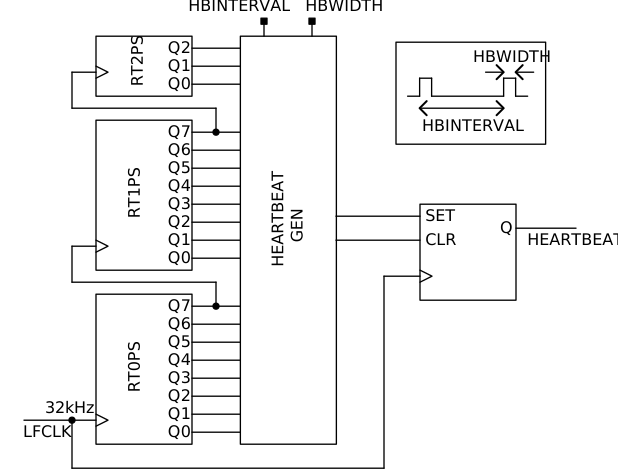 Figure 25-6 Heartbeat Generator Circuit Diagram