SLYY234 December 2024 AMC0106M05 , AMC0106M25 , AMC0136 , AMC0311D , AMC0311S , AMC0386 , AMC0386-Q1 , AMC1100 , AMC1106M05 , AMC1200 , AMC1200-Q1 , AMC1202 , AMC1203 , AMC1204 , AMC1211-Q1 , AMC1300 , AMC1300B-Q1 , AMC1301 , AMC1301-Q1 , AMC1302-Q1 , AMC1303M2510 , AMC1304L25 , AMC1304M25 , AMC1305M25 , AMC1305M25-Q1 , AMC1306M05 , AMC1306M25 , AMC1311 , AMC1311-Q1 , AMC131M03 , AMC1336 , AMC1336-Q1 , AMC1350 , AMC1350-Q1 , AMC23C12 , AMC3301 , AMC3330 , AMC3330-Q1
- 1
- Introduction
- Introduction to Isolated Signal Chain
- Selection Trees
-
Current Sensing
- Shunt Resistor Selection for Isolated Data Converters
- Design considerations for isolated current sensing
- Isolated Current-Sensing Circuit With ±50-mV Input and Single-Ended Output
- Isolated Current-Sensing Circuit With ±50-mV Input and Differential Output
- Isolated Current-Sensing Circuit With ±250-mV Input Range and Single-Ended Output Voltage
- Isolated current-measurement circuit with ±250-mV input and differential output
- Isolated Overcurrent Protection Circuit
- Interfacing a Differential-Output (Isolated) Amp to a Single-Ended Input ADC
- Utilizing AMC3311 to Power AMC23C11 for Isolated Sensing and Fault Detection
- Isolated Current-Sensing Circuit With Front-End Gain Stage
- Accuracy Comparison of Isolated Shunt and Closed-Loop Current Sensing
-
Voltage Sensing
- Maximizing Power Conversion and Motor Control Efficiency With Isolated Voltage Sensing
- Increased Accuracy and Performance with Integrated High Voltage Resistor Isolated Amplifiers and Modulators
- Isolated Amplifiers With Differential, Single-Ended Fixed Gain and Ratiometric Outputs for Voltage Sensing Applications
- Isolated Voltage-Measurement Circuit With ±250-mV Input and Differential Output
- Split-Tap Connection for Line-to-Line Isolated Voltage Measurement Using AMC3330
- ±12V Voltage Sensing Circuit With an Isolated Amplifier and Pseudo-Differential Input SAR ADC
- ±12-V voltage sensing circuit with an isolated amplifier and differential input SAR ADC
- Isolated Undervoltage and Overvoltage Detection Circuit
- Isolated Zero-Cross Detection Circuit
- ±480V Isolated Voltage-Sensing Circuit With Differential Output
-
EMI Performance
- Best in Class Radiated Emissions EMI Performance with Isolated Amplifiers
- Best Practices to Attenuate AMC3301 Family Radiated Emissions EMI
-
End Equipment
- Comparing Shunt- and Hall-Based Isolated Current-Sensing Solutions in HEV/EV
-
Design Considerations for Current Sensing
in DC EV Charging Applications
- Abstract
- Introduction
-
Current Sensing in AC/DC Converters
- Basic Hardware and Control Description of AC/DC
- Point A and B – AC/DC AC Phase-Current Sensing
- Point C and D – AC/DC DC Link Current Sensing
- Summary of Positives and Negatives at Point A, B, C1/2 and D1/2 and Product Suggestions
- Current Sensing in DC/DC Converters
- Conclusion
- References
-
Using isolated comparators for fault
detection in electric motor drives
- Introduction
- Introduction to electric motor drives
- Understanding fault events in electric motor drives
- Achieving reliable detection and protection in electric motor drives
- Use case No. 1: Bidirectional in-phase overcurrent detection
- Use case No. 2: DC+ overcurrent detection
- Use case No. 3: DC– overcurrent or short-circuit detection
- Use case No. 4: DC-link (DC+ to DC–) overvoltage and undervoltage detection
- Use case No. 5: IGBT module overtemperature detection
- Discrete DESAT for Opto-Compatible Isolated Gate Driver UCC23513 in Motor Drives
- Isolated voltage sensing in AC motor drives
- Achieving High-Performance Isolated Current and Voltage Sensing in Server PSUs
-
Additional Reference Designs/Circuits
- Designing a Bootstrap Charge-Pump Power Supply for an Isolated Amplifier
-
Clock Edge Delay Compensation With
Isolated Modulators Digital Interface to MCUs
- Abstract
- Introduction
- Design Challenge With Digital Interface Timing Specifications
- Design Approach With Clock Edge Delay Compensation
- Test and Validation
- Conclusion
- References
- Utilizing AMC3311 to Power AMC23C11 for Isolated Sensing and Fault Detection
Design Challenge With Digital Interface Timing Specifications
Isolated Delta-Sigma modulators offer interface options for both an externally and internally generated clock signal with either a CMOS interface or a LVDS interface. For devices with externally-provided clock source, for example AMC1306M25 with CMOS interface or AMC1305L25 with LVDS interface the clock signal is routed from the MCU to the Delta-Sigma modulator’s clock input, whereas for devices with an internally-provided clock source, the output bit-stream is synchronized to the internally generated clock, for exampleAMC1303M2520. There are also isolated Delta-Sigma modulator devices with Manchester coded output bit stream that support single-wire data and clock transfer, for example AMC1306E25. For all isolated Delta-Sigma modulators, the data output of the modulator provides a bit stream of digital ones and zeros that is shifted out synchronous to the clock edge.
Figure 145 shows a simplified example of CMOS interface with 3.3V I/O between the isolated Delta-Sigma modulator AMC1306M25 and a C2000 MCU TMS320F28379D. As the AMC1306M25 requires an externally-provided clock source, the clock signal is generated by the MCU TMS320F28379D and is provided to the Delta-Sigma modulators clock input, CLKIN. In parallel, the generated clock signal is also routed to the clock input to the MCUs Sigma-Delta Filter Module (SDFM) SD1_C1 (GPIO123). Depending on the system design there can be a clock buffer included in the clock interface between the MCU and the isolated Delta-Sigma modulator. The isolated data output DOUT of the Delta-Sigma modulator is directly connected to the MCUs Sigma-Delta Filter Module (SDFM) data input SD1_D1 (GPIO122).
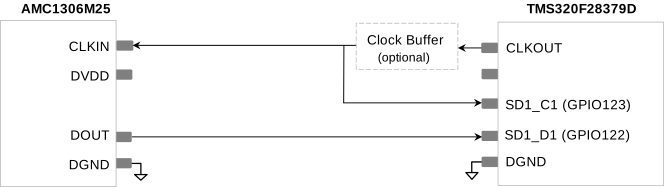 Figure 145 Simplified AMC1306M25 Digital Interface to TMS320F28379D
Valid communication between the isolated Delta-Sigma modulator and the MCU is described in the respective device data sheets by the setup and hold timing requirements. The setup time is the amount of time that the data signal must be valid and stable prior to a clock signal transition to capture the data signal in the MCU. Hold time is the amount of time that a signal must be held valid and stable after a clock signal transition occurs. Meeting the MCUs setup and hold time requirements is crucial as any violation can cause incorrect data to be captured. Incompatibility between the digital interface setup and hold timing requirements of the isolated Delta-Sigma modulator and the MCU can present a design challenge.
Figure 146 outlines the digital interface timing for setup and hold time of the AMC1306x which supports a recommended clock frequency (CLKIN) from 5 MHz to 21 MHz with a data hold time th(MIN) = 3.5 ns and a data delay time td (MAX) = 15 ns.
 Figure 146 AMC1306x Digital Interface Timing
Figure 147 outlines the timing diagram, of the TMS320F28379D Sigma-Delta Filter Module (SDFM) for Mode 0. The data input at SDx_Dy needs to meet the minimum setup time tsu(SDDV-SDCH)M0 and minimum hold time th(SDCH-SDD)M0 with reference to the rising clock edge of the SDx_Cy signal in the SDFM module.
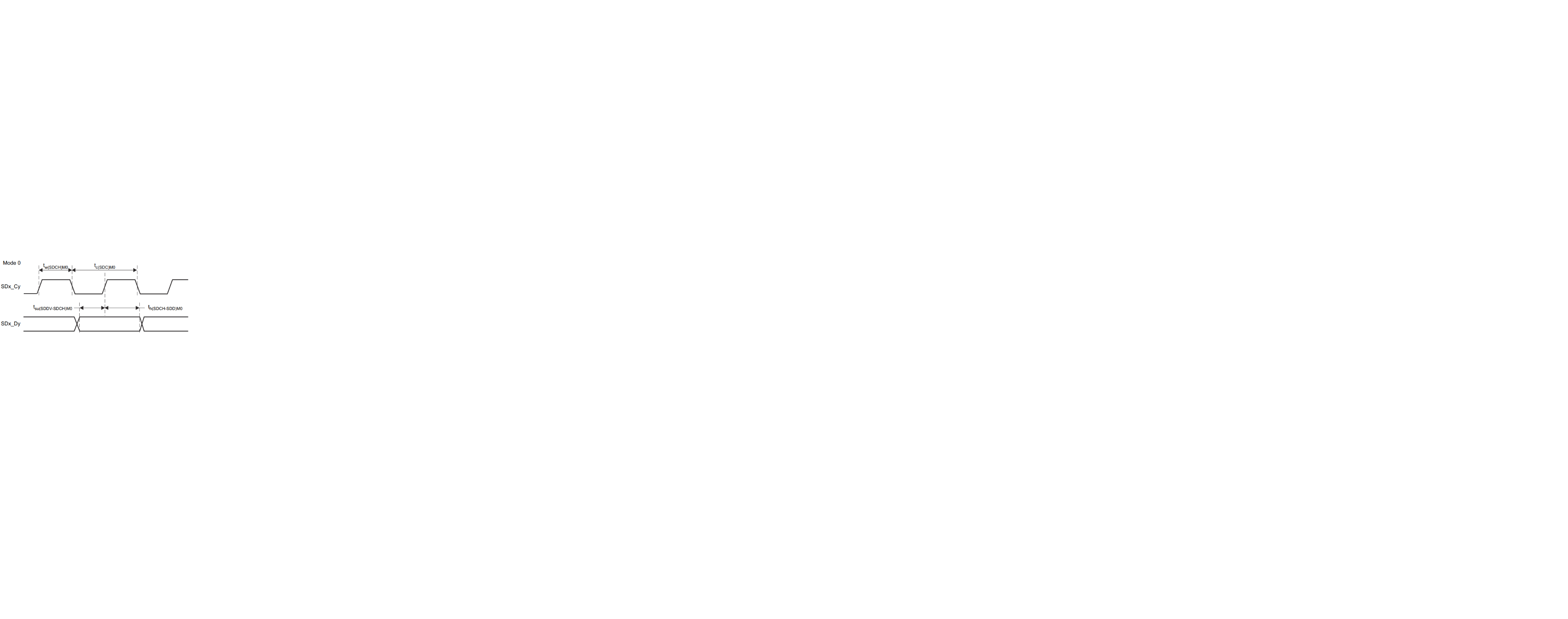 Figure 147 TMS320F28379D SDFM Timing Diagram – Mode 0
For the TMS320F28379D SDFM module in Mode 0, we recommend to use the SDFM operation with qualified GPIO (3-sample window). This mode provides protection against random noise glitches with the input clock signal (SDx_Cy) and data input (SDx_Dy) to avoid false comparator over-current trip and false Sinc filter output. The minimum setup and hold times for a 200 MHz system clock with TMD320F28379D are both 10 ns: tsu (SDDV-SDCH)M0 (MIN) = 10 ns and th(SDCH-SDD)M0 (MIN) = 10 ns.
This creates a design challenge as the AMC1306M25 minimum hold time th(MIN) is 3.5 ns, but 10 ns is required for the SDFM module to maintain correct acquisition at the data input SDx_Dy with reference to the rising clock edge of the SDx_Cy signal.
An additional challenge is that the propagation delay of additional components in the signal chain with the digital interface such as a clock buffer as well as the propagation delay of the clock and data signals introduced by the trace length on the PCB have an impact on the timings between SDx_Cy and SDx_Dy inputs and complicate the correct acquisition timing of the data input.
The same applies to Delta-Sigma modulators with a LVDS interface, such as the AMC1305L25. The only difference to AMC1306M25 Delta-Sigma modulators with CMOS interface type is that additional components like a LVDS driver and receiver are required with the digital signal chain to a MCU with CMOS interface, which contribute to further propagation delays. Figure 148 shows a simplified digital interface between the isolated Delta-Sigma modulator AMC1305L25 with LVDS interface and the MCU TMS320F28379D with CMOS interface.
 Figure 148 AMC1305L25 Digital Interface to TMS320F28379D
Figure 149 shows a simplified digital interface of an isolated Delta-Sigma modulator with internally-created clock source AMC1303Mx with CMOS interface to TMS320F28379D with CMOS interface. The internally generated clock signal CLKOUT of the AMC1303Mx is input to the MCUs Sigma-Delta Filter Module (SDFM) SD1_C1 (GPIO123). The isolated data output DOUT of the Delta-Sigma Modulator is directly connected to MCUs data input SD1_D1 (GPIO122) of the SDFM.
 Figure 149 AMC1303M2520 3.3-V CMOS Digital Interface to TMS320F28379D
When using an isolated modulator with an internal clock, the digital interface challenge is limited to the different timing specifications of the isolated Delta-Sigma modulator and the MCUs setup and hold times. The propagation delay of clock and data signals introduced by the trace length on the PCB can be neglected if the clock and data signals are routed at the same length. Typically, the modulator is directly interfaced to the MCU and there’s no need for a buffer or level-shifter, which adds additional propagation delay.
The AMC1303Mx hold time th(MIN) is 7 ns and the delay time td (MAX) is 15 ns for the 10 MHz and 20 MHz clock versions. The challenge is that the AMC1303Mx minimum hold th(MIN) is 7 ns, but 10 ns is required by the SDFM module for correct acquisition of the data input at SDx_Dy without any setup and hold time violations.
For isolated Delta-Sigma modulators with a Manchester encoded bitstream output, e.g. AMC1306E25, data and clock are transferred through a single-wire. So that the setup and hold time requirements of the receiving device versus the modulator clock do not have to be considered.
A commonly used method and compromise to meet the MCUs setup and hold time requirements is to reduce the clock frequency. However, reducing the clock frequency is also reducing the data output rate of the isolated Delta-Sigma modulator and increases the latency of the current measurement. A more suitable method is to use clock edge delay compensation which enables moving the clock edge of the clock signal to an ideal sample point of the data signal to meet the setup and hold timing requirements. By using this method, the clock frequency limitations are eliminated which allows the isolated Delta-Sigma modulator and the system to operate at full performance.