SLYY234 December 2024 AMC0106M05 , AMC0106M25 , AMC0136 , AMC0311D , AMC0311S , AMC0386 , AMC0386-Q1 , AMC1100 , AMC1106M05 , AMC1200 , AMC1200-Q1 , AMC1202 , AMC1203 , AMC1204 , AMC1211-Q1 , AMC1300 , AMC1300B-Q1 , AMC1301 , AMC1301-Q1 , AMC1302-Q1 , AMC1303M2510 , AMC1304L25 , AMC1304M25 , AMC1305M25 , AMC1305M25-Q1 , AMC1306M05 , AMC1306M25 , AMC1311 , AMC1311-Q1 , AMC131M03 , AMC1336 , AMC1336-Q1 , AMC1350 , AMC1350-Q1 , AMC23C12 , AMC3301 , AMC3330 , AMC3330-Q1
- 1
- Introduction
- Introduction to Isolated Signal Chain
- Selection Trees
-
Current Sensing
- Shunt Resistor Selection for Isolated Data Converters
- Design considerations for isolated current sensing
- Isolated Current-Sensing Circuit With ±50-mV Input and Single-Ended Output
- Isolated Current-Sensing Circuit With ±50-mV Input and Differential Output
- Isolated Current-Sensing Circuit With ±250-mV Input Range and Single-Ended Output Voltage
- Isolated current-measurement circuit with ±250-mV input and differential output
- Isolated Overcurrent Protection Circuit
- Interfacing a Differential-Output (Isolated) Amp to a Single-Ended Input ADC
- Utilizing AMC3311 to Power AMC23C11 for Isolated Sensing and Fault Detection
- Isolated Current-Sensing Circuit With Front-End Gain Stage
- Accuracy Comparison of Isolated Shunt and Closed-Loop Current Sensing
-
Voltage Sensing
- Maximizing Power Conversion and Motor Control Efficiency With Isolated Voltage Sensing
- Increased Accuracy and Performance with Integrated High Voltage Resistor Isolated Amplifiers and Modulators
- Isolated Amplifiers With Differential, Single-Ended Fixed Gain and Ratiometric Outputs for Voltage Sensing Applications
- Isolated Voltage-Measurement Circuit With ±250-mV Input and Differential Output
- Split-Tap Connection for Line-to-Line Isolated Voltage Measurement Using AMC3330
- ±12V Voltage Sensing Circuit With an Isolated Amplifier and Pseudo-Differential Input SAR ADC
- ±12-V voltage sensing circuit with an isolated amplifier and differential input SAR ADC
- Isolated Undervoltage and Overvoltage Detection Circuit
- Isolated Zero-Cross Detection Circuit
- ±480V Isolated Voltage-Sensing Circuit With Differential Output
-
EMI Performance
- Best in Class Radiated Emissions EMI Performance with Isolated Amplifiers
- Best Practices to Attenuate AMC3301 Family Radiated Emissions EMI
-
End Equipment
- Comparing Shunt- and Hall-Based Isolated Current-Sensing Solutions in HEV/EV
-
Design Considerations for Current Sensing
in DC EV Charging Applications
- Abstract
- Introduction
-
Current Sensing in AC/DC Converters
- Basic Hardware and Control Description of AC/DC
- Point A and B – AC/DC AC Phase-Current Sensing
- Point C and D – AC/DC DC Link Current Sensing
- Summary of Positives and Negatives at Point A, B, C1/2 and D1/2 and Product Suggestions
- Current Sensing in DC/DC Converters
- Conclusion
- References
-
Using isolated comparators for fault
detection in electric motor drives
- Introduction
- Introduction to electric motor drives
- Understanding fault events in electric motor drives
- Achieving reliable detection and protection in electric motor drives
- Use case No. 1: Bidirectional in-phase overcurrent detection
- Use case No. 2: DC+ overcurrent detection
- Use case No. 3: DC– overcurrent or short-circuit detection
- Use case No. 4: DC-link (DC+ to DC–) overvoltage and undervoltage detection
- Use case No. 5: IGBT module overtemperature detection
- Discrete DESAT for Opto-Compatible Isolated Gate Driver UCC23513 in Motor Drives
- Isolated voltage sensing in AC motor drives
- Achieving High-Performance Isolated Current and Voltage Sensing in Server PSUs
-
Additional Reference Designs/Circuits
- Designing a Bootstrap Charge-Pump Power Supply for an Isolated Amplifier
-
Clock Edge Delay Compensation With
Isolated Modulators Digital Interface to MCUs
- Abstract
- Introduction
- Design Challenge With Digital Interface Timing Specifications
- Design Approach With Clock Edge Delay Compensation
- Test and Validation
- Conclusion
- References
- Utilizing AMC3311 to Power AMC23C11 for Isolated Sensing and Fault Detection
Steady State Analysis: Fundamental and Zero Crossing Currents
In this analysis, grid currents are controlled in the switching nodes (point-B) and a typical profile of the controlled currents are shown in Figure 79. Figure 79 shows that the three currents and the three voltages are in phase, allowing an active power conversion from the DC toward the AC grid (11 kW toward the grid). The zoomed-in portion in Figure 80 shows the current in the switching node is composed of a fundamental component at 50 Hz, plus an important current ripple amplitude caused by the switching of a 2-level converter.

 Figure 79 Grid Voltages and Currents of an AC/DC Converter Working at the Nominal Load of 11 kW
Figure 80 is a zoomed-in view of Figure 79 which shows the rectifier current plus the average current having a fundamental harmonic of 50 Hz.
 Figure 80 Zoomed in Portion at t = 0s (Span 100μs)
Power conversion between AC and DC is achieved by means of the currents controlled at the grid frequency. Therefore, the measurement of the fundamental harmonic of the current (for example, I_L1_B_AVG) with correct amplitude and no important phase-delay needs to be delivered to the MCU. The 50-Hz or 60-Hz component can be derived by means of sampling technique as synchronous sampling, average control, and so forth. By adopting these techniques, no important phase delay in the digital control loop is introduced, allowing a faster response of the loop12. Conversely, current sensors cannot be considered an ideal choice since current sensors have a bandwidth limitation. The current sensors can lead to important phase-delay and amplitude errors present at the MCU terminals. This error can be reflected in an error of the active and reactive powers exchanged and are expressed as in Equation 47.
where
- φ is the phase delay between the measured current and the real current
- fe is the electrical frequency of the measured signal, which is equal for this application to 50 Hz or 60 Hz
- τ is the constant time of the low-pass filter behavior presented by the measurement chain
By using Equation 47, with a cutoff frequency higher than a hundred times the grid electrical frequency (6 kHz when having a grid at 60 Hz) a phase-angle delay lower than 0.6°can be achieved. This phase shift results in 50 Hz or 60 Hz to a negligible error of the active and reactive controlled power. The component to which the power conversion occurs, a 6-kHz bandwidth, is more than sufficient for controlling grid currents.
In general, 50 Hz or 60 Hz are not the only component to be controlled but there are higher frequency components in the grid currents introduced by the dead time in the power stage, leading to a significant increase of the THD. The high frequency component must be captured by the measurement such that the MCU can correct them, allowing a software cancellation. Increasing the dead time leads to higher distortions, in particular at the zero crossing of the current (at 11 ms) as shown in Figure 81. In this picture, current waveforms in point A drained by an AC/DC converter working at 11 kW are shown when the dead time of the controller is changed. The top graph shows the current waveform with 250-ns dead time, the bottom graph with 1.5-μs dead time.

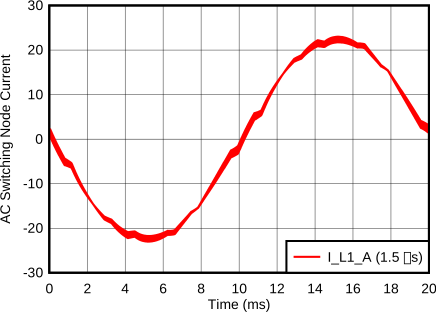 Figure 81 Current Drained From the PCC When a Dead Time of 250ns and 1.5μs are Implemented (50-Hz Operation)
Excessive dead time can lead to significant THD which exceeds the limits set by the standards. To comply with the standards, either a large output filter is needed or adequate software control must be provided. Multiple control techniques were developed with the aim to compensate this disturbance; however, all these options require sufficient bandwidth of the current sensor. To determine the minimum bandwidth requirements, an fast Fourier transform (FFT) transformation of the current waveform is performed to analyzed the frequency content of the disturbance.
Figure 82 shows the results of FFTs of the currents in the PCC when full power is required by the grid.

 Figure 82 FFT of the Currents Depicted in Figure 2-6 Plus Zoomed Portion (50 Hz)
The most important frequencies to be compensated in Figure 82 are the 5th, 13th, and 17th harmonics, leading to 250 Hz, 650 Hz, and 850 Hz when the grid is working at 50 Hz. Correspondingly, when the grid operates at 60 Hz the frequencies are 300 Hz, 780 Hz, and 1020 Hz. By applying Equation 47 to the new frequencies, a minimum bandwidth from the current sensing stage of 102 kHz needs to be provided to make sure a proper compensation of the harmonics.
In conclusion, from steady-state analysis, a minimum bandwidth of 102 kHz when having a 60-Hz grid is necessary to improve the total harmonic distortion of the currents when an important dead-time is present in the PFC stage. When the grid is operating at 50 Hz, the minimum bandwidth can be scaled down to 95 kHz. The current sensor bandwidth is required in either point A or B depending where the currents are controlled because harmonic content generated by dead time is the same in both the measurement points. The reason is due to the fact that the EMI filter (see Figure 76) is optimized for much higher frequency content; therefore, no important mitigation can be achieved at low frequency.