SLYY234 December 2024 AMC0106M05 , AMC0106M25 , AMC0136 , AMC0311D , AMC0311S , AMC0386 , AMC0386-Q1 , AMC1100 , AMC1106M05 , AMC1200 , AMC1200-Q1 , AMC1202 , AMC1203 , AMC1204 , AMC1211-Q1 , AMC1300 , AMC1300B-Q1 , AMC1301 , AMC1301-Q1 , AMC1302-Q1 , AMC1303M2510 , AMC1304L25 , AMC1304M25 , AMC1305M25 , AMC1305M25-Q1 , AMC1306M05 , AMC1306M25 , AMC1311 , AMC1311-Q1 , AMC131M03 , AMC1336 , AMC1336-Q1 , AMC1350 , AMC1350-Q1 , AMC23C12 , AMC3301 , AMC3330 , AMC3330-Q1
- 1
- Introduction
- Introduction to Isolated Signal Chain
- Selection Trees
-
Current Sensing
- Shunt Resistor Selection for Isolated Data Converters
- Design considerations for isolated current sensing
- Isolated Current-Sensing Circuit With ±50-mV Input and Single-Ended Output
- Isolated Current-Sensing Circuit With ±50-mV Input and Differential Output
- Isolated Current-Sensing Circuit With ±250-mV Input Range and Single-Ended Output Voltage
- Isolated current-measurement circuit with ±250-mV input and differential output
- Isolated Overcurrent Protection Circuit
- Interfacing a Differential-Output (Isolated) Amp to a Single-Ended Input ADC
- Utilizing AMC3311 to Power AMC23C11 for Isolated Sensing and Fault Detection
- Isolated Current-Sensing Circuit With Front-End Gain Stage
- Accuracy Comparison of Isolated Shunt and Closed-Loop Current Sensing
-
Voltage Sensing
- Maximizing Power Conversion and Motor Control Efficiency With Isolated Voltage Sensing
- Increased Accuracy and Performance with Integrated High Voltage Resistor Isolated Amplifiers and Modulators
- Isolated Amplifiers With Differential, Single-Ended Fixed Gain and Ratiometric Outputs for Voltage Sensing Applications
- Isolated Voltage-Measurement Circuit With ±250-mV Input and Differential Output
- Split-Tap Connection for Line-to-Line Isolated Voltage Measurement Using AMC3330
- ±12V Voltage Sensing Circuit With an Isolated Amplifier and Pseudo-Differential Input SAR ADC
- ±12-V voltage sensing circuit with an isolated amplifier and differential input SAR ADC
- Isolated Undervoltage and Overvoltage Detection Circuit
- Isolated Zero-Cross Detection Circuit
- ±480V Isolated Voltage-Sensing Circuit With Differential Output
-
EMI Performance
- Best in Class Radiated Emissions EMI Performance with Isolated Amplifiers
- Best Practices to Attenuate AMC3301 Family Radiated Emissions EMI
-
End Equipment
- Comparing Shunt- and Hall-Based Isolated Current-Sensing Solutions in HEV/EV
-
Design Considerations for Current Sensing
in DC EV Charging Applications
- Abstract
- Introduction
-
Current Sensing in AC/DC Converters
- Basic Hardware and Control Description of AC/DC
- Point A and B – AC/DC AC Phase-Current Sensing
- Point C and D – AC/DC DC Link Current Sensing
- Summary of Positives and Negatives at Point A, B, C1/2 and D1/2 and Product Suggestions
- Current Sensing in DC/DC Converters
- Conclusion
- References
-
Using isolated comparators for fault
detection in electric motor drives
- Introduction
- Introduction to electric motor drives
- Understanding fault events in electric motor drives
- Achieving reliable detection and protection in electric motor drives
- Use case No. 1: Bidirectional in-phase overcurrent detection
- Use case No. 2: DC+ overcurrent detection
- Use case No. 3: DC– overcurrent or short-circuit detection
- Use case No. 4: DC-link (DC+ to DC–) overvoltage and undervoltage detection
- Use case No. 5: IGBT module overtemperature detection
- Discrete DESAT for Opto-Compatible Isolated Gate Driver UCC23513 in Motor Drives
- Isolated voltage sensing in AC motor drives
- Achieving High-Performance Isolated Current and Voltage Sensing in Server PSUs
-
Additional Reference Designs/Circuits
- Designing a Bootstrap Charge-Pump Power Supply for an Isolated Amplifier
-
Clock Edge Delay Compensation With
Isolated Modulators Digital Interface to MCUs
- Abstract
- Introduction
- Design Challenge With Digital Interface Timing Specifications
- Design Approach With Clock Edge Delay Compensation
- Test and Validation
- Conclusion
- References
- Utilizing AMC3311 to Power AMC23C11 for Isolated Sensing and Fault Detection
Design Goals
| High Side Supply | Input Voltage |
Working Voltage |
Low Side Supply |
Output Voltage |
|---|---|---|---|---|
12 V | ±170 Vpk Sine Wave | ≥ 400 VRMS | 3.3 V to 5.0 V ±10% | ≤ Low-Side Supply |
Design Description
A zero-crossing detector circuit changes output state when the AC input crosses the zero-cross reference voltage. This design features a single chip solution for zero-crossing detection of an AC sine wave with inverting and non-inverting digital outputs. The circuit is created by setting the comparator inverting input to ground and applying a clamped sine wave to the noninverting input. The input voltage is clamped by R1 and a pair of antiparallel diodes. In this case, diodes are used instead of an attenuator to maximize the slew rate of the input near the zero-crossing, which reduces output latency. The circuit is used for AC line zero-cross detection in control circuits to reduce standby and off-mode power consumption.
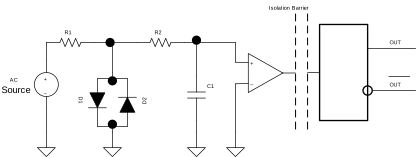 Isolated Zero-Cross Detection Circuit Schematic
Design Notes
- The circuit must be capable of handling 750-V working voltage across the isolation barrier.
- The maximum input voltage at IN+ must be ±1 V
- Inverting and non-inverting output are desired
- Maximum current flowing through R1 is 100 µA ±10%
- Limit the operating voltage of each resistor in the string to 100 V ±10% maximum
- The input AC source voltage is 120 VRMS, higher AC voltages are easily accommodated with component modifications. See the Alternate Design section for details
- Ensure the hysteresis voltage at the AC zero-cross is no more than ±30 mV
Design Steps
- Determine the ideal R1 resistor value. The
maximum peak input voltage of 120 VRMS × √2 = 170 VPK.
Note that the forward voltage of the diode D1 is near zero, and not included in
this calculation.
- Divide R1 into 3 equal resistors to maintain design limits of ≤ 100 V per resistor:
- Use the Analog Engineer’s Calculator to find a standard E96 1% resistor value for R1. The nearest value is 569 kΩ.
- Select the anti-parallel diodes. Choose diodes which will provide at least ± 350-mV forward voltage with the 100 µA supplied through R1.
- Optional – design low-pass filter at VINP defined
by R2 and C1. The frequency response is defined as:
Revised Design
The following schematic shows implementation of the revised design using the AMC23C10.
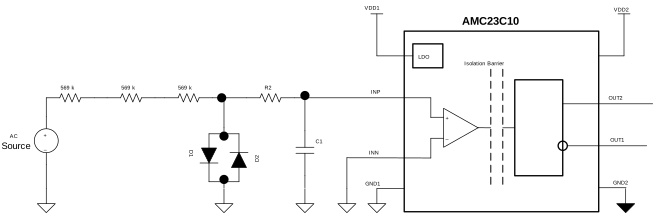 Revised Design With AMC23C10 Isolated Comparator
The AMC23C10 uses capacitive isolation to provide a working voltage of 1000 V. The voltage source for VDD1 is specified from 3 V to 27 V, controlled internally through an LDO. VDD2 is specified from 2.7 V to 5.5 V. The input voltage range under normal operation is ±1 V. The logic output on OUT1 is open drain which can be used with a pullup resistor to VDD1. OUT2 is a push-pull type output needing no external pullup resistors.
Design Simulations
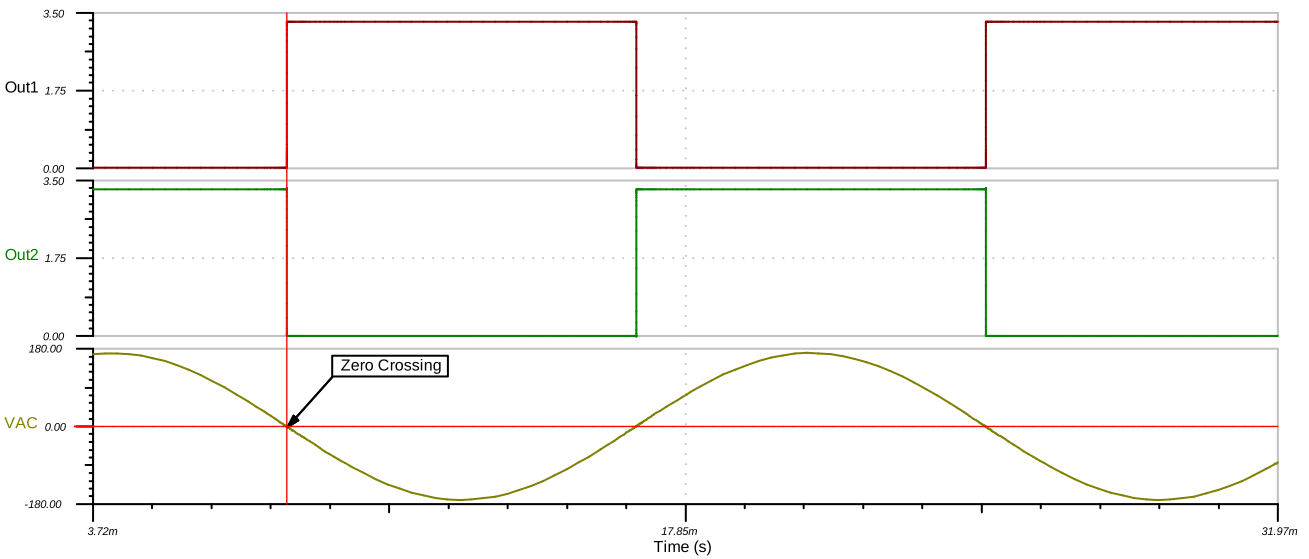 Simulation of Zero-Crossing Detection With Sine Wave Input
 Simulation of Zero-Crossing Detection With Rectified Input
 Simulation of Response Time for Zero-Crossing Detection
Measured Response
The following images show the measured response of the zero-crossing detection circuit using the AMC23C10 isolated comparator. The input is captured on trace 1, while OUT1 and OUT2 are shown on traces 2 and 3 respectively. When measured at both the rising and falling edges of the input, the delay between the zero-crossing of the input and the output transition does not exceed 220 ns.
 Zero-Crossing Detection of Rectified Input
 Zero-Crossing Detection Output Latency – Falling Edge
 Zero-Crossing Detection Output
Latency – Rising Edge
Zero-Crossing Detection Output
Latency – Rising EdgeDesign References
See Analog Engineer's Circuit Cookbooks for TI's comprehensive circuit library.
Texas Instruments, AMC23C10 Fast Response, Reinforced Isolated Comparator With Dual Output data sheet
Design Featured Isolated Comparator
| AMC23C10 | |
|---|---|
| Working Voltage | 1000 VRMS |
| VDD1 | 3.0 V–27 V |
| VDD2 | 2.7 V–5.5 V |
| Input Voltage Range | ±1000 mV |
| Output Options | OUT1 - Open Drain |
| OUT2 - Push-Pull | |
| AMC23C10 | |
Alternate Design for 230-VAC Input
| AMC23C10 | |
|---|---|
| Working Voltage | 1000 VRMS |
| AC Input | 325 Vpk |
| R1 Ideal | 3.25 MΩ |
| R1 E96 Standard | Three each 1.09 MΩ |