SLYY234 December   2024 AMC0106M05 , AMC0106M25 , AMC0136 , AMC0311D , AMC0311S , AMC0386 , AMC0386-Q1 , AMC1100 , AMC1106M05 , AMC1200 , AMC1200-Q1 , AMC1202 , AMC1203 , AMC1204 , AMC1211-Q1 , AMC1300 , AMC1300B-Q1 , AMC1301 , AMC1301-Q1 , AMC1302-Q1 , AMC1303M2510 , AMC1304L25 , AMC1304M25 , AMC1305M25 , AMC1305M25-Q1 , AMC1306M05 , AMC1306M25 , AMC1311 , AMC1311-Q1 , AMC131M03 , AMC1336 , AMC1336-Q1 , AMC1350 , AMC1350-Q1 , AMC23C12 , AMC3301 , AMC3330 , AMC3330-Q1


  1.   1
  2.   Introduction
  3.   Introduction to Isolated Signal Chain
    1.     Comparing Isolated Amplifiers and Isolated Modulators
      1.      Abstract
      2.      Introduction to Isolated Amplifiers
      3.      Introduction to Isolated Modulators
      4.      Performance Comparison Between Isolated Amplifiers and Isolated Modulators
      5.      Isolated Modulators in Traction Inverters
      6.      Isolated Amplifier and Modulator Recommendations
      7.      Conclusion
    2.     TI’s First Isolated Amplifiers With Ultra-Wide Creepage and Clearance
      1.      Application Brief
  4.   Selection Trees
  5.   Current Sensing
    1.     Shunt Resistor Selection for Isolated Data Converters
      1.      17
    2.     Design considerations for isolated current sensing
      1.      19
      2.      Conclusion
      3.      References
      4.      Related Websites
    3.     Isolated Current-Sensing Circuit With ±50-mV Input and Single-Ended Output
      1.      24
    4.     Isolated Current-Sensing Circuit With ±50-mV Input and Differential Output
      1.      26
    5.     Isolated Current-Sensing Circuit With ±250-mV Input Range and Single-Ended Output Voltage
      1.      Design Goals
      2.      Design Description
      3.      Design Notes
      4.      Design Steps
      5.      Design Simulations
      6.      DC Simulation Results
      7.      Closed-Loop AC Simulation Results
      8.      Transient Simulation Results
      9.      Design References
      10.      Design Featured Isolated Amplifier
      11.      Design Alternate Isolated Amplifier
    6.     Isolated current-measurement circuit with ±250-mV input and differential output
      1.      Design Goals
      2.      Design Description
      3.      Design Notes
      4.      Design Steps
      5.      Design Simulations
      6.      DC Simulation Results
      7.      Closed Loop AC Simulation Results
      8.      Transient Simulation Results
      9.      Design References
      10.      Design Featured Op Amp
      11.      Design Alternate Op Amp
    7.     Isolated Overcurrent Protection Circuit
      1.      52
    8.     Interfacing a Differential-Output (Isolated) Amp to a Single-Ended Input ADC
      1.      54
    9.     Utilizing AMC3311 to Power AMC23C11 for Isolated Sensing and Fault Detection
      1.      Application Brief
    10.     Isolated Current-Sensing Circuit With Front-End Gain Stage
      1.      58
    11.     Accuracy Comparison of Isolated Shunt and Closed-Loop Current Sensing
      1.      60
  6.   Voltage Sensing
    1.     Maximizing Power Conversion and Motor Control Efficiency With Isolated Voltage Sensing
      1.      63
      2.      Solutions for high-voltage sensing
      3.      Integrated resistor devices
      4.      Single-ended output devices
      5.      Integrated isolated voltage-sensing use cases
      6.      Conclusion
      7.      Additional resources
    2.     Increased Accuracy and Performance with Integrated High Voltage Resistor Isolated Amplifiers and Modulators
      1.      Abstract
      2.      Introduction
      3.      High Voltage Resistor Isolated Amplifiers and Modulators Advantages
        1.       Space Savings
        2.       Improved Temperature and Lifetime Drift of Integrated HV Resistors
        3.       Accuracy Results
        4.       Fully Integrated Resistors vs. Additional External Resistor Example
        5.       Device Selection Tree and AC/DC Common Use Cases
      4.      Summary
      5.      References
    3.     Isolated Amplifiers With Differential, Single-Ended Fixed Gain and Ratiometric Outputs for Voltage Sensing Applications
      1.      Abstract
      2.      Introduction
      3.      Overview of Differential, Single-Ended Fixed Gain and Ratiometric Outputs
        1.       Isolated Amplifiers with Differential Output
        2.       Isolated Amplifiers With Single-Ended, Fixed-Gain Output
        3.       Isolated Amplifiers With Single-Ended, Ratiometric Output
      4.      Application Examples
        1.       Product Selection Tree
      5.      Summary
      6.      References
    4.     Isolated Voltage-Measurement Circuit With ±250-mV Input and Differential Output
      1.      93
    5.     Split-Tap Connection for Line-to-Line Isolated Voltage Measurement Using AMC3330
      1.      95
    6.     ±12V Voltage Sensing Circuit With an Isolated Amplifier and Pseudo-Differential Input SAR ADC
      1.      97
    7.     ±12-V voltage sensing circuit with an isolated amplifier and differential input SAR ADC
      1.      99
    8.     Isolated Undervoltage and Overvoltage Detection Circuit
      1.      101
    9.     Isolated Zero-Cross Detection Circuit
      1.      103
    10.     ±480V Isolated Voltage-Sensing Circuit With Differential Output
      1.      105
  7.   EMI Performance
    1.     Best in Class Radiated Emissions EMI Performance with Isolated Amplifiers
      1.      Best in Class Radiated Emissions EMI Performance with Isolated Amplifiers
      2.      Introduction
      3.      Current Generation of Texas Instruments Isolated Amplifiers Radiated Emissions Performance
      4.      Previous Generations of Texas Instruments Isolated Amplifiers Radiated Emissions Performance
      5.      Conclusion
      6.      References
    2.     Best Practices to Attenuate AMC3301 Family Radiated Emissions EMI
      1.      Abstract
      2.      Introduction
      3.      Effects of Input Connections on AMC3301 Family Radiated Emissions
      4.      Attenuating AMC3301 Family Radiated Emissions
        1.       Ferrite Beads and Common Mode Chokes
        2.       PCB Schematics and Layout Best Practices for AMC3301 Family
      5.      Using Multiple AMC3301 Devices
        1.       Device Orientation
        2.       PCB Layout Best Practices for Multiple AMC3301
      6.      Conclusion
      7.      AMC3301 Family Table
  8.   End Equipment
    1.     Comparing Shunt- and Hall-Based Isolated Current-Sensing Solutions in HEV/EV
      1.      128
    2.     Design Considerations for Current Sensing in DC EV Charging Applications
      1.      Abstract
      2.      Introduction
        1.       DC Charging Station for Electric Vehicles
        2.       Current-Sensing Technology Selection and Equivalent Model
          1.        Sensing of the Current With Shunt-Based Solution
          2.        Equivalent Model of the Sensing Technology
      3.      Current Sensing in AC/DC Converters
        1.       Basic Hardware and Control Description of AC/DC
          1.        AC Current Control Loops
          2.        DC Voltage Control Loop
        2.       Point A and B – AC/DC AC Phase-Current Sensing
          1.        Impact of Bandwidth
            1.         Steady State Analysis: Fundamental and Zero Crossing Currents
            2.         Transient Analysis: Step Power and Voltage Sag Response
          2.        Impact of Latency
            1.         Fault Analysis: Grid Short-Circuit
          3.        Impact of Gain Error
            1.         Power Disturbance in AC/DC Caused by Gain Error
            2.         AC/DC Response to Power Disturbance Caused by Gain Error
          4.        Impact of Offset
        3.       Point C and D – AC/DC DC Link Current Sensing
          1.        Impact of Bandwidth on Feedforward Performance
          2.        Impact of Latency on Power Switch Protection
          3.        Impact of Gain Error on Power Measurement
            1.         Transient Analysis: Feedforward in Point D
          4.        Impact of Offset
        4.       Summary of Positives and Negatives at Point A, B, C1/2 and D1/2 and Product Suggestions
      4.      Current Sensing in DC/DC Converters
        1.       Basic Operation Principle of Isolated DC/DC Converter With Phase-Shift Control
        2.       Point E, F - DC/DC Current Sensing
          1.        Impact of Bandwidth
          2.        Impact of Gain Error
          3.        Impact of Offset Error
        3.       Point G - DC/DC Tank Current Sensing
        4.       Summary of Sensing Points E, F, and G and Product Suggestions
      5.      Conclusion
      6.      References
    3.     Using isolated comparators for fault detection in electric motor drives
      1.      Introduction
      2.      Introduction to electric motor drives
      3.      Understanding fault events in electric motor drives
      4.      Achieving reliable detection and protection in electric motor drives
      5.      Use case No. 1: Bidirectional in-phase overcurrent detection
      6.      Use case No. 2: DC+ overcurrent detection
      7.      Use case No. 3: DC– overcurrent or short-circuit detection
      8.      Use case No. 4: DC-link (DC+ to DC–) overvoltage and undervoltage detection
      9.      Use case No. 5: IGBT module overtemperature detection
    4.     Discrete DESAT for Opto-Compatible Isolated Gate Driver UCC23513 in Motor Drives
      1.      Abstract
      2.      Introduction
      3.      System Challenge on Isolated Gate Drivers With Integrated DESAT
      4.      System Approach With UCC23513 and AMC23C11
        1.       System Overview and Key Specification
        2.       Schematic Design
          1.        Circuit Schematic
          2.        Configure VCE(DESAT) Threshold and DESAT Bias Current
          3.        DESAT Blanking Time
          4.        DESAT Deglitch Filter
        3.       Reference PCB Layout
      5.      Simulation and Test Results
        1.       Simulation Circuit and Results
          1.        Simulation Circuit
          2.        Simulation Results
        2.       Test Results With 3-Phase IGBT Inverter
          1.        Brake IGBT Test
          2.        Test Results on a 3-Phase Inverter With Phase to Phase Short
      6.      Summary
      7.      References
    5.     Isolated voltage sensing in AC motor drives
      1.      Introduction
      2.      Conclusion
      3.      References
    6.     Achieving High-Performance Isolated Current and Voltage Sensing in Server PSUs
      1.      Application Brief
  9.   Additional Reference Designs/Circuits
    1.     Designing a Bootstrap Charge-Pump Power Supply for an Isolated Amplifier
      1.      Abstract
      2.      Introduction
      3.      Bootstrap Power Supply Design
        1.       Selection of Charge Pump Capacitor
        2.       Simulation in TINA-TI
        3.       Hardware Test with AMC1311-Q1
      4.      Summary
      5.      Reference
    2.     Clock Edge Delay Compensation With Isolated Modulators Digital Interface to MCUs
      1.      Abstract
      2.      Introduction
      3.      Design Challenge With Digital Interface Timing Specifications
      4.      Design Approach With Clock Edge Delay Compensation
        1.       Clock Signal Compensation With Software Configurable Phase Delay
        2.       Clock Signal Compensation With Hardware Configurable Phase Delay
        3.       Clock Signal Compensation by Clock Return
        4.       Clock Signal Compensation by Clock Inversion at the MCU
      5.      Test and Validation
        1.       Test Equipment and Software
        2.       Testing of Clock Signal Compensation With Software Configurable Phase Delay
          1.        Test Setup
          2.        Test Measurement Results
        3.       Testing of Clock Signal Compensation by Clock Inversion at MCU
          1.        Test Setup
          2.        Test Measurement Results
            1.         Test Result – No Clock Inversion of Clock Input at GPIO123
            2.         Test Result – Clock Inversion of Clock Input at GPIO123
        4.       Digital Interface Timing Validation by Calculation Tool
          1.        Digital Interface With No Compensation Method
          2.        Commonly Used Method - Reduction of the Clock Frequency
          3.        Clock Edge Compensation With Software Configurable Phase Delay
      6.      Conclusion
      7.      References
    3.     Utilizing AMC3311 to Power AMC23C11 for Isolated Sensing and Fault Detection
      1.      Application Brief

Design Goals

Nominal Current Overcurrent Level High-Side Supply Low-Side Supply Transient Response Time
50 A 55 A 3 V–27 V 2.7 V–5.5 V ≤ 1000 ns

Design Description

This high-speed, isolated bidirectional overcurrent detection circuit is implemented with the AMC23C12. The AMC23C12 features an isolated window comparator and an adjustable threshold level via a fixed internal precision current source and user-selectable resistor. This circuit is designed for fast detection of overcurrent situations allowing the controller to disable pulse width modulation (PWM) control of high-speed switches used in motor control, traction inverter, and other industrial control systems.

 Overcurrent Protection Circuit Schematic Overcurrent Protection Circuit Schematic

Design Notes

  1. To minimize errors, choose a precision shunt resistor (R1) and the threshold-setting resistor (R2).
  2. The AMC23C12 is powered from the gate-drive supply or high-side auxiliary source up to 27 V.
  3. Select the shunt resistor and threshold-setting resistors to match the nominal current and overcurrent limits using the window comparator mode of operation.

Design Steps

  1. Determine the size of the shunt resistor based on the nominal current level. The shunt resistor is sized to allow 50 mV at the input pin.
    R 1 = ( 50   m V 50  A ) = 1 . 0   m Ω
  2. Determine the value of R2 based on the desired current trip level using the internal 100-µA source and the desired trip level of 55 A with a 1-mΩ shunt for 55 mV at the input to the window comparator.
    R 2 = ( 55   m V 100  μ A ) = 550   Ω
  3. Optional - select a 27-V Zener diode to protect the AMC23C12 from voltages greater than the recommended operating supply voltage.
 Revised Overcurrent Protection Schematic Revised Overcurrent Protection Schematic

Design Simulations

The following images are SPICE simulations of the overcurrent protection circuit. The simulations show the time until the edges trigger which is approximately 360 ns.

 Transient Response of Overcurrent Protection Simulation Transient Response of Overcurrent Protection Simulation
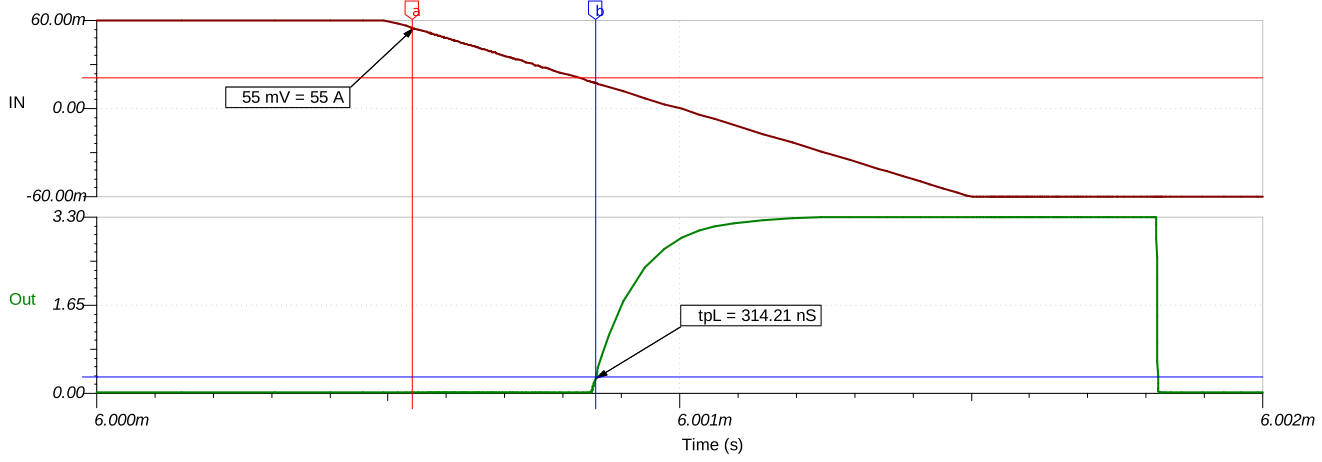
 Transient Response of Overcurrent Protection Simulation - Rising Transient Response of Overcurrent Protection Simulation - Rising
 Transient Response of Overcurrent Protection Simulation - Falling Transient Response of Overcurrent Protection Simulation - Falling

Design Results

The following images are the waveform captures of the physical circuit. Overcurrent Protection Circuit Waveform shows the output on line 1 with relation to input on line 3. Overcurrent Protection Circuit Waveform - Rising shows the rising edge of the output line 1 and the time delay from the triggered current to the output. Overcurrent Protection Circuit Waveform - Falling shows the falling edge of the output line 1 and the time delay from the triggered current to the output.

 Overcurrent Protection Circuit Waveform Overcurrent Protection Circuit Waveform
 Overcurrent Protection Circuit Waveform - Rising Overcurrent Protection Circuit Waveform - Rising
 Overcurrent Protection Circuit Waveform - Falling Overcurrent Protection Circuit Waveform - Falling

Design Featured Devices

Device Key Features Device Link

AMC23C12

  • Wide high-side supply range: 3 V to 27 V

  • Low-side supply range: 2.7 V to 5.5 V

  • Adjustable threshold:

    • Window-comparator mode: ±20 mV to ±300 mV

    • Positive-comparator mode: 600 mV to 2.7 V

  • Reference for threshold adjustment: 100 µA, ±2%

  • Trip threshold error: ±1% (max) at 250 mV

  • Propagation delay: 290 ns (typ)

  • High CMTI: 55 kV/µs (min)

  • Open-drain output with optional latch mode

  • Safety-related certifications:

    • 7000-VPK reinforced isolation per DIN VDE V 0884-11

    • 5000-VRMS isolation for 1 minute per UL1577

  • Fully specified over the extended industrial temperature range: –40°C to +125°C

Device: AMC23C12

Similar Devices: Isolated amplifiers

Design References

See Analog Engineer's Circuit Cookbooks for TI's comprehensive circuit library.

Texas Instruments, AMC23C12 Fast Response, Reinforced Isolated Window Comparator With Adjustable Threshold and Latch Function data sheet