SLYY234 December 2024 AMC0106M05 , AMC0106M25 , AMC0136 , AMC0311D , AMC0311S , AMC0386 , AMC0386-Q1 , AMC1100 , AMC1106M05 , AMC1200 , AMC1200-Q1 , AMC1202 , AMC1203 , AMC1204 , AMC1211-Q1 , AMC1300 , AMC1300B-Q1 , AMC1301 , AMC1301-Q1 , AMC1302-Q1 , AMC1303M2510 , AMC1304L25 , AMC1304M25 , AMC1305M25 , AMC1305M25-Q1 , AMC1306M05 , AMC1306M25 , AMC1311 , AMC1311-Q1 , AMC131M03 , AMC1336 , AMC1336-Q1 , AMC1350 , AMC1350-Q1 , AMC23C12 , AMC3301 , AMC3330 , AMC3330-Q1
- 1
- Introduction
- Introduction to Isolated Signal Chain
- Selection Trees
-
Current Sensing
- Shunt Resistor Selection for Isolated Data Converters
- Design considerations for isolated current sensing
- Isolated Current-Sensing Circuit With ±50-mV Input and Single-Ended Output
- Isolated Current-Sensing Circuit With ±50-mV Input and Differential Output
- Isolated Current-Sensing Circuit With ±250-mV Input Range and Single-Ended Output Voltage
- Isolated current-measurement circuit with ±250-mV input and differential output
- Isolated Overcurrent Protection Circuit
- Interfacing a Differential-Output (Isolated) Amp to a Single-Ended Input ADC
- Utilizing AMC3311 to Power AMC23C11 for Isolated Sensing and Fault Detection
- Isolated Current-Sensing Circuit With Front-End Gain Stage
- Accuracy Comparison of Isolated Shunt and Closed-Loop Current Sensing
-
Voltage Sensing
- Maximizing Power Conversion and Motor Control Efficiency With Isolated Voltage Sensing
- Increased Accuracy and Performance with Integrated High Voltage Resistor Isolated Amplifiers and Modulators
- Isolated Amplifiers With Differential, Single-Ended Fixed Gain and Ratiometric Outputs for Voltage Sensing Applications
- Isolated Voltage-Measurement Circuit With ±250-mV Input and Differential Output
- Split-Tap Connection for Line-to-Line Isolated Voltage Measurement Using AMC3330
- ±12V Voltage Sensing Circuit With an Isolated Amplifier and Pseudo-Differential Input SAR ADC
- ±12-V voltage sensing circuit with an isolated amplifier and differential input SAR ADC
- Isolated Undervoltage and Overvoltage Detection Circuit
- Isolated Zero-Cross Detection Circuit
- ±480V Isolated Voltage-Sensing Circuit With Differential Output
-
EMI Performance
- Best in Class Radiated Emissions EMI Performance with Isolated Amplifiers
- Best Practices to Attenuate AMC3301 Family Radiated Emissions EMI
-
End Equipment
- Comparing Shunt- and Hall-Based Isolated Current-Sensing Solutions in HEV/EV
-
Design Considerations for Current Sensing
in DC EV Charging Applications
- Abstract
- Introduction
-
Current Sensing in AC/DC Converters
- Basic Hardware and Control Description of AC/DC
- Point A and B – AC/DC AC Phase-Current Sensing
- Point C and D – AC/DC DC Link Current Sensing
- Summary of Positives and Negatives at Point A, B, C1/2 and D1/2 and Product Suggestions
- Current Sensing in DC/DC Converters
- Conclusion
- References
-
Using isolated comparators for fault
detection in electric motor drives
- Introduction
- Introduction to electric motor drives
- Understanding fault events in electric motor drives
- Achieving reliable detection and protection in electric motor drives
- Use case No. 1: Bidirectional in-phase overcurrent detection
- Use case No. 2: DC+ overcurrent detection
- Use case No. 3: DC– overcurrent or short-circuit detection
- Use case No. 4: DC-link (DC+ to DC–) overvoltage and undervoltage detection
- Use case No. 5: IGBT module overtemperature detection
- Discrete DESAT for Opto-Compatible Isolated Gate Driver UCC23513 in Motor Drives
- Isolated voltage sensing in AC motor drives
- Achieving High-Performance Isolated Current and Voltage Sensing in Server PSUs
-
Additional Reference Designs/Circuits
- Designing a Bootstrap Charge-Pump Power Supply for an Isolated Amplifier
-
Clock Edge Delay Compensation With
Isolated Modulators Digital Interface to MCUs
- Abstract
- Introduction
- Design Challenge With Digital Interface Timing Specifications
- Design Approach With Clock Edge Delay Compensation
- Test and Validation
- Conclusion
- References
- Utilizing AMC3311 to Power AMC23C11 for Isolated Sensing and Fault Detection
Industrial and automotive applications such as on-board chargers, string inverters and motor drives require some type of isolated current measurement to drive the feed- back algorithm for the current control loop while protecting the digital circuitry from the high-voltage circuit performing a function.
Given their high performance, isolated amplifiers are excellent devices for transferring current-measurement data across the isolation barrier. However, selecting the correct isolated amplifier is not always a straightforward process. There are many decisions to consider when selecting an isolated amplifier, such as isolation specifications, how to power the high side and selection of the input voltage range. This article covers each of these decisions in detail to help select an isolated amplifier best suited to a specific system.
The first decision when selecting a device for isolated current measurement is to determine the level of isolation required. There are two levels of isolation, basic and rein- forced. System architecture and end-equipment standards such as International Electrotechnical Commission (IEC) 61800 for motor drives and IEC 60601 for medical equipment will specify the required isolation level.
Here are the main specifications that quantify the performance of the isolation barrier:
- The isolation working voltage is the maximum voltage defined in the root-mean-square voltage that the isolated amplifier can handle continuously throughout its operating life.
- Common-mode transient immunity describes the maxi- mum rate of change in ground potential difference that the isolated amplifier can withstand without errors.
- The isolation transient overvoltage is the voltage defined in the peak-to-peak voltage that the isolated amplifier can tolerate for 60 s.
- The surge rating (impulse voltage rating) according to IEC 60065 is the 1.2-/50-µs voltage magnitude that the isolated amplifier can tolerate without failure.
Some end-equipment manufacturers have their products certified by third parties to verify that they meet isolation specifications. Isolated amplifiers are not measured to these specifications themselves, since they are components inside end equipment, and end-equipment standards apply only indirectly to them. Instead, components are measured against device-level certifications such as Deutsches Institut für Normung e.V. (DIN) Verband Deutscher Elektrotechniker (VDE) V 0884-11 and Underwriters Laboratories (UL) 1577. As stated in the IEC standards, devices complying with component-level standards that have equivalent requirements do not require separate evaluation. This applies to Comité International Spécial des Perturbations Radio (CISPR) radiated emissions electromagnetic interference (EMI) standards as well. See [1] for radiated emissions performance for isolated amplifiers from Texas Instruments (TI).
For the best performance, the layout and application practices shown in the device-specific data sheet are recommended; [2] lists the TI isolated amplifier device-level certifications.
The next decision when selecting an isolated amplifier is how to power it on the high side of the isolation barrier.
When designing this portion of the circuit, remember that the high-side supply voltage must float with the common- mode input voltage of the current being measured. This means that for multiple-phase current measurements, each phase requires one isolated amplifier with its own high-side power supply. Incorrectly designing the high- side power-supply circuit can lead to exceeding the absolute maximum analog input-voltage ratings, which can cause permanent damage to the device.
There are three main design options to power the high side of an isolated amplifier.
The first design option is to design a discrete isolated transformer circuit that can supply voltage to the high side of the isolated amplifier from the low side. This method will require selecting an isolated transformer, a trans- former driver such as TI’s SN6501 and a low-dropout regulator such as TI’s TLV704. Although easy to design, this approach requires a large board area and several components. Figure 12 illustrates an example implementation on the top portion of the AMC1300 evaluation module (EVM). Figure 12 The AMC1300 EVM with an
isolate transformer.
Figure 12 The AMC1300 EVM with an
isolate transformer.The second design option, shown in Figure 13, uses the floating high-side gate driver supply (typically 15 V) and a shunt regulator such as a Zener diode to regulate the voltage down to 5 V. Examples of this design are in the device data sheets, such as the AMC1300B-Q1 reinforced isolated amplifier. While this design option is economical and effective, layout restrictions and parasitic impedances between the gate-driver-supply ground reference and the amplifier ground reference can lead to common-mode input voltage violations and transient errors.
The third and simplest design option, shown in Figure 14, uses a device with an integrated DC/DC converter. Isolated amplifiers with integrated DC/DC converters such as TI’s AMC3302 greatly reduce solution size and complexity, lower system costs, provide excellent conversion efficiency, and enable flexible placement of the shunt resistor.[4]
The last decision when selecting an isolation amplifier is toselect the input voltage range of the device. Most isolated amplifiers optimized for current sensing have options for either a ±50-mV or ±250-mV linear-input voltage range. Determining which input voltage range is right for the application will depend on the magnitude of current being measured and the size of the shunt resistor. In general, systems with high current magnitudes typically require an isolated amplifier with a smaller input range, such as ±50 mV. Systems with relatively low current magnitudes may benefit from the slightly larger input voltage range of ±250 mV, which allows for higher signal- to-noise ratios
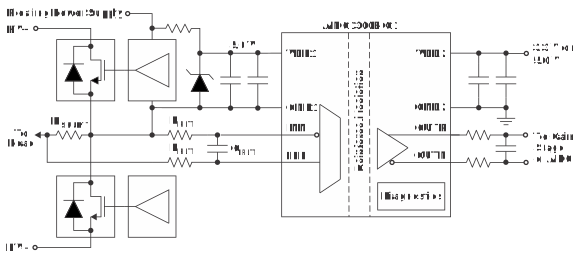 Figure 13 The AMC1300B-Q1 and a floating
power supply.
Figure 13 The AMC1300B-Q1 and a floating
power supply. Figure 14 The AMC3302 isolated amplifier
with an internal DC/DC converter.
Figure 14 The AMC3302 isolated amplifier
with an internal DC/DC converter.There are two equations to consider when selecting the input voltage range: Ohm’s law (see Equation 1), and the power dissipated in a resistor (see Equation 2):
These two equations govern the trade-off between maximizing the full-scale input range of the isolated amplifier and the amount of power dissipated in the shunt resistor. When supplied with current and resistance values, Equation 1 calculates the voltage drop across the shunt resistor. Try to match this voltage range as closely as possible to the full-scale input voltage range of the isolated amplifier, as an mismatch between the two values will result in a direct loss of resolution.
Equation 2 quantifies the power dissipated in the shunt resistor. This is important, since shunt resistors will begin to drift (according to their temperature drift specification) from self-heating once the power dissipated through the resistor reaches one-half the rated power dissipation, resulting in a gain error. In order to avoid excessive shunt drift caused by self-heating, it is often best to limit the shunt resistor’s nominal power dissipation to be equal to or less than one-eighth the rated power dissipation.
For example, if the current requirement is for a nominal current of 18 A and a maximum current of 52 A. Knowing that there are two options for the linear-input voltage range (±50 mV and ±250 mV), as well as the maximum current, it is possible to calculate ideal shunt resistance values to meet the full-scale input range for both choices:
±250 mV: RIdeal = 4.8 mΩ
Finding the closest standard shunt resistor values:
for ±250 mV: R = 5 mΩ
Plugging these values into Equation 1 enables the resulting full-scale voltage drop across the shunt resistor to be calculated:
for ±250 mV: V = I × R = (52 A) × (5 mΩ) = 260 mV
Notice that the resistance value from the ideal calculation to the closest standard value increased slightly, which results in a full-scale input voltage range that is larger than the linear full-scale input range of the isolated amplifier. This means that for full-scale current magnitudes, the resulting voltage magnitude will no longer be within the linear region of the isolated amplifier’s input. Isolated amplifiers often have an additional input voltage range beyond the linear input voltage range before they begin to clip. Within this region—typically as high as ±280 mV for ±250-mV devices and ±56 mV for ±50-mV devices—the accuracy of the isolated amplifier is not specified in the data sheet; however, the isolated amplifier will continue to output a voltage with accuracy similar to the linear region. This may be acceptable for some applications if the accuracy requirement of the maximum current magnitude is relaxed compared to the nominal measurements.
Next, use the standard resistance values and nominal current magnitudes to calculate the power dissipated in the shunt resistor, assuming that the power dissipation rating in the shunt resistor is 3 W.
For the ±50-mV calculation, the nominal power dissipation is less than one-eighth the rated power dissipation. This shunt resistor should not drift significantly from self- heating when measuring the nominal current. The ±250-mV calculation results in power dissipation that is over one-half the rated power dissipation, meaning that there could be significant temperature drift when measuring the nominal current range.
Additional measures can be taken to reduce the heat dissipated in the shunt resistor, such as forming large printed-circuit-board planes, or using heat sinks or fans. For very-high current applications, it is possible to maximize the input range by using an operational amplifier to gain the input signal to match the full-scale input range of the isolated amplifier, a method used in [5].
For most applications that measure high nominal current magnitudes, it’s a good idea to choose an isolated amplifier such as TI’s AMC1302 or AMC3302 with the smaller ±50-mV input voltage range.
The last step is to verify that power dissipation at the maximum current magnitude does not exceed the rated power dissipation of the shunt resistor, as exceeding the rated power dissipation could damage the shunt resistor permanently.
To see measured results similar to the example, see [6].