SPRUJD3A July 2025 – October 2025 F28E120SB , F28E120SC
- 1
- Read This First
- 1 C2000™ Microcontrollers Software Support
- 2 C28x Processor
-
3 System Control and
Interrupts
- 3.1 Introduction
- 3.2 Power Management
- 3.3 Device Identification and Configuration Registers
- 3.4
Resets
- 3.4.1 Reset Sources
- 3.4.2 External Reset (XRS)
- 3.4.3 Power-On Reset (POR)
- 3.4.4 Brown-Out-Reset (BOR)
- 3.4.5 Watchdog Reset (WDRS)
- 3.4.6 NMI Watchdog Reset (NMIWDRS)
- 3.4.7 Debugger Reset (SYSRS)
- 3.4.8 DCSM Safe Code Copy Reset (SCCRESET)
- 3.4.9 Simulate External Reset (SIMRESET.XRS)
- 3.4.10 Simulate CPU Reset (SIMRESET_CPU1RS)
- 3.5 Peripheral Interrupts
- 3.6 Exceptions and Non-Maskable Interrupts
- 3.7
Clocking
- 3.7.1 Clock Sources
- 3.7.2 Derived Clocks
- 3.7.3 Device Clock Domains
- 3.7.4 XCLKOUT
- 3.7.5 Clock Connectivity
- 3.7.6 Clock Source and PLL Setup
- 3.7.7 Using an External Crystal or Resonator
- 3.7.8 Using an External Oscillator
- 3.7.9 Choosing PLL Settings
- 3.7.10 System Clock Setup
- 3.7.11 SYS PLL Bypass
- 3.7.12 Clock (OSCCLK) Failure Detection
- 3.8 32-Bit CPU Timers 0/1/2
- 3.9 Watchdog Timer
- 3.10 Low-Power Modes
- 3.11 Memory Controller Module
- 3.12 JTAG
- 3.13 System Control Register Configuration Restrictions
- 3.14 Software
- 3.15
SYSCTRL Registers
- 3.15.1 SYSCTRL Base Address Table
- 3.15.2 CPUTIMER_REGS Registers
- 3.15.3 PIE_CTRL_REGS Registers
- 3.15.4 WD_REGS Registers
- 3.15.5 NMI_INTRUPT_REGS Registers
- 3.15.6 XINT_REGS Registers
- 3.15.7 SYNC_SOC_REGS Registers
- 3.15.8 DMA_CLA_SRC_SEL_REGS Registers
- 3.15.9 DEV_CFG_REGS Registers
- 3.15.10 CLK_CFG_REGS Registers
- 3.15.11 CPU_SYS_REGS Registers
- 3.15.12 SYS_STATUS_REGS Registers
- 3.15.13 MEM_CFG_REGS Registers
- 3.15.14 MEMORY_ERROR_REGS Registers
- 3.15.15 ROM_WAIT_STATE_REGS Registers
- 3.15.16 TEST_ERROR_REGS Registers
- 3.15.17 UID_REGS Registers
-
4 ROM Code and Peripheral Booting
- 4.1 Introduction
- 4.2 Device Boot Sequence
- 4.3 Device Boot Modes
- 4.4 Device Boot Configurations
- 4.5 Device Boot Flow Diagrams
- 4.6 Device Reset and Exception Handling
- 4.7 Boot ROM Description
- 4.8 Application Notes for Using the Bootloaders
- 4.9 Software
-
5 Dual Code Security Module (DCSM)
- 5.1 Introduction
- 5.2 Functional Description
- 5.3 Flash and OTP Erase/Program
- 5.4 Secure Copy Code
- 5.5 SecureCRC
- 5.6 CSM Impact on Other On-Chip Resources
- 5.7
Incorporating Code Security in User Applications
- 5.7.1 Environments That Require Security Unlocking
- 5.7.2 CSM Password Match Flow
- 5.7.3 C Code Example to Unsecure C28x Zone1
- 5.7.4 C Code Example to Resecure C28x Zone1
- 5.7.5 Environments That Require ECSL Unlocking
- 5.7.6 ECSL Password Match Flow
- 5.7.7 ECSL Disable Considerations for any Zone
- 5.7.8 Device Unique ID
- 5.8 Software
- 5.9 DCSM Registers
-
6 Flash Module
- 6.1 Introduction to Flash and OTP Memory
- 6.2 Flash Bank, OTP, and Pump
- 6.3 Flash Wrapper
- 6.4 Flash and OTP Memory Performance
- 6.5 Flash Read Interface
- 6.6 Flash Erase and Program
- 6.7 Error Correction Code (ECC) Protection
- 6.8 Reserved Locations Within Flash and OTP
- 6.9 Migrating an Application from RAM to Flash
- 6.10 Procedure to Change the Flash Control Registers
- 6.11 Software
- 6.12 FLASH Registers
- 7 Dual-Clock Comparator (DCC)
-
8 General-Purpose Input/Output (GPIO)
- 8.1 Introduction
- 8.2 Configuration Overview
- 8.3 Digital Inputs on ADC Pins (AIOs)
- 8.4 Digital Inputs and Outputs on ADC Pins (AGPIOs)
- 8.5 Digital General-Purpose I/O Control
- 8.6 Input Qualification
- 8.7 GPIO and Peripheral Muxing
- 8.8 Internal Pullup Configuration Requirements
- 8.9 Open-Drain Configuration Requirements
- 8.10 Software
- 8.11 GPIO Registers
- 9 Crossbar (X-BAR)
- 10Direct Memory Access (DMA)
- 11Analog Subsystem
-
12Analog-to-Digital Converter (ADC)
- 12.1 Introduction
- 12.2 ADC Configurability
- 12.3 SOC Principle of Operation
- 12.4 SOC Configuration Examples
- 12.5 ADC Conversion Priority
- 12.6 EOC and Interrupt Operation
- 12.7 Post-Processing Blocks
- 12.8 Opens/Shorts Detection Circuit (OSDETECT)
- 12.9 Power-Up Sequence
- 12.10 ADC Calibration
- 12.11 ADC Timings
- 12.12 Additional Information
- 12.13
Software
- 12.13.1
ADC Examples
- 12.13.1.1 ADC Software Triggering
- 12.13.1.2 ADC MCPWM Triggering
- 12.13.1.3 ADC Temperature Sensor Conversion
- 12.13.1.4 ADC Continuous Conversions Read by DMA (adc_soc_continuous_dma)
- 12.13.1.5 ADC PPB Offset (adc_ppb_offset)
- 12.13.1.6 ADC PPB Limits (adc_ppb_limits)
- 12.13.1.7 ADC SOC Oversampling
- 12.13.1.8 ADC Trigger Repeater Oversampling
- 12.13.1
ADC Examples
- 12.14 ADC Registers
- 13Comparator Subsystem (CMPSS)
-
14Programmable Gain Amplifier
(PGA)
- 14.1 Programmable Gain Amplifier (PGA) Overview
- 14.2 Linear Output Range
- 14.3 Gain Values
- 14.4 Modes of Operation
- 14.5 External Filtering
- 14.6 Error Calibration
- 14.7 Chopping Feature
- 14.8 Enabling and Disabling the PGA Clock
- 14.9 Lock Register
- 14.10 Analog Front-End Integration
- 14.11 Examples
- 14.12 Software
- 14.13 PGA Registers
-
15Multi-Channel Pulse Width Modulator (MCPWM)
- 15.1 Introduction
- 15.2 Configuring Device Pins
- 15.3 MCPWM Modules Overview
- 15.4 Time-Base (TB) Submodule
- 15.5 Counter-Compare (CC) Submodule
- 15.6 Action-Qualifier (AQ) Submodule
- 15.7 Dead-Band Generator (DB) Submodule
- 15.8 Trip-Zone (TZ) Submodule
- 15.9 Event-Trigger (ET) Submodule
- 15.10 PWM Crossbar (X-BAR)
- 15.11
Software
- 15.11.1
MCPWM Examples
- 15.11.1.1 MCPWM Basic PWM Generation and Updates
- 15.11.1.2 MCPWM Basic PWM Generation and Updates
- 15.11.1.3 MCPWM Basic PWM generation With DeadBand
- 15.11.1.4 MCPWM Basic PWM Generation and Updates without Sysconfig
- 15.11.1.5 MCPWM PWM Tripzone Feature Showcase
- 15.11.1.6 MCPWM Global Load Feature Showcase
- 15.11.1.7 MCPWM DMA Configuration for Dynamic PWM Control
- 15.11.1
MCPWM Examples
- 15.12 MCPWM Registers
-
16Enhanced Capture (eCAP)
- 16.1 Introduction
- 16.2 Description
- 16.3 Configuring Device Pins for the eCAP
- 16.4 Capture and APWM Operating Mode
- 16.5 Capture Mode Description
- 16.6
Application of the eCAP Module
- 16.6.1 Example 1 - Absolute Time-Stamp Operation Rising-Edge Trigger
- 16.6.2 Example 2 - Absolute Time-Stamp Operation Rising- and Falling-Edge Trigger
- 16.6.3 Example 3 - Time Difference (Delta) Operation Rising-Edge Trigger
- 16.6.4 Example 4 - Time Difference (Delta) Operation Rising- and Falling-Edge Trigger
- 16.7 Application of the APWM Mode
- 16.8 Software
- 16.9 ECAP Registers
-
17Enhanced Quadrature
Encoder Pulse (eQEP)
- 17.1 Introduction
- 17.2 Configuring Device Pins
- 17.3 Description
- 17.4 Quadrature Decoder Unit (QDU)
- 17.5 Position Counter and Control Unit (PCCU)
- 17.6 eQEP Edge Capture Unit
- 17.7 eQEP Watchdog
- 17.8 eQEP Unit Timer Base
- 17.9 QMA Module
- 17.10 eQEP Interrupt Structure
- 17.11 Software
- 17.12 EQEP Registers
-
18Universal Asynchronous Receiver/Transmitter (UART)
- 18.1 Introduction
- 18.2 Functional Description
- 18.3 Initialization and Configuration
- 18.4 Software
- 18.5 UART Registers
-
19Serial Peripheral Interface (SPI)
- 19.1 Introduction
- 19.2 System-Level Integration
- 19.3 SPI Operation
- 19.4 Programming Procedure
- 19.5 Software
- 19.6 SPI Registers
-
20Inter-Integrated Circuit Module (I2C)
- 20.1 Introduction
- 20.2 Configuring Device Pins
- 20.3
I2C Module Operational Details
- 20.3.1 Input and Output Voltage Levels
- 20.3.2 Selecting Pullup Resistors
- 20.3.3 Data Validity
- 20.3.4 Operating Modes
- 20.3.5 I2C Module START and STOP Conditions
- 20.3.6 Non-repeat Mode versus Repeat Mode
- 20.3.7 Serial Data Formats
- 20.3.8 Clock Synchronization
- 20.3.9 Clock Stretching
- 20.3.10 Arbitration
- 20.3.11 Digital Loopback Mode
- 20.3.12 NACK Bit Generation
- 20.4 Interrupt Requests Generated by the I2C Module
- 20.5 Resetting or Disabling the I2C Module
- 20.6 Software
- 20.7 I2C Registers
-
21Serial Communications Interface (SCI)
- 21.1 Introduction
- 21.2 Architecture
- 21.3 SCI Module Signal Summary
- 21.4 Configuring Device Pins
- 21.5 Multiprocessor and Asynchronous Communication Modes
- 21.6 SCI Programmable Data Format
- 21.7 SCI Multiprocessor Communication
- 21.8 Idle-Line Multiprocessor Mode
- 21.9 Address-Bit Multiprocessor Mode
- 21.10 SCI Communication Format
- 21.11 SCI Port Interrupts
- 21.12 SCI Baud Rate Calculations
- 21.13 SCI Enhanced Features
- 21.14 Software
- 21.15 SCI Registers
- 22Revision History
17.5.4 eQEP Position-compare Unit
The eQEP peripheral includes a position-compare unit that is used to generate a sync output and interrupt on a position-compare match. Figure 17-14 shows a diagram. The position-compare (QPOSCMP) register is shadowed and shadow mode can be enabled or disabled using the QPOSCTL[PSSHDW] bit. If the shadow mode is not enabled, the CPU writes directly to the active position compare register.
 Figure 17-14 eQEP
Position-compare Unit
Figure 17-14 eQEP
Position-compare UnitIn shadow mode, you can configure the position-compare unit (QPOSCTL[PCLOAD]) to load the shadow register value into the active register on the following events, and to generate the position-compare ready (QFLG[PCR]) interrupt after loading.
- Load on compare match
- Load on position-counter zero event
The position-compare match (QFLG[PCM]) is set when the position-counter value (QPOSCNT) matches with the active position-compare register (QPOSCMP) and the position-compare sync output of the programmable pulse width is generated on compare-match to trigger an external device.
For example, if QPOSCMP = 2, the position-compare unit generates a position-compare event on 1 to 2 transitions of the eQEP position counter for forward counting direction and on 3 to 2 transitions of the eQEP position counter for reverse counting direction (see Figure 17-15).
See the register section for the layout of the eQEP Position-Compare Control Register (QPOSCTL) and description of the QPOSCTL bit fields.
 Figure 17-15 eQEP
Position-compare Event Generation Points
Figure 17-15 eQEP
Position-compare Event Generation PointsThe pulse stretcher logic in the position-compare unit generates a programmable position-compare sync pulse output on the position-compare match. In the event of a new position-compare match while a previous position-compare pulse is still active, then the pulse stretcher generates a pulse of specified duration from the new position-compare event as shown in Figure 17-16.
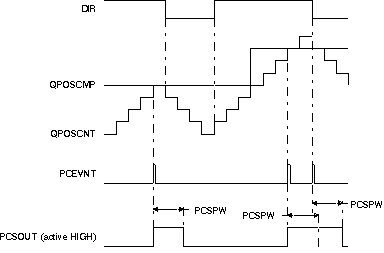 Figure 17-16 eQEP
Position-compare Sync Output Pulse Stretcher
Figure 17-16 eQEP
Position-compare Sync Output Pulse Stretcher